Autumn on the Parkway

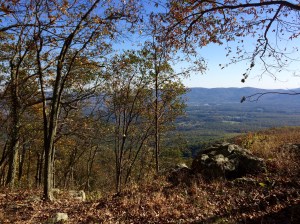
img_9940Yesterday my husband Steve and I took a short drive along the Blue Ridge Parkway, hoping to see some fall colors. My energy and mobility are still pretty limited—for whatever reason, the Taxol has settled into my knees, leaving me to creak around arthritically—so a mountain drive seemed like a nice way to get out of the house and breathe in at least a little fresh air.

The sky was clear and blue, the weather a perfect balance of sunshine tempered by a crisp, occasionally brisk breeze.

The colors this year are pretty lackluster, however.img_9957

Just driving along, looking out over the long-range vistas provided by many of the Parkway’s overlooks, there wasn’t much color to see. The rolling mountains along either side of the ridge, while always lovely in their swells and dips and graceful silhouettes, didn’t offer any breathtaking vistas of brilliant hues. Most of the mountains and valleys remained green, or had simply faded to a kind of dusty, rusty brown, without any fanfare, without any autumnal spectacle. From that perspective, it would be easy to say there was no color at all.

img_9945But every so often, as we rounded a bend and the sun shone just right, a beam filtering through the trees lit up a few yellow poplar clustered a little ways back in the under-story. A low-growing shrub dappled the roadside bank with orange here and there, if you watched carefully. We had to pull over and walk a few feet up the Appalachian Trail to spot the scarlet of a single sassafras leaf, the mottled red and gold of a maple.

Some seasons of life, perhaps, are like that. The beauty is there, it’s just harder to see. You have to look a lot closer to find it. You have to let go of your ideas about the grandeur that should be, and cherish instead the smallest offerings.

Like a quiet afternoon with the man you love, a few moments on a windy ridge with the sun warm on your face, a sliver of splendor you can hold in your hand.

maple2


Thinking About Pink

October, as most are likely aware, is Breast Cancer Awareness Month. My husband Steve has been doing some traveling lately, and he’s sent back a few reports on the awareness efforts he’s encountered on the road. Yesterday all the flight attendants on his trip sported pink ribbons, and the in-flight magazine had a feature story. A couple of weeks ago, he dined at a restaurant that served up pink tortilla chips. Not that travel is required to see plenty of pink during October: I previously noted the Ulta ad that landed in my mailbox, and every time I turn on the television, I find a public service announcement for a tie or scarf I can purchase to help the cause.

think-pink-cafe-000-page-1Public support and awareness is a good thing, of course. Our local mall recently hosted a “Positively Pink Parade,” raising funds for the Every Woman’s Life program, which provides free mammograms to low-income, uninsured, and underinsured women in our area. Personally, I had the opportunity to attend a retreat for breast cancer survivors sponsored by our local breast care center. It was a powerful experience, both uplifting and draining, physically and emotionally. We interacted with other survivors, created healing art, asked questions of a panel of doctors. It was humbling and inspiring to hear the stories and witness the resilience of the women gathered there, several of whom referred to our shared experience as a kind of sisterhood.

Yet I find myself resisting the proliferation of pink, the idea that with my diagnosis I’ve joined a club of sorts, one that comes ready-made with a club symbol, theme color, purchasable bling, and annual rituals. Maybe all of it takes me uncomfortably back to my visit to the wedding book aisle as a forty-something first-time bride, when I felt like I’d been transported into Barbie- and baby-land, all pink and purple book covers and unrelentingly cutesy fonts. I mean, wedding planning is something grown women do, ideally, not tweens. Similarly, I find much of the imagery of Breast Cancer Awareness Month cloying and cutesifying, when not disturbingly sexualized. I’ve heard this phenomenon referred to as “pink-washing,” and while some women find solace there, many others experience the explosion of pretty tchotchkes and slogans like “Save the ta-tas” as more trivializing than empowering. At times the approach seems almost celebratory.

There’s nothing fun about having breast cancer. At this moment in my journey, I am faced with deciding whether to have only one or both of my breasts surgically removed. I am about to undergo genetic testing to find out if my ovaries might need to follow. There’s nothing cute about contemplating reconstruction options. There’s nothing sexy about the prospect of losing my nipples, all sensation in my breasts. There is not enough pink tulle on the planet to make any of this palatable or easy. I will not need souvenirs manufactured in China: the scars I will come to bear will be pink ribbon reminder enough.

porchtea3

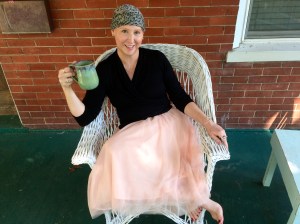
I like pink. I even own a pink tulle skirt—purchased long before my diagnosis. To me, it says “ballerina,” not “breast cancer.” The only statement it makes is a style statement, and I’d like to keep it that way.

This is not a club I would have chosen to join.

Given a choice, I’m guessing most people wouldn’t. (I think of Groucho Marx, who reputedly once sent a wire stating, “Please accept my resignation. I don’t care to belong to any club that will have me as a member.”) I’m not a joiner by nature, never have been, so some of my resistance no doubt stems thence. My husband Steve compared this process to graduate school. Deep bonds are forged there—often through some trial and misery—that remain for a lifetime, but once you graduate, you’re no longer a student, and you move on, leave that identity behind. I am a person who lives where I am. I don’t wax nostalgic about high school, or grad school, or my first job or home. I turn my attention to the people and places of this moment.

I expect my experience with cancer to be similar. For now, a significant part of my identity is “cancer patient,” but (god willing) that will not always be true. And I will, for the rest of my life (god willing), be a cancer survivor. But I am and will also be a writer, a teacher, a wife, an artist, a daughter, a friend. I will always be of a double mind about having had this disease. Cancer is teaching me important lessons about how to pay more attention to what really matters, how to let go of what doesn’t. But if I’m honest, given the option to go back and not have cancer, I can’t say I’d embrace it, even if it meant losing a lesson or two.

pinkparadeimage

Let me say again: public support and awareness are unequivocally good. If a pink parade ensures a woman gets the mammogram that saves her life, that parade is worth every ounce of its pink bling. If 5,000 people buy beaded bracelets at Ulta, and that money goes to ground-breaking research, those bracelets are worth their weight in gold.

Yet I wonder how successful these events are in terms of really educating people. How many people know that most women diagnosed with breast cancer do not have a family history? How many people know that there are a number of different types of breast cancer, and each has different treatment protocols? How many know that, even with those differences, surgery is still almost always the standard bearer? How many people understand that even once you are “cancer-free,” there is a waiting period, a wondering period, when recurrence is a concern, up to 3, 5, even 10 years? Research is advancing rapidly in many ways; doctors can target treatment so much more effectively than even five years ago. Yet the primary cures—mastectomy, chemotherapy, radiation—remain pretty darn toxic and brutal. When will that change?

Given the prominence of pink in October, I find it hard to imagine that people aren’t “aware” of breast cancer in a larger sense. It’s other cancers that often get short shrift. My husband is a testicular cancer survivor; a dear friend is a survivor of intestinal cancer; a Facebook friend from high school has just seen her daughter treated for brain cancer. These forms of cancer don’t get the press that breast cancer does, but they cause just as much pain and suffering. All cancers hurt. Maybe we can pull back a bit on the pink and invest in understanding causes and treatments that work while doing as little harm as possible.

cancersucks

So if the bling is not your thing, what can you do? From the front lines, here are my recommendations:

  • Ladies (gents, too, especially if you have a family cancer history), do your monthly self-exams. Get your mammogram. Ask if your facility has 3-D mammography. If you are informed (as, by law, you must be in many states) that you have “dense breast tissue,” ask your doctor what your rights are to a follow-up ultrasound, paid for by insurance. If you have a history of family cancer, you might want to ask about genetic testing and/or additional screening: those with established risk factors have access to more options.
  • Donate to research—and do your homework first. From my explorations thus far, I recommend Stand Up to Cancer, the American Cancer Society, and the Breast Cancer Research Foundation.
  • Alternately, focus on local initiatives and care centers, or directly support individual families and patients you know. A colleague of mine organized a Meal Train for us during chemotherapy, and it was an absolute godsend. A cozy blanket to cuddle under and Lifesavers to suck on during the saline wash while in the chemo chair will, I can attest, be deeply appreciated.

Cancer sucks. Let’s kick its butt together.

Special Guest Post: The Chemistry Professor & the Poisonous Tree

Today’s post is authored by my wonderful husband, Steve.  As I approach my last chemotherapy appointment this Friday (yay!), he shares the story of Taxol, the drug at work on me.

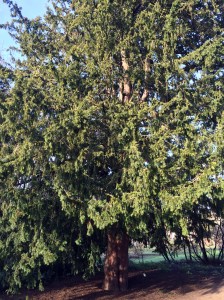
Pacific Yew
Pacific Yew

My wife sleeps in the reclining chair of the chemotherapy treatment room. A shawl knitted by her sister-in-law, herself a breast cancer survivor, is wrapped around her shoulders. A bright fuzzy blanket made by her mother lies across her lap and legs. Two plastic bags on the IV stand feed a clear liquid through the tangle of tubes to the port on her chest and then straight into her heart. The chemical in the liquid works in a unique way to halt cell division, which stops the cancer from growing. Drop by drop, minute by minute, it flows through her veins to poison the tumor that threatens her life.

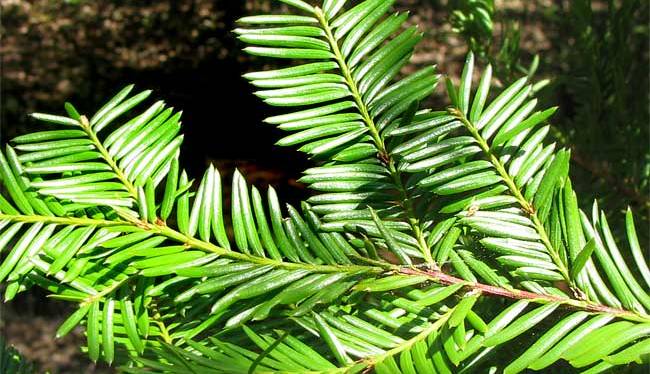
I’ve spent my career as a forester, so I’m fascinated by this chemotherapy agent which was found in the bark of a tree. An unremarkable and slow-growing tree compared to its neighbors in the moist mountains of the Pacific Northwest, the Pacific yew, Taxus brevifolia, rarely reaches 50 feet tall. All parts of the tree, except for the fleshy aril surrounding its seed, are extremely poisonous.

Bark of Pacific Yew
Bark of Pacific Yew

Seven years before Sandee was born, botanist Arthur Barclay from the New Crops Research branch of the US Department of Agriculture and several graduate students were roaming the deep forests and steep slopes of the Gifford Pinchot National Forest in Washington. They collected samples of stem, fruit, and bark from a scraggly Pacific yew and sent them to labs for study. Researchers spent decades trying to identify the compound in the bark and its medicinal properties. It wasn’t until Sandee was in her mid-teens, however, that the drug derived from the yew bark, Taxol, entered clinical trials for cancer treatment. Only in 1991 was it shown to be effective against breast cancer.

But while life-saving for cancer patients, the production of Taxol could have been devastating to the yew trees.  In the early days of Taxol research, it took about 6 trees to produce the 25 pounds of bark needed to produce just one-half gram of Taxol, the amount required for a single patient. And removing the bark kills the trees. There simply were not enough of these trees to supply the needed quantities of bark; mass production of the drug could eradicate the species.

~ ~ ~

In 1999, when I moved to Blacksburg, Virginia, I met David Kingston, a tall, lean Englishman with a penchant for bowties, born in London and educated at Cambridge University. He was an elder at the church I attended, and his earnest yet compassionate and thoughtful approach to preaching made his sermons some of the most impactful I have heard.

English Yew, Oxford
English Yew, Oxford Botanical Garden

Dr. Kingston is also a chemistry professor at Virginia Tech. He was part of the research team that tackled the problem of synthesizing Taxol so that it could be produced sustainably. The Pacific yew has a cousin, the English or European yew (Taxus baccata), with its own long and storied history. English yew has been used to make bows for centuries, dating as far back, according to Homer, as the siege of Troy, and poet William Wordsworth spoke of a yew tree “of vast circumference and gloom profound.” The English yew is far more widespread than the Pacific yew, growing even as an ornamental shrub in the US, and its needles can be harvested without killing the tree. Dr. Kingston and his collaborators found a way to use a compound from the needles of the English yew to create the molecule needed to synthesize Taxol. It is this compound, hidden away in the bark and leaves of trees, decades in the making, that is coursing through Sandee’s veins while she sleeps.

Oxford Yew Stats!
English Yew in Oxford: 370 years!

I think of the times Sandee and I have hiked through forests, sharing our love for natural spaces. I remember the hike we took in the Cascade Mountains of Washington on a day off from her writers’ conference. We may have walked right by one of these Pacific yews. I recall the 370-year old English yew in the Oxford Botanical Garden we encountered a few years ago. I think of the millenia that people have used plant products for healing.

And I marvel at the decades of patient, persistent efforts of scientists and doctors who have overcome so many challenges to bring a compound from the bark of a poisonous tree into the very heart of my wife.  I’m honored to have known one of these scientists, but I am grateful to them all.

Be Kind. Always.

Not too long after I was diagnosed with breast cancer, a meme appeared in my Facebook feed: “Everyone you meet is fighting a battle you know nothing about. Be Kind. Always.”

bekind

I had seen this piece of wisdom before, but prior to my current struggle, it was essentially an abstraction. I’ve quickly come to understand it at a much more visceral level. You never really know what’s going on inside another person. So be kind, be compassionate.

Because you never really know.

img_9301

 A parable of sorts.

In between the date of receiving my cancer diagnosis and going broadly public with it, I shared a post on my Facebook page that listed which members of congress had voted to allow those on the Terrorist Watch List to buy assault rifles. Though headlined with the clear stance “Vote the nay-voters out,” the list itself was pure information: who voted for what. Immediately a Facebook “friend”—John, someone I barely remember from high school—responded with disagreement, and a lively thread largely populated by three additional friends who supported the initial stance ensued.

I’d shared the post the same morning I had my first appointment with the breast surgeon. There I learned that my cancer was Stage 3 with lymph node involvement, that I would need chemotherapy before surgery, that further tests were required to verify there was no metastasis. It was heavy news, not what we’d hoped for, and in that moment the second amendment quickly shifted pretty far down my list of concerns.

In the thread, John had moved fast to dismissive comments peppered with things like “STFU,” “you don’t have a clue,” and broad insults to all liberals. I have no patience for incivility of that sort on a good day, and the rapidly rising snark factor upset me. After a few more snipes and insults, I wrote the following on the thread:

“John, enough. I am not having the best day ever and this stuff is not helping. Thanks all.

And just a note for the future. I don’t post things on my page as an invitation for other people to shoot them down and argue with me. I post them because I believe in them. You don’t have to agree, but neither do you have to try to start an argument. My mind is unlikely to be changed, and I don’t need that kind of negativity in my life.”

I pointed out I’d never once picked an argument deliberately on his page, although he frequently leapt at the chance to tell me how wrong I was in my posts. I asked him to stop, to show some restraint, as nicely as I could.

His response: “Spoken like a true liberal. Only post if you agree. No opposing arguments. Got it.”

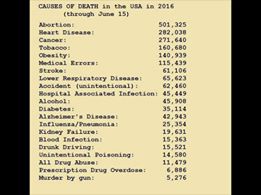
And then he posted this (completely unsourced, terrible visual-quality) graphic, on causes of death in the USA:

causegraphic

The number three cause of death listed: cancer.

Everyone you meet is fighting a battle you know nothing about. Be kind. Always.

Sunflowers4

Since my own diagnosis, I’ve had a friend suffer from a serious spider bite. Another saw his sister diagnosed with cancer. Two friends have seen their beloved dogs through serious surgeries and biopsies. Another, an avid runner, is laid up for a few months after surgery to repair ruptured tendons and ligaments. Still another tragically lost her son to suicide. A former student faces abdominal surgery for ongoing health issues, a dear friend has heart surgery coming up soon. The aging parents of several friends have been in and out of the hospital multiple times, and one young woman lost her mother. Another girlfriend has feared loss of a job. A twenty-two-year-old model I’ve worked with continues his battle against leukemia. Two friends have disclosed serious depression. And countless people now face recovering from the damages of Hurricane Matthew.

And these are just some of the battles I do know about.

What of all the others? The man in front of me in line at the grocery store? The student sitting quietly in the back of the coffee shop? The neighbor loading a box into her car? The commenter on the online thread?

Since my own diagnosis, I have been the recipient of depths and breadths of kindness that I do not know how I will ever repay. Notes, cards, music, books, food, flowers, yoga, housecleaning, hugs, prayers, gatherings of support, so so many words of encouragement. I have been moved to tears by the incredible love and generosity of the people in this world.

That is the world I want to live in, to help create.

Everyone you meet is fighting a battle you know nothing about.

Be kind.

Always.

img_9291


Hair Today, Gone Tomorrow

Once I knew I’d have chemotherapy as part of my cancer treatment, I assumed I’d be bald for a while. My oncologist confirmed that fact at my first appointment: “You will lose your hair,” he noted. I just nodded. It would begin to thin within a week or two after the first treatment, he said, and likely shed in earnest after the second round.

minority-report-precog
Precog at work

Before I even lost the first strand, the vision of my bald self that kept appearing in my mind’s eye was of one of the Precogs in the 2002 movie Minority Report, a sci-fi thriller set in Washington DC in 2054. The Precogs are three mutated humans with extra-sensory powers who spend most of the film floating in a tank, “previsualizing” crimes so that Tom Cruise’s character can arrest potential perpetrators before any heinous acts take place.

minorityreport2
Precog, rescued

The Precogs—specifically the character of Agatha Lively, played by Samantha Morton—are pale, near-bald, and wide-eyed, and for some reason, every time I tried to imagine myself without hair, that’s the image I saw.

I’m not sure why, as my one previous near-bald experience involved neither liquid immersion nor futuristic crime-fighting. I got a buzz cut in my mid-thirties when, at the university where I taught in Georgia, I played the lead role in Wit, Margaret Edson’s play about a stiff-lipped professor of British literature who faces ovarian cancer. Actors typically shave their heads for the role, and I was game. I made the transition gradually, having my bobbed hair cut short, then shorter, finally shaving it down to a buzz.

Weeks after -Wit-
Weeks after -Wit-

At that point I’m sorry to say I lost my nerve. Though I didn’t take it all the way to bare skin, that experience helped prepare me for the prospect of being bald once I became a real cancer patient who didn’t have a choice in the matter.

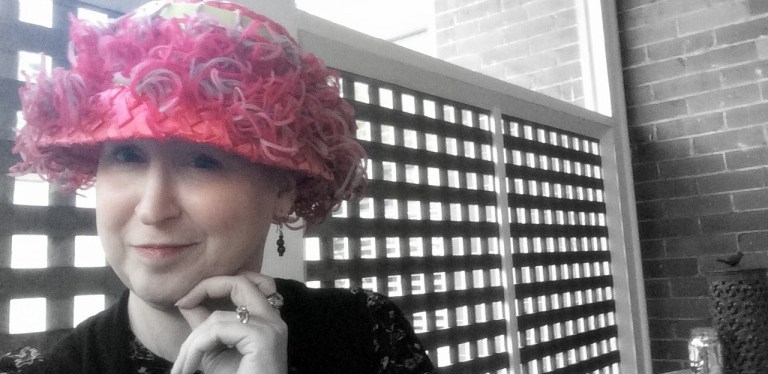
My approach was pragmatic. As the doctor had outlined it, the timeline of my treatments meant I could retain my regular haircut through my parents’ 50th anniversary party in mid-July. After that, a transition to a pixie cut would make the progressive loss less immediately obvious, and probably less traumatic. As I told an old friend at my folks’ gathering, I decided to relish, with intention, those last couple of weeks of having hair: I went a little brighter blonde than usual for fun, styled it deliberately each day, tinkered with a new curling wand I’d bought a month before. Once the hair was gone, my plan was to break out my vintage hats and scarf collection, and enjoy the inevitable simplification of my daily grooming routine with equal deliberateness.

The first significant thinning took place while Steve and I were visiting my parents for the anniversary party, a week after my first chemo. When I got up to go to the bathroom during the night, there in the mirror, by the light of the nightlight, I saw a distinct shadow on my left breast, a darkening of the skin where the cancer was located. Instinctively I understood the shadow to be a concentrating of the chemotherapy drugs in the mass. The first significant cluster of hair strands shed into my hands as I showered the next morning. So, the drugs were working. That was good.

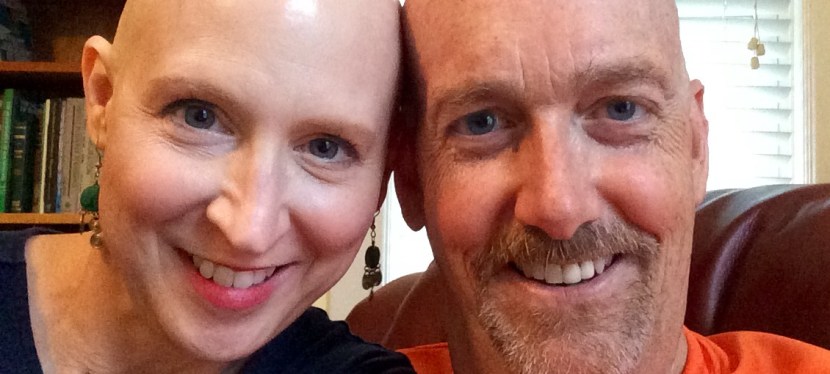
The next week my Roanoke stylist Brandy gave me the anticipated pixie cut, accompanied by a welcome mimosa. The pixie got raves, but it only lasted about a week. I let my hair come out on its own until it got patchy, then invited my girlfriends over for a head-shaving porch party. I cried as the hair fell away, but we laughed together, too, and I felt surrounded by love and support as they rallied around and Steve kissed my head, which now matched his. When a few days later my thirteen-year-old nephew showed up shorn and shaven, having cut his long hair off to donate to Locks of Love, I was overwhelmed with gratitude.

My daily routine has shifted dramatically. No shampooing or conditioning, which I expected. No blow-dryer or flat-iron. But also: no leg or underarm or bikini shaving. The number of products I use regularly has been cut by at least a third. The change has made me wonder how many hours of my life, how much of my money, I’ve given over to hair all these years. I feel more confident when I’m coiffed and styled, when I wear makeup, but the investment is bigger than I’d ever reckoned. Now I’m left wondering: is all the time worth the trade-off?

For a while I did a double-take anytime I passed by a mirror. Wait, who’s that woman with the short hair/buzz cut/no hair? I wore something on my head most all the time at first, even sleeping with a blue wool beanie (sexy!) like Pa in his cap, T’was the Night Before Christmas-style. After the hot flashes set in (another side effect courtesy of chemo), I was almost glad not to have a hat of hair closing off the handy heat-vent that is my bare scalp.

Ulta flyer
Whose idea was this?

Compared to the prospect of permanent loss and alteration of my breasts, temporary hair loss is just that—temporary, and not so terrible. But there have been a few irksome moments. On our recent visit to Asheville, I spent a day at the Grove Park Inn Spa. As the attendant took me and another patron on a tour, she pointed out all the luxurious goodies we’d have access to in the showers: citrus shampoo and conditioner, body wash, shaving cream. I smiled ruefully. Well, yay for body wash. Just a few days ago I got an Ulta Beauty catalog-advertisement in the mail that made me shake my head. The cover advertised two events: a special promotion for October as Breast Cancer Awareness Month, and the month’s beauty focus, “The Gorgeous Hair Event,” tagline “Every Girl’s Way to Good Hair Days.” The first fourteen pages of the ad are devoted solely to hair care products and tools. Then follows a two-page spread on Breast Cancer Research Foundation initiatives–two support options are getting a shampoo/cut or pink hair extensions. Someone did not think that combo through fully, methinks.

Grove Park Spa Pool
Spa pool oasis

No one seems to mind the state of my head, really, though that day in the spa, I did get a few startled glances from other patrons when I first shed my headscarf. As I lay back in one of the pools, I imagine I really did resemble a Precog, ready to send and receive messages from the larger store of humanity. Across the room, a man with an artificial leg removed his prosthetic and slid into another pool; an elderly woman helped a frailer friend navigate stone tile steps. As I floated, listening to the underwater music, I gazed up through the skylight above me, watching the clouds shapeshift in the blue beyond. I had no predictions to make, for ill or good. I simply rested, my shiny head and healing body absorbing the truth of our shared imperfections: we’re all bald beneath our hair.

Kittycuddle

Everywhere’s a Metaphor

You know how when you buy a new car, suddenly that make and model starts showing up on every street you drive, every lot where you park? You’d never noticed it before you owned said car yourself, but suddenly it’s everywhere?

When you get diagnosed with cancer, the same thing happens. Instantly, it seems, every magazine you pick up has an ad for a new cancer drug, or a story of someone’s battle with cancer, or both. Every novel you read features a character with a mother or brother or friend who struggles with the disease (often used as shorthand for explaining the character’s current problems, especially if the mother’s/brother’s/friend’s cancer resulted in death). Watch any TV series long enough, and there will be a cancer mention, if not a full-on plot-line. Turn on NPR, and it comes up in that day’s interview.

Was I just not paying attention before now? Sometimes I wonder. I’ve lost count of the number of people I’ve met who reveal, once they hear I have breast cancer, that they are survivors: the technician who administered my pre-chemo EKG, a nurse practitioner I saw for an unrelated issue, my massage therapist. Friends have told me about mothers, aunts, sisters, co-workers who’ve traveled this path. It’s not that cancer had never entered my personal sphere: my sister-in-law is a six-year breast cancer survivor, and my husband, though his journey took place long before we met, is twenty-nine years cancer-free. But now I see it everywhere. Now it feels epidemic.

And with it come the metaphors.

fallingmetaphors

Professional hazard: when you’re a writerly type, and you’re trying to make sense of the weird detour your life has taken, the metaphors are dogged. You’re in the early stages of diagnosis and testing, and you drive to the beach. The weather is gorgeous for a few miles, then suddenly the gray gathers ahead, and your road leads straight into dark, threatening clouds. Rain pummels the car with such force you slow to a crawl. It lets up, a breather. You keep driving, round another bend, the storm crashes again. Just when it seems you’ll have to pull off the road to breathe without fear, the road bends westward, and the sky ahead shines clear and blue. You even catch a glimpse of a rainbow before it shimmers away. A bank of black clouds still hovers to the left. Will the rain follow you? Will the road turn directly into its path again?

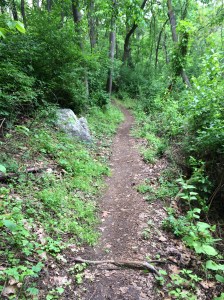
You walk a mountain path through a nearby park. The first 100 yards of the trail are open, exposed to the blazing sun. It’s hot and uncomfortable until you reach the wooded portion of the trail that winds through the trees, where the dappled shade and a light breeze keeps the heat in check. It’s an out-and-back route, so you’ll trace those same 100 yards at the end of your walk. They weren’t fun at the beginning, and you know they’ll be even harder once you’re tired and spent and sweaty from the rest of your walk. But the only way home is back through.

2629

According to F. Scott Fitzgerald, “The test of a first-rate intelligence is the ability to hold two opposed ideas in mind at the same time and still retain the ability to function.” Chemotherapy, I think, is a first-rate test of a first-rate intelligence—and it’s a tough one, physically and psychologically. Embracing chemo means embracing toxic chemicals and nasty side effects that feel a lot like “harm,” even as you understand they’re doing “good” by helping you defeat the threat of the cancer.

Though the comparison feels more cliché than metaphor, chemo, for me, has been a roller coaster. Most breast cancer patients who have chemotherapy are on an every 2-week or 3-week cycle. As a two-weeker, I have one good week and one tough week. To concretize: imagine you’re going to be hit by a truck and catch the flu at the same time. For a week, you have intense body aches, nerve flare-ups, fatigue, nausea or other digestive issues, headaches, some fever. The worst passes after four to five days, followed by a couple days of lingering, less intense symptoms. You feel better, maybe almost normal, for a week. Then you willingly throw yourself in front of the truck again, because the truck is going to save your life.

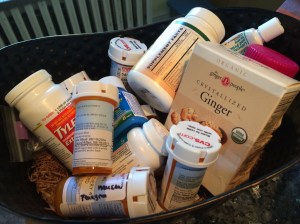
I’ve been lucky, all things considered. My treatments have consisted of two sets of drugs, the first four a combination of Cytoxan and Adriamycin, and the second four rounds of Taxol. The first were the hardest, in part I think because of the ripple effect of adding drug-upon-drug to control side effects. In addition to the two chemo drugs in my drip, there was a steroid and two anti-nausea medications. I was also given a drug to boost my white-blood-cell count the day after chemo. Add Claritin to counter the bone pain brought on by the white-blood-cell booster, two at-home nausea meds should I need them, and laxative because all the anti-nausea meds cause constipation. I was already taking Ativan to sleep at night and Tylenol for discomfort. We’re talking twelve drugs going into a body that until a few weeks before hadn’t been processing anything more complicated than ibuprofen and the occasional Tums. Thankfully, I didn’t need all that was on offer—nausea wasn’t a major issue for me; I’ve only thrown up twice since I was eighteen. For what it’s worth, I did spend those eight weeks belching like a seventh grader. This phenomenon was not caught on camera.

image

Taxol, for most, is more easily tolerated and requires fewer maintenance drugs, though I am in the 20% of patients (yay!) who experience fairly pronounced bone and muscle pain, and the cumulative fatigue that’s been promised is setting in. But on the whole I’ve done well. I’ve hydrated like crazy, brought yoga and massage on board to help, stayed in communication with my doctors so adjustments could be made, and (knock on wood) had no major allergic reactions. The worst event was a single scary blood pressure crash one evening after the first treatment.

The being yanked back and forth has been, perhaps, the toughest piece. The days I’m out and about, dressed, seeing friends, playing with hats: those are the good days. I seize them joyfully because I can (and because after a week parked on the sofa binge-watching The Mindy Project, I am restless and bored and eager to interface with actual people). It’s necessary to find and relish the joy, to resist succumbing to the undertow of I feel good now, but I know I’m going to feel bad again. The upside of knowing: I can plan around it. The downside: the pressure of trying to cram in everything I need and want to do, especially with increasing limitations. At first, I was fully functional during my “good” weeks. Then I started limiting myself to no more than 2 outside-the-house commitments or errands per day, then one, and I’m rapidly heading toward an every-other-day energy conservation model.

In truth, all of life moves this way, back and forth between the strong days and the hard ones. In a way, having some measure of predictability is a rare gift. In our everyday lives, none of us knows when such shifts will occur, when we will turn into the path of the storm, when the trail will grow hot and steep, when or if the rainbow might reappear.

My current shifts are dramatic and clearly delineated, but the biggest change is in my own awareness. These shifts have always been. They will always be. I can neither anticipate nor thwart them, and trying to do so just makes more wasted energy. The best, the only, place for me, for any of us to rest is here, now, in this intricate present.

porch oasis


Still Life, Still Celebrating: Special Anniversary Edition

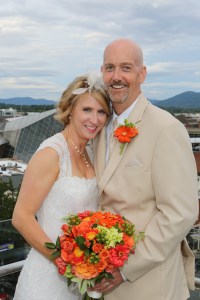
njm_3015-001One year ago last Monday, Steve and I stood atop the Rooftop of the Center in the Square surrounded by family and friends and said “I do.” It was a cloudy, almost blustery day, but the rain held off, and we had a beautiful ceremony with our beloved mountains as backdrop, and a wonderful evening with dancing, cupcakes, heartfelt toasts that made us laugh and cry, and so much love and joy I thought I might burst.

I’ve often heard people say the first year of marriage is the hardest. There have been some adjustments to be made as Steve and I settled in to our new home (“Do you really want to hang that pink and yellow painting in the living room?” “Can you please close the hamper to keep the dirty clothes smell inside?”) Slowly we found our way to shared spaces that make us both smile, and we discovered new “together” routines that we love, honor and cherish.

My cancer diagnosis added some unexpected complications to that “first year is the hardest” admonition. I don’t think when we said our vows that either of us realized just how soon, and how dramatically, we’d be practicing the “in sickness and in health” portion of our pledge to one another.

imageBack when Steve and I celebrated our one-year dating anniversary, we had traveled to Seattle for a conference that same week. While touring around Pike Place Market, we hit upon the idea to honor our milestone by purchasing a piece of artwork jointly. We had already discerned that our tastes in art didn’t always converge–Steve preferred the representational, while I looked first for color, pattern, and mood–and though we weren’t yet engaged, we knew we were heading toward a future together. At the market we found a Scott Alberts woodcut of Mount Rainier with a cobalt blue sky. Steve liked the wood, I liked the color, and we both liked the mountain, which was recognizable but not straight realism. Sold!

The traditional first wedding anniversary gift is paper, so Steve had the wonderful idea that we should reprise our joint-artwork purchase: instead of each buying separate gifts, we could look for a watercolor or painting on paper that we both liked during our brief celebratory visit to Asheville, where we’d shared several special moments, including the day when Steve met my dad, and our honeymoon.

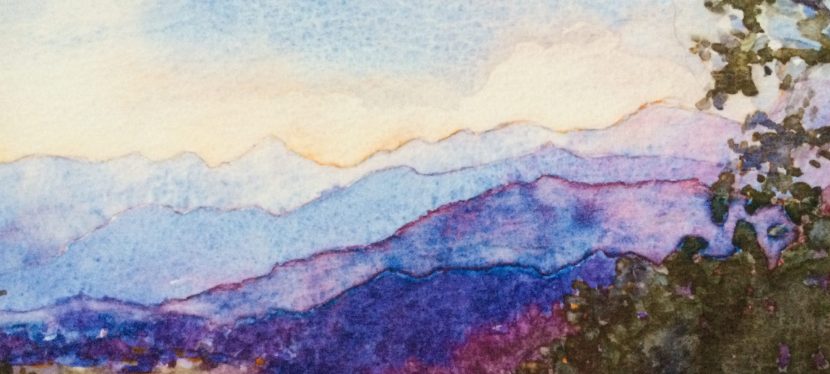
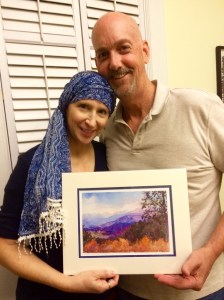
imageAs we wandered around some of the downtown shops and galleries, we kept our eyes open. Nothing much grabbed us until we saw a beautiful Jane Voorhees giclee print of a watercolor. The colors were rich and vibrant, the scene impressionistic rather than realistic, yet the painting clearly captured a Blue Ridge mountain landscape. When we picked it up and read its title, “these healing mountains,” it seemed meant for us.

Our first anniversary looked pretty different than what I would have described, if you’d asked me to project a vision of it back on our wedding day (especially the hairdo I’d be sporting…). Still, I was able to stroll through a city filled with good memories, enjoy delicious food, and let the beauty of the mountains sooth me, all with my husband, my love, right by my side.

It is enough.

The Waiting is the Hardest Part

I remember only a few details from my appointment with the breast surgeon the Tuesday following the MRI. I remember I wore a black t-shirt and a wraparound raw silk skirt I’d bought at a street fair some years back. She wore a simple black sheath. I remember her saying, “We’re going to get the scary stuff out of the way, and then we’re going to forget about it and move ahead.” Then she drew a picture to explain triple negative breast cancer and reassured me that the “Stage 3” was automatically determined by the size of the mass and the local lymph node involvement, that she hadn’t seen anything to make her think there was more going on. I remember shaking uncontrollably. I remember her asking, as she felt my breast, if it were possible the lump had been that hard and pronounced for long, her whispering in my ear as she hugged me good-bye, “We’re going to be hopeful and prayerful. Hopeful and prayerful.”

img_7893Despite her reassurances that there was no immediate evidence of metastasis, I would need a CT scan and a bone scan to be certain the cancer hadn’t progressed beyond the local nodes. I kept shaking, so the staff moved mountains to schedule the tests as soon as possible, three days away, that Friday. Results would likely come after the weekend.

The verb “wait” dates to circa 1200, “to watch with hostile intent, to lie in wait for,” hearkening back to the Old North French waitier, “to watch,” from the Old French gaitier, “watch out, be on one’s guard.” It takes a few centuries before the specific meaning to “endure a period of waiting” is recorded, in 1849.

Steve and I had been waiting to tell family and friends about my diagnosis until we had solid information, a sense of scope and plan. Plus, I knew announcing it to others would make it inescapably real. But it was becoming increasingly impossible to sit on the news. We were scheduled to travel to Georgia in a couple of weeks to help host my parents’ 50th anniversary party, and they’d begun asking questions about the specifics of our visit.

img_7896The noun weight comes from the Old English gewiht, “weighing, weight, downward force of body, heaviness.” The figurative sense of “burden” arrives in the late 14th century.

My parents were celebrating a milestone. I didn’t want to burden them with distraction and worry. But the uncertainties were becoming too heavy to bear alone. I remember crying through the phone call. I remember their calm, steady voices. I remember the sense of relief afterwards.

The use of the phrase “waiting game” is first recorded in 1835. Early on, it referred specifically to a horse-racing strategy for horses whose strength was speed over endurance.

Steve and I had also been looking forward to a trip to Folly Beach. We’d originally planned to leave the Friday the scans were scheduled, but we delayed our departure to Saturday. We’d make an overnight trip back to Roanoke on Monday to see the oncologist, then drive back to South Carolina and finish our week at the shore. It was the best compromise we could manage: we’d have our beach trip, and we’d have a plan.

The two days we spent at the beach not knowing whether the cancer had already spread felt like two centuries.

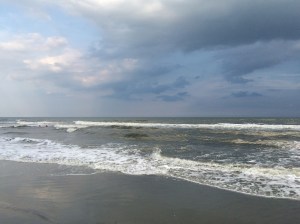
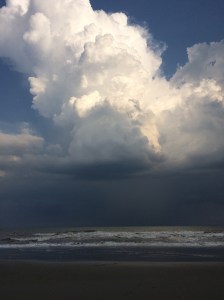
The evening we arrived, Steve left me to walk on the beach while he went into town to pick up some groceries. I strolled along the edge of the breaking surf, breathing in the salt air, gazing out at a distant horizon that made me feel both seen and insignificant. The sky was dark and heavy with clouds, a storm over the water. I turned around to see the sun beginning to set behind me. As it dropped behind another bank of clouds, it outlined one with a bright halo, its rays splaying dramatically across the sky. Light behind a cloud: was this hope?

img_7909The literal meaning of the verb “weight,” as in “to load with weight” is recorded first in 1747. Its figurative meaning, to load the mind with weight, appeared earlier, as early as the 1640s.

The side effects of chemotherapy are often debilitating and painful. Knowing your body will be permanently altered by surgery is disorienting, even devastating. But the waiting, all the waiting: for appointments, for surgery dates, for results, for reports, for recovery, for any piece of positive news. Ask a cancer patient, and I think many will tell you: all the waiting is the hardest part.

We got the call from the surgeon’s office Monday as we were driving back to Roanoke to meet with the oncologist: my scans were clear. You know your world has flipped upside down and backwards when “stage 3 breast cancer,” a diagnosis that left you shaking in fear just days before, takes on the modifier “only” and suddenly feels like the first good news you’ve had in weeks.

The nurse had tried to call with results late Friday afternoon. I remembered: I’d been on the phone with a delivery company when an unknown local number rang through. I’d started to hang up to answer it, but I couldn’t get a word in with the woman talking furniture. When I checked voice mail afterwards, my phone said it was full, no new messages.

The sense of “wait” meaning to “remain in some place” is from the 14th century.

img_7900-editedGiven a choice, I would not have elected to suffer through those two days of waiting and wondering. But it threw my perspective into sharp focus, gave me a fierce appreciation for the beauty all around me: the gritty give of warm sand under my feet; the spicy bite of fresh shrimp cooked with Old Bay seasoning; the constellation of freckles on my husband’s smiling face. And the sun shining out from behind a darkened cloud.

We’ll wait again, and again. And while we do, my heart breathes every gorgeous moment.


All etymological references are adapted from the Online Etymology Dictionary. Thanks to Tom Petty and the Heartbreakers (via Steve) for the title inspiration.

MRI: The Sounds of Scanning

After my initial diagnosis and prior to meeting with a surgeon, I was sent for an MRI so the medical team could get a clearer picture of the size and spread of the cancer in my breast. My appointment was at 8 am, and I sat sleepily in the chair across from the administering technician, unsure what to expect. I knew an MRI used magnets, and I was pretty sure I was going to have to spend some time inside a big tube, a fact that made my claustrophobic self shudder.

The technician, named Steve—a good omen, I thought, his sharing my husband’s name—told me that first he needed to ask a series of questions to make sure I didn’t have any metal on or in my body. I’d left my jewelry at home as instructed, so I didn’t think there was an issue, but the inquisition was protocol.

MRI-Steve clicked a few keys on the computer in front of him. “Do you have anything inside your body that you were not born with?”

Later, I’d wish I’d been quick enough to offer “cancer.” Instead, I said, “Um, contact lenses?”

He chuckled a little.  “Good answer.”

http://www.ironvillagewelders.com/

He clicked another key and proceeded to the next question. No, no pacemaker. No artificial joints. No piercings except my ears, no tattoos (some ink has metallic compounds), and no, I’ve never been a welder. Wait, what? Apparently welders often have tiny traces of metal in their eyes, and if they do, the machine can pull the traces out and blind the welder in the process. Ow.

Finally MRI-Steve asked what kind of music I liked. While I was in the machine I would hear some noises—a kind of clunking, and then a series of buzzes. “Your test will only last 30 minutes or so, so it’s not too bad,” he said. “Some can take an hour or more.” Patients were provided with headphones hooked up to Spotify or Pandora to mitigate the noise.

“Oh, well, I like the Indigo Girls,” I said. “I just saw them in concert last night.”

I wondered what he’d have said if I answered “heavy metal.”

∼ ∼ ∼

After inserting a magnet-friendly IV via a needle that left behind only a tiny plastic tube, MRI-Steve walked me back to the dimly lit room that housed the MRI machine, an impressively large and imposing white, plastic extra-deep donut with a gurney-like table jutting out from the near side of the opening. I thought it odd they were playing club music, techno with a heavy, steady bass beat: ka-thunk, ka-thunk ka-thunk. Then I realized the rhythm was coming from the machine. If those were the clunks MRI- Steve had referred to, the noise wasn’t too bad.

 MRI, AP Photo/Jeff McIntosh

Steve left me with his assistant Shevonne to help me get settled on the table. Lightly padded and lined with a sheet, it was shaped like a body. Close in, it looked like a sleeping capsule in an old sci-fi film, or maybe a mummification crypt with a shroud. Shevonne pointed to two pronounced breast-shaped imprints. I was to position myself so that each of my breasts hung down into one of the cups, where cameras were located. I decided not to think too much about how that worked as I climbed aboard. At Shevonne’s direction, I stretched my arms out in front of me, like Supergirl in flying mode.

I was given a squeeze-bulb call button to hold in my left hand, and Shevonne wrapped some of the tubing for the IV around my thumb on the right. Midway through the procedure I’d be given a contrast agent, and the machine would track its progress through my veins. The face cradle allowed me to breathe freely and had a long slit to accommodate opening my eyes. When I’d told MRI-Steve my fear of small spaces, he’d reassured me that since I’d be facedown and looking into a mirror, I’d be less aware of being inside the tube. Shevonne placed the earphones on my head and asked if anything tickled or itched. Once inside, no scratching allowed.

I felt the gurney lift up a few inches, then move forward. I peered down through the eye slit. I couldn’t see myself, so maybe I’d misunderstood about a mirror. As I slid further into the machine, it looked as if the floor dropped away below me, revealing another small room below.

Within seconds, I was dizzy with vertigo.

MRI-Steve’s voice came over the loudspeaker. “Everything okay?”

My head spun. “I’m really, really dizzy,” I said. “Is that normal?”

Amy Ray

“Um, no, not really,” he said. There was a pause. “Sometimes if you didn’t eat breakfast…?”

Slowly the dizziness abated. “I think it’s starting to subside,” I said. The Indigo Girls’ “Closer to Fine” played through my headphones. “I went to the doctor. I went to the mountains…”

“We’re going to start your test now. It will be loud, so don’t be startled.”

“Okay,” I said. I closed my eyes and pictured the finale of the previous night’s concert, the euphoria I’d felt singing along with the Girls and the audience to the song now playing in my ears.

Then a fire alarm went off.

∼ ∼ ∼

MNAAH. MNAAH. When MRI-Steve had said “buzz” and “loud,” I had not translated it as “You know, like that fire alarm that used to make you leap out of bed, adrenaline coursing and heart pounding, for 3 AM college dorm fire drills.” MNAAH. MNAAH. MNAAH. It continued for another 30 seconds. Then it stopped. Music returned. A second round. Musical interlude. Then another set of noises, with a higher pitch and faster pulse, an old-fashioned dial tone on steroids, quickly supplanted by a light bamboo-stick percussion that morphed into an electronic chicken, bok-bok-bok-bok-BAWK on the right, then loud bamboo sticks, more buzzy dial tone BEEP-BEEP-BEEP, more soft bamboo and the chicken circled around to my left, bok-bok-bok-bok-BAWK ticketa ticketa ticketa BEEP-BEEP-BEEEEP. Caesura. “The less I seek my source for some definitive, the closer I am to fine.”
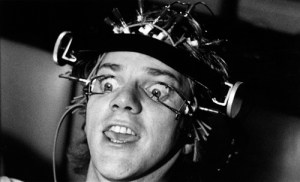
"A Clockwork Orange," Malcom McDowell, 1971 Warner

Maybe they ensconced you in a tube to keep you from fleeing the racket. I felt like I’d landed somewhere between a bad carnival funhouse and an auditory version of Ludovico’s re-programming technique in A Clockwork Orange. Another cycle of the same, then another, each a little longer than the one before. In between, music played through the headphones: a tinny war protest song about not marching no more, some traditional bluegrass pickin’. Not my fave, but preferable to two minutes of fire alarm. MNAAH. MNAAH.

MRI-Steve’s voice filtered in. “We’ve put the contrast in, so two more minutes of pictures, then you’ll be more than halfway done.”

Halfway? I was reminded of my hiker friend Jeff’s comment about climbing steep mountains: “Usually when you think you’re almost there, it really means you’ve only gone halfway.”

A coolness spread from my right arm down to my hand, and for a few moments an astringent, metallic taste filled my mouth and stung my nostrils, then disappeared. As the cool crept up both arms and dissipated, the fire alarm sounded again. When it stopped, an Old Navy commercial was playing.

“Nine minutes,” MRI-Steve said.

I tried to breathe evenly. Jeff Buckley sang “Hallelujah,” and the electronic chickens circled once more around my head.

∼ ∼ ∼
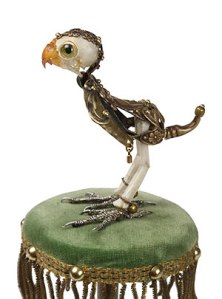
Robot Bird, Artist Jessica JoslinWhen they finally slid me out, I watched the white floor of the little room below rise up again. I had to put my head down and lie still for a few moments before I could stand up. “Dizzy,” I said into the cradle.

Once upright and retying my robe, I put it together: a mirror in the head cradle gave the illusion of a disappearing floor, an empty space below the machine, to counter claustrophobia. As my body moved forward and back on a flat plane, my eyes perceived I was moving up and down: ergo, vertigo. It really was a sort of funhouse trick.

Queasy and rattled, I headed to the dressing room. It would be several days before we’d find out the results of the imaging. It was too bad that sound waves couldn’t dissolve cancer cells the same way they did kidney stones—I’d be well on my way to cured. In the dressing room mirror, my forehead sported a bright red imprint from the pressure of the cradle, while my body, everywhere but my breasts, was marked with wrinkles from the sheet.

My Steve raised his eyebrows at my unsteadiness when I emerged. I wanted to warn the other guy sitting there, awaiting his own test, but how exactly do you explain being assaulted by the squawks of unseen robot birds?

I was sorely in need of a nap. I just hoped the chickens wouldn’t follow me into my dreams.


Photo credits:

Welder: http://www.ironvillagewelders.com/; MRI Machine: AP Photo by Jeff McIntosh; Amy Ray of the Indigo Girls, personal photo; A Clockwork Orange still, Malcolm McDowell, Warner 1971: www.imdb.com; Robot Chicken, Artist Jessica Joslin: http://mine-dart.blogspot.com/2011/04/artiste-jessica-joslin.html


Beginnings: Biopsy

On a Friday morning in early June I kissed my husband of nine months Steve good-bye and headed to my scheduled doctor’s appointment. I was having a couple of cysts aspirated—a routine procedure for me, as I’d had benign, fluid-filled cysts making regular appearances in my breasts since I was thirty. My annual mammogram, which I’d had the week before, had been clear. I typically had a follow-up ultrasound because of my dense, and busy, breast tissue, but I’d opted out of it this time. The radiologist didn’t think it necessary, and I knew I was heading back for the aspirations, anyway. I figured it would take about an hour to drain the one or two cysts in each breast that were bothering me, and then I planned to head to the office to finish the one last report standing between me and summer break.

IMG_7804

The large cyst in my right breast had, as they sometimes did, already calmed down on its own; I wondered whether it was even worth bothering with it. My left breast still felt swollen and tender, though, so I kept the early morning appointment.

The attending nurse and the ultrasound technician arranged me on the table, placing a pillow under my left shoulder and asking me to curve my arm over my head, lifting my chest. The surgeon joined us and asked for the location of the cyst to be drained. I pointed him to the lower outer quadrant of my left breast.

“Oh, yes, I can almost see it there,” he said. With my body contorted, the lump under the skin was nearly prominent enough to spot with the naked eye.

The doctor located the cysts, per usual, with ultrasound. I always watched the images as they appeared on the monitor next to my bed. Each breast typically featured a multitude. They looked a bit like photos I’d seen of black holes, or solar eclipses: a black center, with a clear light-ring around the edges. As the surgeon rolled the wand over my left breast, I noticed something odd on the monitor. There was a dark mass, but unlike the manifold cysts I’d seen on the screen over the years, its border was irregular, furred.

“That doesn’t have the defined outline that a cyst usually does,” I said.

The doctor kept rolling the wand back and forth, back and forth. “No, that doesn’t look like a cyst,” he said quietly. “I think we’re going to need to turn this into a biopsy.”

˜ ˜ ˜

IMG_7772Just a few nights before, my husband Steve and I had been lying in bed, talking about what a crazy, busy year it had been. We’d bought a new house together, moved and combined our two households, moved each of his two sons into their first apartments, planned our wedding and gotten married,  and graduated the youngest son from college. We’d both worked the full academic year as professors, and there’d been some work-related stresses for both of us. Steve had, in fact, just started a new job with a research non-profit, while I was wrapping up teaching a three-week intensive learning course that included camping and rafting in West Virginia. Our new life together was good, but we were exhausted. “I bet we’d score off the charts in one of those life-stress tests,” I joked, and Steve agreed.

When I awoke the next morning, our conversation still on my mind, I searched online and found the Holmes-Rahe Stress Inventory, which assigns point values to significant changes (positive or negative) in a person’s life. Curious, I completed it—and scored a whopping 412 points. According to the inventory, any score over 300 increased by 80% my chances of having a “major health breakdown” within the next two years. I understood the score as proof positive that our past year had, indeed, been stressful and eventful. At the time I didn’t think much about whether it might actually predict my future.

 ˜ ˜ ˜

I went straight home after my appointment and called Steve. The doctor had completed a core needle biopsy of my left breast, taking three separate samples of the mass they’d found. In some discomfort, I decided to skip the office and work from home. I threw myself into finishing the report, then began packing. Steve and I had planned a weekend at the Peaks of Otter, a rustic lodge and restaurant off the Blue Ridge Parkway, overlooking a small lake in the valley below Sharp Top and Flat Top mountains. We wouldn’t have any answers until Monday or Tuesday, so we went ahead with our getaway.

IMG_7739
Sharp Top

Having the fact of your mortality plunked down in your path recalibrates perspective, turns up your awareness. We stopped on the way to the Peaks to browse art and antiques in nearby Bedford. A light breeze lifted and chuffed my hair as I rounded a corner onto Main Street. I thought: pay attention to this pleasure; you won’t have it long if you lose your hair to chemotherapy. Later, walking along a forest trail, I noticed tiny details: unremarkable mushrooms, striking patterns of bark on trees.

We tried to stay positive. I researched “benign breast tumors” on my phone, looking for descriptions of all the possible permutations that matched my symptoms. In a lighter moment, Steve looked at me with a tender smile and twinkly eye and said, “I thought of this earlier, but I wasn’t sure I should say it—I don’t mind if you have one Sharp Top and one Flat Top.” He reassured me that even if we’d known for certain we’d face this moment before we’d walked down the aisle, he still would have chosen to marry me. We’d had so little time together, and we wanted so much more.

IMG_7779
Flat Top

The next morning, as we strolled the path around the lodge’s lake, we met Ranger Neas, who pulled fossils from his backpack that showed the Roanoke Valley was once an ocean, and asked us if we were familiar with Einstein’s theory of relativity and the time-space continuum. We’d asked him about trees, and ended up talking about time. Instead of understanding time as relative, he asserted, we’ve become slaves to our human construct of time and the belief that time-is-money. “But nature doesn’t do that, the mountains don’t do that,” the Ranger said. I was reminded of Aldo Leopold’s “Thinking Like a Mountain”—the mountain takes the long view, even as it understands the value of the smallest interaction. We could choose to change our relationship to time, the ranger urged. Instead of the clock being life’s measure, we could choose beauty, joy, love—the richness of the life we live. We could learn to understand, value, spend time in ways that are more meaningful.

My own relationship to fate and faith is ever-changing, but our conversation with the ranger felt something more than coincidental.

Each evening during our stay, Steve and I held hands as we sat outside on our room’s balcony, tracking the stars as they appeared to move across the firmament. We tried to describe the different shades of dark that were the sky, the water, the mountains, pondering whether reflected moonlight was silver or some other color. When I saw a single falling star, I wished, and hard.

 ˜ ˜ ˜

The call came, as promised, on Monday afternoon. The radiologist’s phrasing stuck with me: “I’m sorry to tell you, it is a cancer.” A cancer: singular, specific. It felt somehow less all-encompassing, stated that way—a thing that was, a thing that existed, not a blanket pronouncement of my fate. I was grateful for that, and for the kindness in his voice. “We’re going to fix this,” he said. “I hate it, since you’re so young. But we’re going to fix it. It’s a garden-variety—if there can be such a thing—intermediate-grade breast cancer. And we’re going to fix it.”

IMG_7730I hung up, cursed, cried. Steve and I walked a few fast laps around the park across from our house, amped up on adrenaline. After we’d burned off some of the shock, we decided to have dinner at the local restaurant where we’d shared our first date.

There, as the sun set, it created star-shaped shadows from the lamps hanging behind the window shades. There was still much we didn’t know. The waiting had begun.