

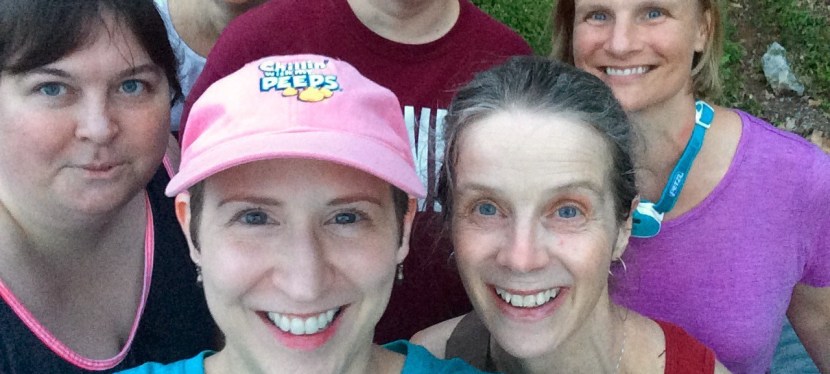
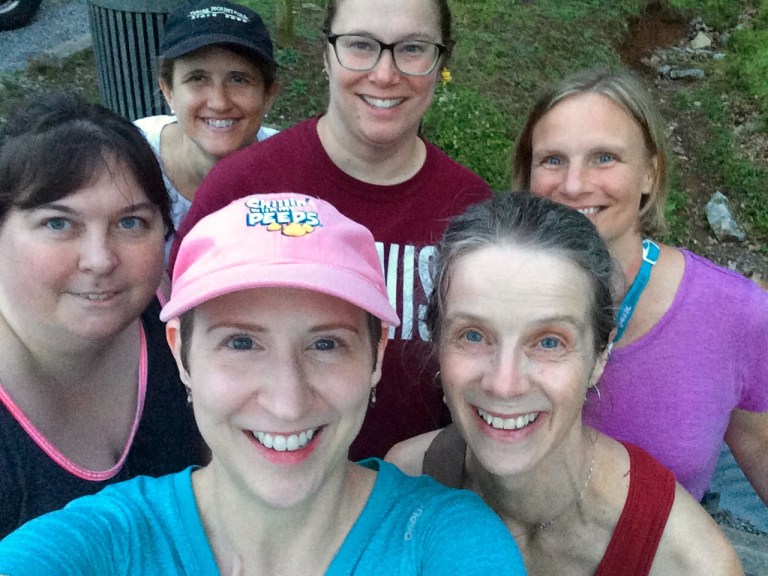
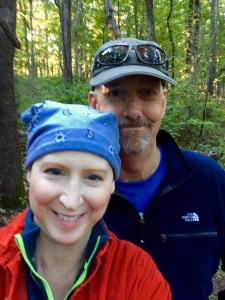
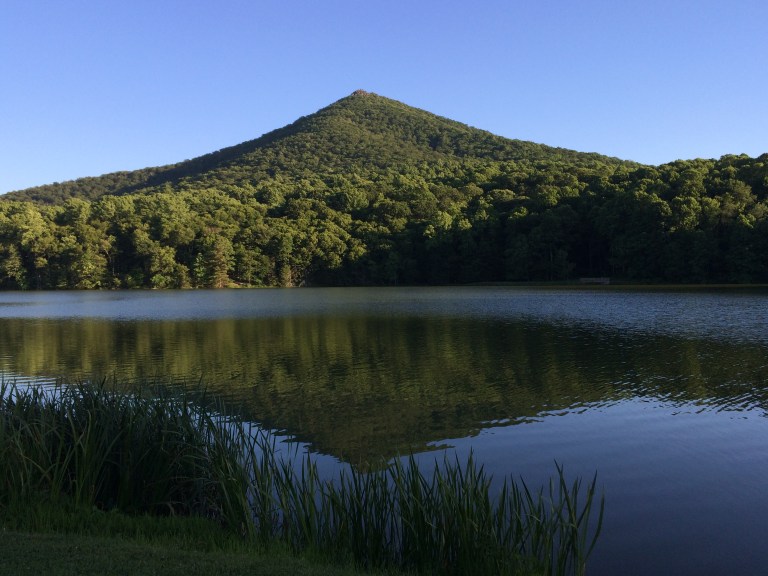
On Tuesday evening, June 13th, I went on a silent meditation hike with a few friends to commemorate the anniversary of my diagnosis. The hike was my friend Sarah’s idea; after reading my post “Climb Every Mountain,” she suggested that hiking down an actual mountain might be a good way to mark the end of the year-long uphill climb of diagnosis and treatment, and honor the path of ongoing recovery I’m on now and will be for a while: the (metaphorical) climb down.
Sarah and I planned to start at the top of Mill Mountain, and two friends would begin at the bottom, meet up with us on the trail, then turn back, and together we’d hike the rest of the way down. Two more planned to meet us at the bottom. I also carried several notes from friends and loved ones in my pocket, who’d shared words such as “hope,” “grace,” and “serenity,” and wishes for the coming year.
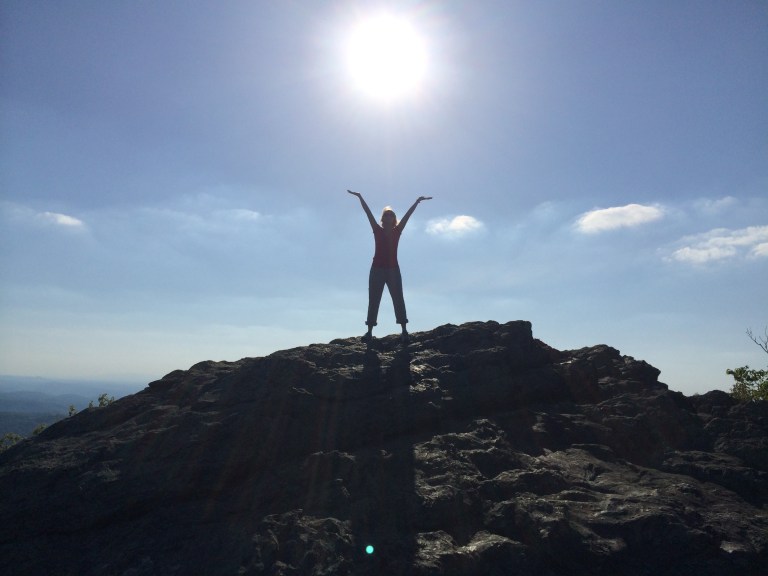
Sarah and I visited the overlook at the summit before we started down. I was almost moved to tears to see the sunset. Last year, Steve and I spent a few anxious days at the beach waiting to find out whether or not my cancer had metastasized. As I walked on the beach the first evening, the sun shone out from behind a dark cloud, its rays forming a kind of halo. In that moment, it felt like hope. As Sarah and I stood at the top of Mill Mountain, the sun once again shone its rays from behind the clouds. It felt like coming full circle.
Then Sarah noticed a smiling, shining sun painted on a rock that someone had left on the overlook sign. It was from the “Kindness Rocks” project. I snapped a picture and left it there to bring the next person who spotted it a smile.


At the trailhead I said, “Here’s to a new and different kind of year,” and then we started down in silence.
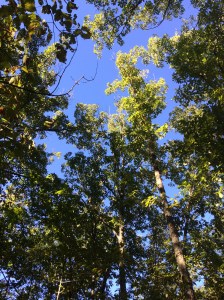
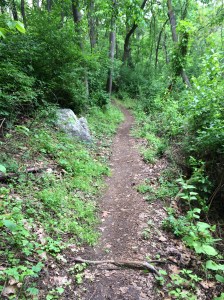
The metaphor is almost too easy; it practically writes itself. Much of the trail was rocky, though there were also smooth stretches, times when it was easier to look up and really take in the woods surrounding us. Some parts were wide and almost flat; others narrow and crossed by root-tangles. Once the trail jackknifed so hard to the left I almost missed the turn and became disoriented for a moment. One of my friends had to point the way. I walked in front, and there were times, especially when the trail grew narrow and steep, when I felt as I walking alone. But I knew I could just turn around and see people I loved were there, always behind me.
The downhill was relentless, and more than once I thought, “I didn’t think this trail was this long.” I also looked up at the slope we’d descended and thought, “That’s one big mountain. And I actually climbed it.” Metaphorically, vis à vis the physical Mill Mountain; literally, the mountain called Cancer.
At the start of our hike I mostly heard leaves rustling in the breeze, the soft thuds of my feet on the trail. In the middle I became aware of cars passing on the nearby road, the world outside the forest going about its business, unaware of our walk in progress. The closer we got to the bottom, the more birdsong I heard: owls hooting, wood thrushes whistling and trilling.
I stopped a few times to rest my cranky knees, to listen, to look. I saw a piece of glass on the trail and left it there because it wasn’t safe for me to pick it up and carry it; in my mind it represented worry, the thoughts and fears that can rob you of joy in the present. When I saw a golden glint, I bent down to investigate and found a tiny golden charm. I turned it over to see it read “create.” I laughed and put it in my pocket, thanking the Universe for the reminder and encouragement.

At the bottom Sarah said some beautiful words: “In all the noise of living, remember the silence. And in the silence hear your soul’s voice. In all the rushing of living, remember the stillness. And in the stillness feel the pulse of life. In all the living of life, remember the dying. And know in the dying there is new life.” I had gone through a kind of death in the last year, she said, and now I was emerging, stepping into a new life, a new start.
There were hugs shared all around. I wanted to say something eloquent, too, express how much the love, kindness and support of my friends and family has meant, somehow capture all the ways my heart has broken and mended and split wide open in the hardest and most wonderful ways this year.
In the moment I squeaked out a teary “thank you.”
Two words that contain multitudes. Maybe, sometimes, “thank you” is enough. Sometimes, maybe, it is everything.
Thank you to all who voted on a name change for the blog, and for the thoughtful suggestions that I consider a title without the word “cancer” in it at all. The clear preference (at 85%) of the poll choices was “Still Life, Beyond Cancer.” While I’m still on the mountain, as I will be for a bit, I think that title fits—but the comments have made me think about entertaining another name change in the not-so-distant future that reflects moving beyond even “beyond.” Thank you, dear readers and friends.
Tomorrow I’m scheduled to undergo my final major reconstructive surgery. I’ll be reporting soon on the new bionic boobs (an improvement, I hope, over the tissue expanders, also known as “bricks in your breasts”), and sharing more stories, resources, and fun hats.



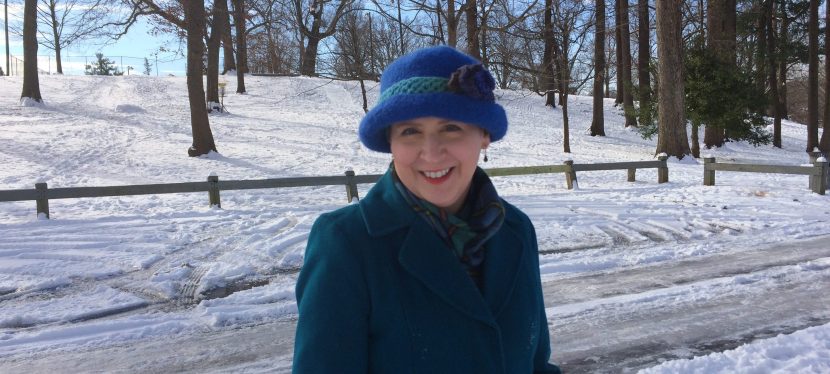
 Like much of the U.S., we recently had snow here in Southwest Virginia. I usually welcome snow, as it tends (at least here in the South) to make us slow down a bit and refocus our attention, for a day or two, on things like nature’s beauty, play, and family. The cold inspires gratitude for the warm shelter I call home, a gift denied to too many.


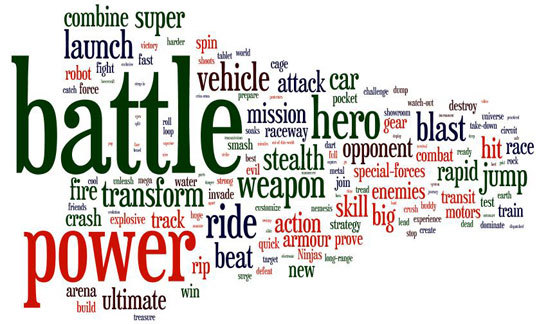
 Still, as surgery looms on the horizon, I’ve grown more aware of how the language of aggression, while ostensibly empowering, also pits one against one’s own body in some curious and distressing ways. My sister-in-law Lisa, a survivor, mentioned her discomfort with this language shortly after I was diagnosed. Susan Sontag, in a 1978 essay entitled “Illness as Metaphor,” describes the dilemma: “The controlling metaphors in descriptions of cancer are, in fact, drawn…from the language of warfare; every physician and every attentive patient is familiar with, if perhaps inured to, this military terminology. Thus, cancer cells do not simply multiply; they are ‘invasive’” (714). The language surrounding treatment has a similar inflection: chemotherapy is “chemical warfare, using poisons” that aim to “kill” (715).
 The main reason I resist is that none of us knows the future. That’s a fundamental truth. It isn’t that I don’t want to be healthy and cured—of course I do! But it feels like tempting fate to declare certainty in relation to a particular outcome; I don’t and can’t make predictions. I can only know the present.
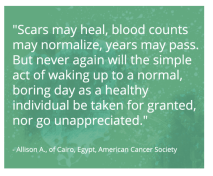 If this is my life (and it is) and if my life (like all our lives) is finite, and if I don’t know its deadline (and none of us does), then how do I want to spend it? Waiting and wishing for a different kind of life, a different kind of day, a “better” one in some projected future? Or do I find a way to accept where I am in the present, since that’s all any of us really knows or has?
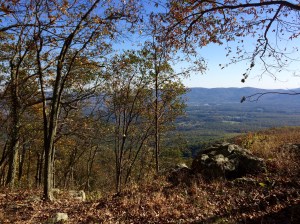 Yesterday my husband Steve and I took a short drive along the Blue Ridge Parkway, hoping to see some fall colors. My energy and mobility are still pretty limited—for whatever reason, the Taxol has settled into my knees, leaving me to creak around arthritically—so a mountain drive seemed like a nice way to get out of the house and breathe in at least a little fresh air.
 But every so often, as we rounded a bend and the sun shone just right, a beam filtering through the trees lit up a few yellow poplar clustered a little ways back in the under-story. A low-growing shrub dappled the roadside bank with orange here and there, if you watched carefully. We had to pull over and walk a few feet up the Appalachian Trail to spot the scarlet of a single sassafras leaf, the mottled red and gold of a maple.




 Still Life, Beyond Cancer