

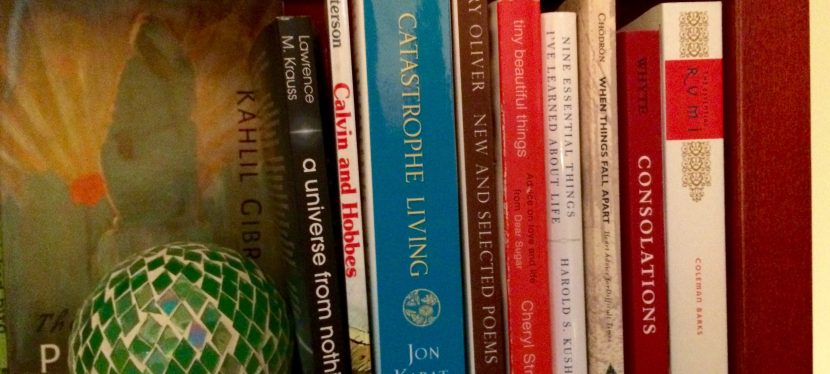
Last weekend Steve and I took a trip to New York City to see Cheryl Strayed’s Tiny Beautiful Things, adapted for the stage by Nia Vardalos (writer/star of My Big Fat Greek Wedding) and directed by Thomas Kail (director, Hamilton). The moment I saw the announcement, which was months before my diagnosis, that Strayed’s book would be adapted into a play and would run at the Public Theater in November and December, I told Steve that seeing it was what I wanted for my birthday. Because, to adopt my nephew Daniel’s language, “Tiny Beautiful Things changed my life.”
Strayed is best known for her memoir Wild, a number one New York Times bestseller, which recounts Strayed’s hike along the Pacific Crest Trail, a journey that helps her come to terms with her mother’s death. Tiny Beautiful Things came out in book form after Wild, but most of its contents had appeared previously on TheRumpus.net, for which Strayed anonymously penned the “Dear Sugar” advice column after taking it over from originator Steve Almond at his request.
 The book is subtitled “Advice on love and life from Dear Sugar,” but to label Tiny Beautiful Things as merely a collection of advice columns does not do justice to its beauty or wisdom. Strayed turns the conventions of advice columns upside down and taps into her own memories and experiences in her responses, doing “something brilliantly counter-intuitive,” as noted by the Public’s Artistic Director Oskar Eustis,” using self-revealing stories of her own life for generous purposes.” Strayed’s luminous and powerful responses to what are often heart-wrenching letters are some of the most lucid, honest, moving essays I have ever read.
I first encountered Strayed’s book shortly after it came out, in 2012. At the time I was struggling to make sense of my romantic life, which seemed to have stalled out in an on-again, off-again relationship that, deep down, I knew wasn’t going anywhere. As I read, especially her responses to the lovelorn, I underlined passages that spoke to me—sometimes because they comforted, but more often than not, because they pierced me with uncomfortable truths. A few months later I gifted the book to my sometime-fellow, and the same truths resonated with him. Inspired, at least in part, by Strayed’s words, we broke up, and stayed that way. Free to open my heart fully for the first time in several years, I soon met and fell in love with the man who is now my husband.
I wasn’t kidding when I said the book changed my life.
 My heart buoys and breaks over different matters these days, but Strayed’s words still speak to me. Gauging by the shared laughter and the unmistakable sounds of whole-audience-weeping in the theatre, they speak to many. (When the lights came up, Steve turned to me, both of us still wiping our eyes, and he said, “You didn’t warn me!”) It was a powerful performance.
Seeing Strayed’s words brought to life on stage sent me back to the book. I find myself drawn to passages on managing suffering and finding healing. For example, in a response to a young woman mourning a miscarriage, she writes the following about grief. Though she is talking specifically about the lost daughter, her words resonated with me, as I’ve recently felt “stuck” in my own emotional journey: “This is how you get unstuck, Stuck. You reach. Not so you can walk away…but so you can live the life that is yours—the one that includes the sad loss of your daughter, but is not arrested by it. … That place of true healing is a fierce place. It’s a giant place. It’s a place of monstrous beauty and endless dark and glimmering light. And you have to work really, really hard to get there, but you can do it.” (22)
Later: “Nobody will protect you from your suffering. You can’t cry it away or eat it away or starve it away or walk it away or punch it away or even therapy it away. It’s just there, and you have to survive it. You have to endure it. You have to live through it and love it and move on and be better for it and run as far as you can in the direction of your best and happiest dreams across the bridge that was built by your own desire to heal.” (30)
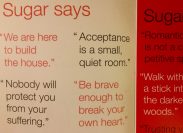 And this, in response to a professor and class who asked Sugar’s advice to graduating college students: “Whatever happens to you belongs to you. Make it yours. Feed it to yourself even if it feels impossible to swallow. Let it nurture you, because it will.” (133)
Or this, recalling Strayed’s own response to an exchange with her estranged father: “I had that feeling you get—there is no word for this feeling—when you are simultaneously happy and sad and angry and grateful and accepting and appalled and every other possible emotion, all smashed together and amplified. Why is there no word for this feeling? Perhaps because the word is ‘healing’ and we don’t want to believe that. We want to believe healing is purer and more perfect, like a baby on its birthday. Like we’re holding it in our hands. Like we’ll be better people than we have before. Like we have to be. It is on that feeling I have survived. And it will be your salvation too, my dear.” (311)
Steve Almond says that Strayed practices “radical empathy.” If there’s anything the world could use more of these days, it’s radical empathy—for others, and for ourselves.
I have gifted Tiny Beautiful Things many times. It changed my life, and my nephew’s, too. Who knows? If you read it, it might also change yours.

 There’s an article that’s made its way around the internet about the
 I’m looking forward to experiencing that revelation again, whenever it finally arrives. I know it might be a while. Until then, I try to remember what my friend Sarah said when I shared my frustrations with her about my lack of productivity, my inability to do all the things I need and want to do.










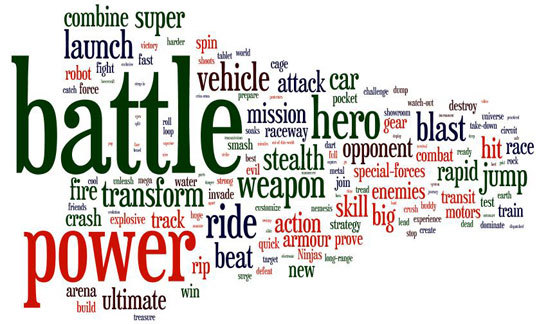
 Still, as surgery looms on the horizon, I’ve grown more aware of how the language of aggression, while ostensibly empowering, also pits one against one’s own body in some curious and distressing ways. My sister-in-law Lisa, a survivor, mentioned her discomfort with this language shortly after I was diagnosed. Susan Sontag, in a 1978 essay entitled “Illness as Metaphor,” describes the dilemma: “The controlling metaphors in descriptions of cancer are, in fact, drawn…from the language of warfare; every physician and every attentive patient is familiar with, if perhaps inured to, this military terminology. Thus, cancer cells do not simply multiply; they are ‘invasive’” (714). The language surrounding treatment has a similar inflection: chemotherapy is “chemical warfare, using poisons” that aim to “kill” (715).
 The main reason I resist is that none of us knows the future. That’s a fundamental truth. It isn’t that I don’t want to be healthy and cured—of course I do! But it feels like tempting fate to declare certainty in relation to a particular outcome; I don’t and can’t make predictions. I can only know the present.
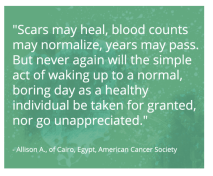 If this is my life (and it is) and if my life (like all our lives) is finite, and if I don’t know its deadline (and none of us does), then how do I want to spend it? Waiting and wishing for a different kind of life, a different kind of day, a “better” one in some projected future? Or do I find a way to accept where I am in the present, since that’s all any of us really knows or has?
 Kushner’s work is embedded in the Jewish faith, though his lessons are broadly applicable, drawing equally upon everyday people’s stories as well as religious texts and history for illustration. I’m a spiritual seeker who does not identify solely or specifically with any single faith tradition at this point in my life, though I feel there is something larger and greater than individual human desires, and I tend to imagine the sacred, in the broadest terms, as the realization of the combined forces of love and compassion in the world. So much of Kushner’s understanding of who and what “God” is (and isn’t) resonates with me, given that one of his truths is “God is Not a Man Who Lives in the Sky.” He writes, “To me, God is like love, affecting all people but affecting each one differently, according to who he or she is. God is like courage, a single trait that manifests itself differently as it is filtered through the lives and souls of specific individuals” (29). Love and courage: both profoundly human and deeply sacred.
 In the later chapter on doubt and anger, Kushner explores another theme close to my heart, especially at this juncture in my life. I have always been a bit allergic to certainty, and he actively embraces the idea that we should raise questions, “admit our anger” when it arises, and affirm a “readiness to live with doubt.” To do otherwise means we’re avoiding truth and minimizing the complexity of any genuine relationship: “Accepting anger, ours and that of people close to us, has to be part of any honest relationship” (130), writes Kushner, and it’s only through acknowledging that the tough stuff is equally as valid as the good that we can love–that we can be fully present in any capacity, I would add–with our whole hearts.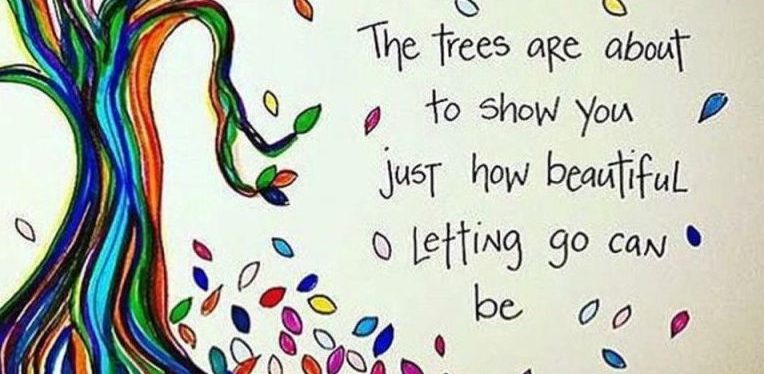


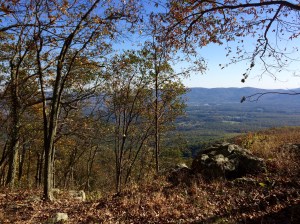 Yesterday my husband Steve and I took a short drive along the Blue Ridge Parkway, hoping to see some fall colors. My energy and mobility are still pretty limited—for whatever reason, the Taxol has settled into my knees, leaving me to creak around arthritically—so a mountain drive seemed like a nice way to get out of the house and breathe in at least a little fresh air.
 But every so often, as we rounded a bend and the sun shone just right, a beam filtering through the trees lit up a few yellow poplar clustered a little ways back in the under-story. A low-growing shrub dappled the roadside bank with orange here and there, if you watched carefully. We had to pull over and walk a few feet up the Appalachian Trail to spot the scarlet of a single sassafras leaf, the mottled red and gold of a maple.
 Still Life, Beyond Cancer