The Waiting is the Hardest Part

I remember only a few details from my appointment with the breast surgeon the Tuesday following the MRI. I remember I wore a black t-shirt and a wraparound raw silk skirt I’d bought at a street fair some years back. She wore a simple black sheath. I remember her saying, “We’re going to get the scary stuff out of the way, and then we’re going to forget about it and move ahead.” Then she drew a picture to explain triple negative breast cancer and reassured me that the “Stage 3” was automatically determined by the size of the mass and the local lymph node involvement, that she hadn’t seen anything to make her think there was more going on. I remember shaking uncontrollably. I remember her asking, as she felt my breast, if it were possible the lump had been that hard and pronounced for long, her whispering in my ear as she hugged me good-bye, “We’re going to be hopeful and prayerful. Hopeful and prayerful.”
img_7893Despite her reassurances that there was no immediate evidence of metastasis, I would need a CT scan and a bone scan to be certain the cancer hadn’t progressed beyond the local nodes. I kept shaking, so the staff moved mountains to schedule the tests as soon as possible, three days away, that Friday. Results would likely come after the weekend.

The verb “wait” dates to circa 1200, “to watch with hostile intent, to lie in wait for,” hearkening back to the Old North French waitier, “to watch,” from the Old French gaitier, “watch out, be on one’s guard.” It takes a few centuries before the specific meaning to “endure a period of waiting” is recorded, in 1849.

Steve and I had been waiting to tell family and friends about my diagnosis until we had solid information, a sense of scope and plan. Plus, I knew announcing it to others would make it inescapably real. But it was becoming increasingly impossible to sit on the news. We were scheduled to travel to Georgia in a couple of weeks to help host my parents’ 50th anniversary party, and they’d begun asking questions about the specifics of our visit.
img_7896The noun weight comes from the Old English gewiht, “weighing, weight, downward force of body, heaviness.” The figurative sense of “burden” arrives in the late 14th century.

My parents were celebrating a milestone. I didn’t want to burden them with distraction and worry. But the uncertainties were becoming too heavy to bear alone. I remember crying through the phone call. I remember their calm, steady voices. I remember the sense of relief afterwards.

The use of the phrase “waiting game” is first recorded in 1835. Early on, it referred specifically to a horse-racing strategy for horses whose strength was speed over endurance.

Steve and I had also been looking forward to a trip to Folly Beach. We’d originally planned to leave the Friday the scans were scheduled, but we delayed our departure to Saturday. We’d make an overnight trip back to Roanoke on Monday to see the oncologist, then drive back to South Carolina and finish our week at the shore. It was the best compromise we could manage: we’d have our beach trip, and we’d have a plan.

The two days we spent at the beach not knowing whether the cancer had already spread felt like two centuries.

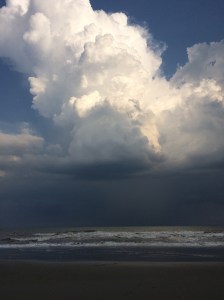
The evening we arrived, Steve left me to walk on the beach while he went into town to pick up some groceries. I strolled along the edge of the breaking surf, breathing in the salt air, gazing out at a distant horizon that made me feel both seen and insignificant. The sky was dark and heavy with clouds, a storm over the water. I turned around to see the sun beginning to set behind me. As it dropped behind another bank of clouds, it outlined one with a bright halo, its rays splaying dramatically across the sky. Light behind a cloud: was this hope?

img_7909The literal meaning of the verb “weight,” as in “to load with weight” is recorded first in 1747. Its figurative meaning, to load the mind with weight, appeared earlier, as early as the 1640s.

The side effects of chemotherapy are often debilitating and painful. Knowing your body will be permanently altered by surgery is disorienting, even devastating. But the waiting, all the waiting: for appointments, for surgery dates, for results, for reports, for recovery, for any piece of positive news. Ask a cancer patient, and I think many will tell you: all the waiting is the hardest part.

We got the call from the surgeon’s office Monday as we were driving back to Roanoke to meet with the oncologist: my scans were clear. You know your world has flipped upside down and backwards when “stage 3 breast cancer,” a diagnosis that left you shaking in fear just days before, takes on the modifier “only” and suddenly feels like the first good news you’ve had in weeks.

The nurse had tried to call with results late Friday afternoon. I remembered: I’d been on the phone with a delivery company when an unknown local number rang through. I’d started to hang up to answer it, but I couldn’t get a word in with the woman talking furniture. When I checked voice mail afterwards, my phone said it was full, no new messages.

The sense of “wait” meaning to “remain in some place” is from the 14th century.

img_7900-editedGiven a choice, I would not have elected to suffer through those two days of waiting and wondering. But it threw my perspective into sharp focus, gave me a fierce appreciation for the beauty all around me: the gritty give of warm sand under my feet; the spicy bite of fresh shrimp cooked with Old Bay seasoning; the constellation of freckles on my husband’s smiling face. And the sun shining out from behind a darkened cloud.

We’ll wait again, and again. And while we do, my heart breathes every gorgeous moment.


All etymological references are adapted from the Online Etymology Dictionary. Thanks to Tom Petty and the Heartbreakers (via Steve) for the title inspiration.
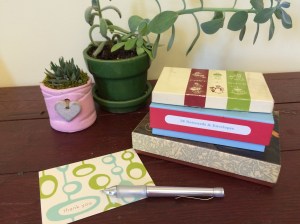
Do Good to Feel Good: Thank Someone Who Made a Difference

Science–and common sense–tells us that doing something good for others is good for us: it raises our endorphins, boosts our self-esteem, gives us an emotional lift. Doing good is good for others and for healing ourselves.

So, in this feature, I will occasionally suggest a small action each of us can take to make the world a better place. I will if you will!

image

Say Thanks to Someone Who Made a Difference

Is there someone in your past or present life–perhaps a teacher, a caregiver, a mentor–who made a real difference to you, personally or professionally, and about whom you’ve sometimes thought: I should tell ______ what a difference s/he made?

Now’s your chance! I recommend writing a letter, card, or email (or go public with a blog or even a Facebook post!), so the recipient can hang on to your thanks and revisit the good feeling it will no doubt elicit. But you know your recipient best, and a call or other intentional communication will also surely be much appreciated.

Feel free to post your intentions in a comment below, if you are so inclined.

Do good to feel good!


MRI: The Sounds of Scanning

After my initial diagnosis and prior to meeting with a surgeon, I was sent for an MRI so the medical team could get a clearer picture of the size and spread of the cancer in my breast. My appointment was at 8 am, and I sat sleepily in the chair across from the administering technician, unsure what to expect. I knew an MRI used magnets, and I was pretty sure I was going to have to spend some time inside a big tube, a fact that made my claustrophobic self shudder.

The technician, named Steve—a good omen, I thought, his sharing my husband’s name—told me that first he needed to ask a series of questions to make sure I didn’t have any metal on or in my body. I’d left my jewelry at home as instructed, so I didn’t think there was an issue, but the inquisition was protocol.

MRI-Steve clicked a few keys on the computer in front of him. “Do you have anything inside your body that you were not born with?”

Later, I’d wish I’d been quick enough to offer “cancer.” Instead, I said, “Um, contact lenses?”

He chuckled a little.  “Good answer.”

http://www.ironvillagewelders.com/

He clicked another key and proceeded to the next question. No, no pacemaker. No artificial joints. No piercings except my ears, no tattoos (some ink has metallic compounds), and no, I’ve never been a welder. Wait, what? Apparently welders often have tiny traces of metal in their eyes, and if they do, the machine can pull the traces out and blind the welder in the process. Ow.

Finally MRI-Steve asked what kind of music I liked. While I was in the machine I would hear some noises—a kind of clunking, and then a series of buzzes. “Your test will only last 30 minutes or so, so it’s not too bad,” he said. “Some can take an hour or more.” Patients were provided with headphones hooked up to Spotify or Pandora to mitigate the noise.

“Oh, well, I like the Indigo Girls,” I said. “I just saw them in concert last night.”

I wondered what he’d have said if I answered “heavy metal.”

∼ ∼ ∼

After inserting a magnet-friendly IV via a needle that left behind only a tiny plastic tube, MRI-Steve walked me back to the dimly lit room that housed the MRI machine, an impressively large and imposing white, plastic extra-deep donut with a gurney-like table jutting out from the near side of the opening. I thought it odd they were playing club music, techno with a heavy, steady bass beat: ka-thunk, ka-thunk ka-thunk. Then I realized the rhythm was coming from the machine. If those were the clunks MRI- Steve had referred to, the noise wasn’t too bad.

 MRI, AP Photo/Jeff McIntosh

Steve left me with his assistant Shevonne to help me get settled on the table. Lightly padded and lined with a sheet, it was shaped like a body. Close in, it looked like a sleeping capsule in an old sci-fi film, or maybe a mummification crypt with a shroud. Shevonne pointed to two pronounced breast-shaped imprints. I was to position myself so that each of my breasts hung down into one of the cups, where cameras were located. I decided not to think too much about how that worked as I climbed aboard. At Shevonne’s direction, I stretched my arms out in front of me, like Supergirl in flying mode.

I was given a squeeze-bulb call button to hold in my left hand, and Shevonne wrapped some of the tubing for the IV around my thumb on the right. Midway through the procedure I’d be given a contrast agent, and the machine would track its progress through my veins. The face cradle allowed me to breathe freely and had a long slit to accommodate opening my eyes. When I’d told MRI-Steve my fear of small spaces, he’d reassured me that since I’d be facedown and looking into a mirror, I’d be less aware of being inside the tube. Shevonne placed the earphones on my head and asked if anything tickled or itched. Once inside, no scratching allowed.

I felt the gurney lift up a few inches, then move forward. I peered down through the eye slit. I couldn’t see myself, so maybe I’d misunderstood about a mirror. As I slid further into the machine, it looked as if the floor dropped away below me, revealing another small room below.

Within seconds, I was dizzy with vertigo.

MRI-Steve’s voice came over the loudspeaker. “Everything okay?”

My head spun. “I’m really, really dizzy,” I said. “Is that normal?”

Amy Ray

“Um, no, not really,” he said. There was a pause. “Sometimes if you didn’t eat breakfast…?”

Slowly the dizziness abated. “I think it’s starting to subside,” I said. The Indigo Girls’ “Closer to Fine” played through my headphones. “I went to the doctor. I went to the mountains…”

“We’re going to start your test now. It will be loud, so don’t be startled.”

“Okay,” I said. I closed my eyes and pictured the finale of the previous night’s concert, the euphoria I’d felt singing along with the Girls and the audience to the song now playing in my ears.

Then a fire alarm went off.

∼ ∼ ∼

MNAAH. MNAAH. When MRI-Steve had said “buzz” and “loud,” I had not translated it as “You know, like that fire alarm that used to make you leap out of bed, adrenaline coursing and heart pounding, for 3 AM college dorm fire drills.” MNAAH. MNAAH. MNAAH. It continued for another 30 seconds. Then it stopped. Music returned. A second round. Musical interlude. Then another set of noises, with a higher pitch and faster pulse, an old-fashioned dial tone on steroids, quickly supplanted by a light bamboo-stick percussion that morphed into an electronic chicken, bok-bok-bok-bok-BAWK on the right, then loud bamboo sticks, more buzzy dial tone BEEP-BEEP-BEEP, more soft bamboo and the chicken circled around to my left, bok-bok-bok-bok-BAWK ticketa ticketa ticketa BEEP-BEEP-BEEEEP. Caesura. “The less I seek my source for some definitive, the closer I am to fine.”

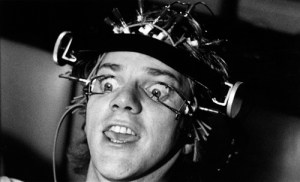
"A Clockwork Orange," Malcom McDowell, 1971 Warner

Maybe they ensconced you in a tube to keep you from fleeing the racket. I felt like I’d landed somewhere between a bad carnival funhouse and an auditory version of Ludovico’s re-programming technique in A Clockwork Orange. Another cycle of the same, then another, each a little longer than the one before. In between, music played through the headphones: a tinny war protest song about not marching no more, some traditional bluegrass pickin’. Not my fave, but preferable to two minutes of fire alarm. MNAAH. MNAAH.

MRI-Steve’s voice filtered in. “We’ve put the contrast in, so two more minutes of pictures, then you’ll be more than halfway done.”

Halfway? I was reminded of my hiker friend Jeff’s comment about climbing steep mountains: “Usually when you think you’re almost there, it really means you’ve only gone halfway.”

A coolness spread from my right arm down to my hand, and for a few moments an astringent, metallic taste filled my mouth and stung my nostrils, then disappeared. As the cool crept up both arms and dissipated, the fire alarm sounded again. When it stopped, an Old Navy commercial was playing.

“Nine minutes,” MRI-Steve said.

I tried to breathe evenly. Jeff Buckley sang “Hallelujah,” and the electronic chickens circled once more around my head.

∼ ∼ ∼

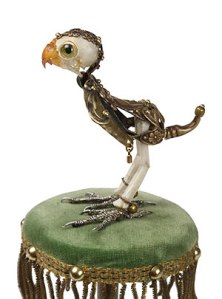
Robot Bird, Artist Jessica JoslinWhen they finally slid me out, I watched the white floor of the little room below rise up again. I had to put my head down and lie still for a few moments before I could stand up. “Dizzy,” I said into the cradle.
Once upright and retying my robe, I put it together: a mirror in the head cradle gave the illusion of a disappearing floor, an empty space below the machine, to counter claustrophobia. As my body moved forward and back on a flat plane, my eyes perceived I was moving up and down: ergo, vertigo. It really was a sort of funhouse trick.

Queasy and rattled, I headed to the dressing room. It would be several days before we’d find out the results of the imaging. It was too bad that sound waves couldn’t dissolve cancer cells the same way they did kidney stones—I’d be well on my way to cured. In the dressing room mirror, my forehead sported a bright red imprint from the pressure of the cradle, while my body, everywhere but my breasts, was marked with wrinkles from the sheet.

My Steve raised his eyebrows at my unsteadiness when I emerged. I wanted to warn the other guy sitting there, awaiting his own test, but how exactly do you explain being assaulted by the squawks of unseen robot birds?

I was sorely in need of a nap. I just hoped the chickens wouldn’t follow me into my dreams.


Photo credits:

Welder: http://www.ironvillagewelders.com/; MRI Machine: AP Photo by Jeff McIntosh; Amy Ray of the Indigo Girls, personal photo; A Clockwork Orange still, Malcolm McDowell, Warner 1971: www.imdb.com; Robot Chicken, Artist Jessica Joslin: http://mine-dart.blogspot.com/2011/04/artiste-jessica-joslin.html


Heads Up #1! — Hats on Parade

Beautiful, quirky, vintage hats make me happy, so I’ve titled this series “Heads Up!” as a reminder to keep my (currently bald) head up, to pay attention to the good in the world, and as an encouragement to myself and others facing a tough road that it’s possible to find the fun in even the most challenging circumstances.

hatboxes

I’ve collected vintage hats since college. I can’t recall what sparked my initial interest, although I do remember scanning the newspaper for estate sales one summer looking for vintage hats and clothing (this was pre-Craigslist, -eBay, and -Etsy –how times change!). I discovered a treasure trove at a sale in my Georgia hometown that day and have been hooked ever since. I inherited hats from my maternal grandmother, my mom gifted some from her younger days, and others have come as gifts over the years. I also own some great vintage scarves and contemporary toppers that may find their way into this feature occasionally.

I think we lost the opportunity for some serious fashion fun when hats went out of vogue, and I’ve long thought they should have a comeback. I wore my vintage finds regularly for a while, and I still wear hats with pleasure, though these days I reach for contemporary styles more often than I do the oldies. Since choosing good headwear has now become an almost daily ritual, I thought this moment in my life was a good time to dig back into the hatboxes and have a little extra fun with my collection. Why should it stay hidden atop our closet shelves?

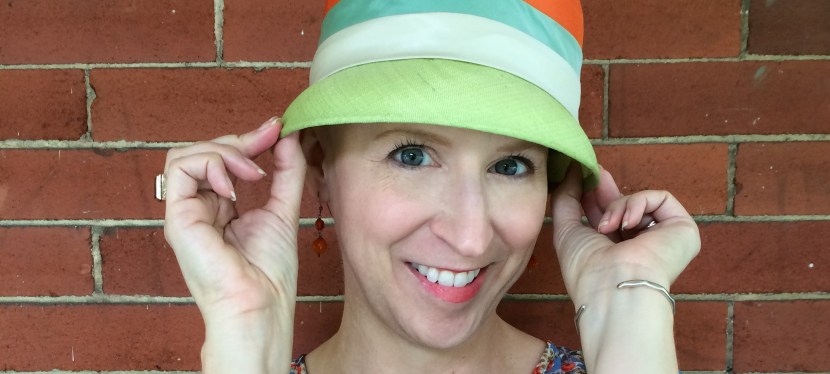
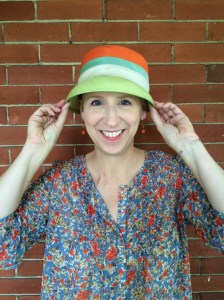
So, featured hat #1: A spring-green blocked fabric cloche with three wide ribbon stripes in orange, aqua, and cream. No label, found at a local antique store some years ago.

image

Perfect for an outdoor summer party, or to add a little cheer to the chemo treatment room!

Heads up, friends!


Next-post preview: What do chickens and an MRI have in common? Revisit on Friday to find out…

Beginnings: Biopsy

On a Friday morning in early June I kissed my husband of nine months Steve good-bye and headed to my scheduled doctor’s appointment. I was having a couple of cysts aspirated—a routine procedure for me, as I’d had benign, fluid-filled cysts making regular appearances in my breasts since I was thirty. My annual mammogram, which I’d had the week before, had been clear. I typically had a follow-up ultrasound because of my dense, and busy, breast tissue, but I’d opted out of it this time. The radiologist didn’t think it necessary, and I knew I was heading back for the aspirations, anyway. I figured it would take about an hour to drain the one or two cysts in each breast that were bothering me, and then I planned to head to the office to finish the one last report standing between me and summer break.

IMG_7804

The large cyst in my right breast had, as they sometimes did, already calmed down on its own; I wondered whether it was even worth bothering with it. My left breast still felt swollen and tender, though, so I kept the early morning appointment.

The attending nurse and the ultrasound technician arranged me on the table, placing a pillow under my left shoulder and asking me to curve my arm over my head, lifting my chest. The surgeon joined us and asked for the location of the cyst to be drained. I pointed him to the lower outer quadrant of my left breast.

“Oh, yes, I can almost see it there,” he said. With my body contorted, the lump under the skin was nearly prominent enough to spot with the naked eye.

The doctor located the cysts, per usual, with ultrasound. I always watched the images as they appeared on the monitor next to my bed. Each breast typically featured a multitude. They looked a bit like photos I’d seen of black holes, or solar eclipses: a black center, with a clear light-ring around the edges. As the surgeon rolled the wand over my left breast, I noticed something odd on the monitor. There was a dark mass, but unlike the manifold cysts I’d seen on the screen over the years, its border was irregular, furred.

“That doesn’t have the defined outline that a cyst usually does,” I said.

The doctor kept rolling the wand back and forth, back and forth. “No, that doesn’t look like a cyst,” he said quietly. “I think we’re going to need to turn this into a biopsy.”

˜ ˜ ˜

IMG_7772Just a few nights before, my husband Steve and I had been lying in bed, talking about what a crazy, busy year it had been. We’d bought a new house together, moved and combined our two households, moved each of his two sons into their first apartments, planned our wedding and gotten married,  and graduated the youngest son from college. We’d both worked the full academic year as professors, and there’d been some work-related stresses for both of us. Steve had, in fact, just started a new job with a research non-profit, while I was wrapping up teaching a three-week intensive learning course that included camping and rafting in West Virginia. Our new life together was good, but we were exhausted. “I bet we’d score off the charts in one of those life-stress tests,” I joked, and Steve agreed.

When I awoke the next morning, our conversation still on my mind, I searched online and found the Holmes-Rahe Stress Inventory, which assigns point values to significant changes (positive or negative) in a person’s life. Curious, I completed it—and scored a whopping 412 points. According to the inventory, any score over 300 increased by 80% my chances of having a “major health breakdown” within the next two years. I understood the score as proof positive that our past year had, indeed, been stressful and eventful. At the time I didn’t think much about whether it might actually predict my future.

 ˜ ˜ ˜

I went straight home after my appointment and called Steve. The doctor had completed a core needle biopsy of my left breast, taking three separate samples of the mass they’d found. In some discomfort, I decided to skip the office and work from home. I threw myself into finishing the report, then began packing. Steve and I had planned a weekend at the Peaks of Otter, a rustic lodge and restaurant off the Blue Ridge Parkway, overlooking a small lake in the valley below Sharp Top and Flat Top mountains. We wouldn’t have any answers until Monday or Tuesday, so we went ahead with our getaway.

IMG_7739
Sharp Top

Having the fact of your mortality plunked down in your path recalibrates perspective, turns up your awareness. We stopped on the way to the Peaks to browse art and antiques in nearby Bedford. A light breeze lifted and chuffed my hair as I rounded a corner onto Main Street. I thought: pay attention to this pleasure; you won’t have it long if you lose your hair to chemotherapy. Later, walking along a forest trail, I noticed tiny details: unremarkable mushrooms, striking patterns of bark on trees.

We tried to stay positive. I researched “benign breast tumors” on my phone, looking for descriptions of all the possible permutations that matched my symptoms. In a lighter moment, Steve looked at me with a tender smile and twinkly eye and said, “I thought of this earlier, but I wasn’t sure I should say it—I don’t mind if you have one Sharp Top and one Flat Top.” He reassured me that even if we’d known for certain we’d face this moment before we’d walked down the aisle, he still would have chosen to marry me. We’d had so little time together, and we wanted so much more.

IMG_7779
Flat Top

The next morning, as we strolled the path around the lodge’s lake, we met Ranger Neas, who pulled fossils from his backpack that showed the Roanoke Valley was once an ocean, and asked us if we were familiar with Einstein’s theory of relativity and the time-space continuum. We’d asked him about trees, and ended up talking about time. Instead of understanding time as relative, he asserted, we’ve become slaves to our human construct of time and the belief that time-is-money. “But nature doesn’t do that, the mountains don’t do that,” the Ranger said. I was reminded of Aldo Leopold’s “Thinking Like a Mountain”—the mountain takes the long view, even as it understands the value of the smallest interaction. We could choose to change our relationship to time, the ranger urged. Instead of the clock being life’s measure, we could choose beauty, joy, love—the richness of the life we live. We could learn to understand, value, spend time in ways that are more meaningful.

My own relationship to fate and faith is ever-changing, but our conversation with the ranger felt something more than coincidental.

Each evening during our stay, Steve and I held hands as we sat outside on our room’s balcony, tracking the stars as they appeared to move across the firmament. We tried to describe the different shades of dark that were the sky, the water, the mountains, pondering whether reflected moonlight was silver or some other color. When I saw a single falling star, I wished, and hard.

 ˜ ˜ ˜

The call came, as promised, on Monday afternoon. The radiologist’s phrasing stuck with me: “I’m sorry to tell you, it is a cancer.” A cancer: singular, specific. It felt somehow less all-encompassing, stated that way—a thing that was, a thing that existed, not a blanket pronouncement of my fate. I was grateful for that, and for the kindness in his voice. “We’re going to fix this,” he said. “I hate it, since you’re so young. But we’re going to fix it. It’s a garden-variety—if there can be such a thing—intermediate-grade breast cancer. And we’re going to fix it.”

IMG_7730I hung up, cursed, cried. Steve and I walked a few fast laps around the park across from our house, amped up on adrenaline. After we’d burned off some of the shock, we decided to have dinner at the local restaurant where we’d shared our first date.

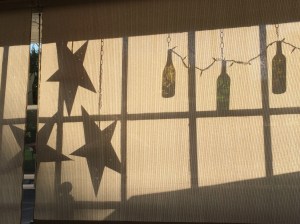
There, as the sun set, it created star-shaped shadows from the lamps hanging behind the window shades. There was still much we didn’t know. The waiting had begun.