As Good As It Gets!

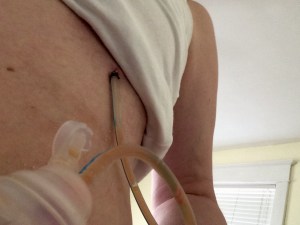
The good news: when I went in for my second “fill” today, I was able to have one of my JP drains removed. Here I am, happily saying goodbye to it:

img_0797

The length of tubing stretching from the open end in my left hand to the fingers of my right was what was inside my body–yikes. Makes we wonder where, exactly, it all wound around.

So that’s the good news. But the BEST news is this: my pathology reports from surgery came back, and I am officially cancer-free! They found NO cancer cells in either breast or in lymph nodes. None. Nada. Zilch. Hooray!

img_0806

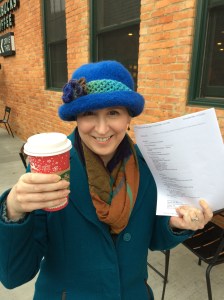
Receiving the report makes for a great start to the new year. This is me enjoying a celebratory Starbucks. Cheers!

I will still undergo radiation treatments, as one final precautionary push-back against the possibility of local recurrence in the skin or area lymph nodes. Radiation will start in another three weeks or so. In the meantime, drain #2 will likely come out within the week (which may, on its own, be enough to warrant a second celebratory latte!).

There are no guarantees; there never are in life. But in this context, on this journey, today’s news is genuinely as good as it gets. I am humbled and deeply grateful.

Please celebrate with me by hugging someone you love, and telling them how much they mean to you. Happy, happy new year, all!


Coming soon: more thoughts on hair, an homage to husbands, and some new ideas for doing good to feel good in 2017. Thanks as always for reading!

Post-Mastectomy: The Lay of the Land

barbieshow2
Barbie show

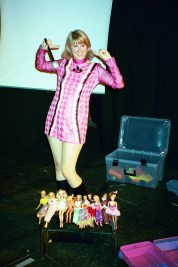
Some years ago, during my late twenties and early thirties, I penned and performed a one-woman show about Barbie. I had (and still have) a love-hate relationship with the ubiquitous doll, who, as the play reveals, was the source of many happy hours of childhood play, but whose questionable influence on young girls’ ideas about women’s bodies and gender roles troubles me. One scene in the show tells the story of a lavender nightgown I was given by a friend who’d outgrown it, a gown 10-year-old me was enamored of because its silky nylon bodice with sheer chiffon sleeves reminded me of a similar Barbie doll gown I found particularly glamorous. There was only one fault with the lavender nightdress: it hung straight down from my shoulders, whereas my Barbie’s gown “nipped in at the waist, flowed out over rounded hips,” accentuating her every curve. I began to insist my gown needed a belt, and after much pleading, my mother—reluctantly—purchased me a yard and a quarter of matching lavender ribbon. I bloused the top of the gown over the ribbon belt, reasonably satisfied.

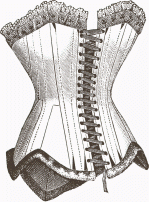
My original vision for staging this scene in performance was to wear a gown similar to the one described; then, as I told the story, I would raise my arms into the air and stand on tiptoe as a stagehand came out and laced me, grommet by grommet and tug by tug, into an old-fashioned corset. Though it proved impractical to realize, that’s still my preferred staging of the scene: the tale of the little girl glorying in the big girl nightgown, beauty equal in her mind to Barbie’s womanly curves, juxtaposed with a literal representation of the cost of attaining that desire. As she (innocently) embraces society’s ideal of feminine beauty, she becomes increasing restricted by the corset.

img_0728
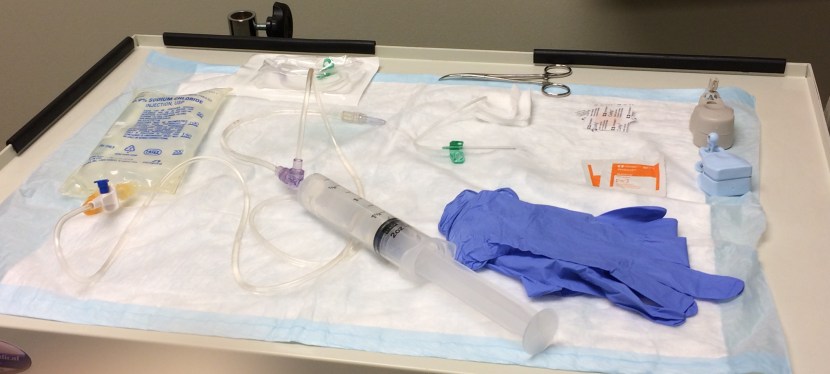
Equipment tray for my first fill

That image has been on my mind recently, now that I am almost three weeks out from a bilateral mastectomy and in the beginning stages of reconstruction. During surgery, after my natural breast tissue was removed, two devices called “tissue expanders” were placed between my chest wall and my pectoralis muscles. Essentially “baggies with ports attached” (my surgeon’s description), the expanders function as placeholders for future implants and, more importantly, slowly stretch the skin and muscle to accommodate them. What that means in practice is a series of appointments during which the doctor uses a magnetic device to locate the metal port and imprint the skin with an “X”-marks-the-spot. Then 100 milliliters of saline are injected into the expander through the port. These are called “fills,” and I will receive a weekly “fill” until my expanders reach their maximum capacity of 550 milliliters each, their size having been determined by the size of my natural breasts.

corset_harpers_bezar1882l1

I’ve heard other breast cancer survivors refer to the expanders as the “iron bra”; some have compared the process of getting fills to having dental braces that are tightened at regular intervals. Both are fair descriptions, though between the expanders and the various pressures exerted by tight muscle fibers and swelling from the trauma of surgery, I feel more like someone has implanted an entire whalebone corset—rather like the one I’d imagined in my Barbie play—inside my body. Sometimes I feel like I’m wearing a strapless, corseted evening gown whose stays keep riding up, jamming into my armpits. My impulse is to want to grab hold and shimmy the offenders back into place, but it’s my own flesh and framework that has risen up to cause me pain.

~~~

So I’ve been thinking a lot about that little girl in her nightgown, the costs and trade-offs of my desire to have breasts, my choice to undergo reconstruction. Without it, I could shorten the whole process: I would heal faster, experience less discomfort. I cannot get my permanent implants until radiation treatments are done and I’ve fully recovered from them, so I’ll be living with my internal corset for six months or longer, if I can stand it.

img_0760
My edgy androgynous look…?

More and more women are electing to remain flat-chested post-mastectomy, in part because the process is long and uncomfortable. There’s a definite declaration of freedom in that choice, and I admire women who make it. With my currently flat chest and super-short buzz-cut, I’m projecting what I like to think of as an edgy androgynous look. As a woman who enjoys playing with fashion and modeling, it’s intriguing to see this other version of me look back from the mirror. But I don’t think I’m prepared to embrace her long-term.

Seeing my altered body for the first time post-surgery was hard, though less traumatic than I anticipated. I’d heard of women who refused to look at themselves, or let lovers see them, for weeks or even months. Instructed by the surgeon to shower and remove my bandages 48 hours after my release from the hospital, I didn’t have much choice but to take the plunge.

Having both breasts removed, I think, made the changed topography of my body seem less, rather than more, shocking, since there was no immediate point of comparison between what was before and what was after. Seeing a flattened and grayed-out mountaintop removal mining site is devastating in part because of its contrast to the beautiful, rolling green hills surrounding it. But my chest had become an entirely foreign landscape, as if I’d fallen asleep in the Appalachian foothills and woken up to the western prairie. I was a little bumpy and not entirely flat, given the expanders and some general swelling; two reasonably symmetrical incisions sealed with a length of surgical tape bisected the memory of each breast mound. That was the phrase the reconstructive surgeon had used when he came by my pre-op station the morning of surgery, and it was the one gesture that had made me cry: watching him outline my natural breasts in black marker so he could remember their placement after they were gone. It was also my last sight of them.

~~~

I feel a strange blend of grief and fascination when I look at or touch my changed body. At first everything just hurt; I had limited use of my arms and needed help going to or from lying prone. As I’ve healed, the overall soreness has faded so that now there’s a distinct difference between the skin over the expanders, which is essentially numb, and everything else, still tender. I’d been warned I would lose most of the sensation in the skin of my breasts. Steve asked if the sensation was akin to how your face feels after a shot of Novocain at the dentist, and some areas are a bit like that. But a more accurate comparison would be to place a book on your thigh, and then tap on the book—you can feel the vibration of the tapping in your leg, but no direct sensation from your fingers touching it. When I got my first fill, I felt nothing when the needle of the saline syringe pierced my skin.

img_0743
JP drain at work

Perhaps I’m able, for the most part, to retain a certain level of detached curiosity because I’m aware the construction of my new breasts is a long process, and it’s still early days. It’s a little bit like writing: my first drafts are messy, uneven, and rarely look much like the final product, but their deficiencies are tolerable because I know I’m not yet finished. Knowing it’s a process helps me feel less disturbed by my bionic boobs’ current non-breast-like appearance. They’re still a bit Frankensteinian at present, with some discoloration from bruising, the odd swelling, and those infernal JP drains, whose tubes are sewn into my skin and descend down my sides to two plastic bulbs. I tuck the bulbs into pockets during the day and squeeze the collected fluid out of them each evening with my husband’s help. Sexy, right?

~~~

 In my Barbie play, I follow the story of the lavender nightgown with the story of Cindy Jackson, who underwent more than twenty plastic surgeries in an effort to become a living Barbie doll. Together, the two stories were intended as a kind of cautionary tale. Just how high a price are we willing to pay to have our bodies conform to the hourglass ideal? The memory gives me pause. My eventual implants, whether fashioned from silicone or my own tissue, will be far more comfortable than the tissue expanders, though my new breasts will probably never regain much sensation. I hope that someday, instead of calling up the feeling of a corset, they will indeed begin to feel like bionic boobs, that they will become a part of me, imperfect but powerful reminders of my strength as a survivor.

Until then, I’ll just have to resist the urge to grab hold of the skin in each of my armpits and yank.

Simple Gifts

The Twelve Days of Christmas traditionally start on Christmas Day, December 25th, and continue through January 6th. The “twelves” that are on my mind these days are a bit different: having had surgery on December 12th means that today, Christmas Eve, marks my 12th day of recovery. Everyone has told me that the first two weeks are the hardest (and I hope they’re right), so I am glad to have reached this milestone, and look forward to continued healing over the next days and weeks.

img_0591I am more aware than ever of the many gifts in my life. Plentiful food; a warm, safe, spacious home. The love and care of so many people: devoted family who share their time and energy generously, decorating the tree, making meals, running errands, offering a voice of experience. Beloved friends who text encouraging messages, share their skills and favorite books, send beautiful holiday cards and bouquets that brighten up the darker days. And an incredible husband who stands by my side, makes me laugh, and doesn’t blink at changing bandages or fetching yet another Coca-Cola Icee (or even question my weird craving for them).

img_0593I’m also aware of gifts I’ve received for so many years without any comprehension they were gifts: the mobility to towel myself dry after a shower, mindlessly, unaware of the many twists and turns my body had to make to accomplish this simple task; the steadiness to reach the sugar where it lives on the highest kitchen shelf without having to ask for help; the stamina to sit at my computer and write for hours at a stretch. The gift of the absence of pain or discomfort. The gift of good health. Gifts I hope to receive again, and fully appreciate hereafter.

img_0634We won’t receive the full pathology report from the surgery until early January: we are hoping, based on the post-chemo scans, for good news.  Until then, we will continue to celebrate the gift–a precious one– of another Christmas together. And I’ll keep you posted as often as I’m able about my ongoing Adventures in Cancerland.

Happy holidays, everyone!

Write Soon

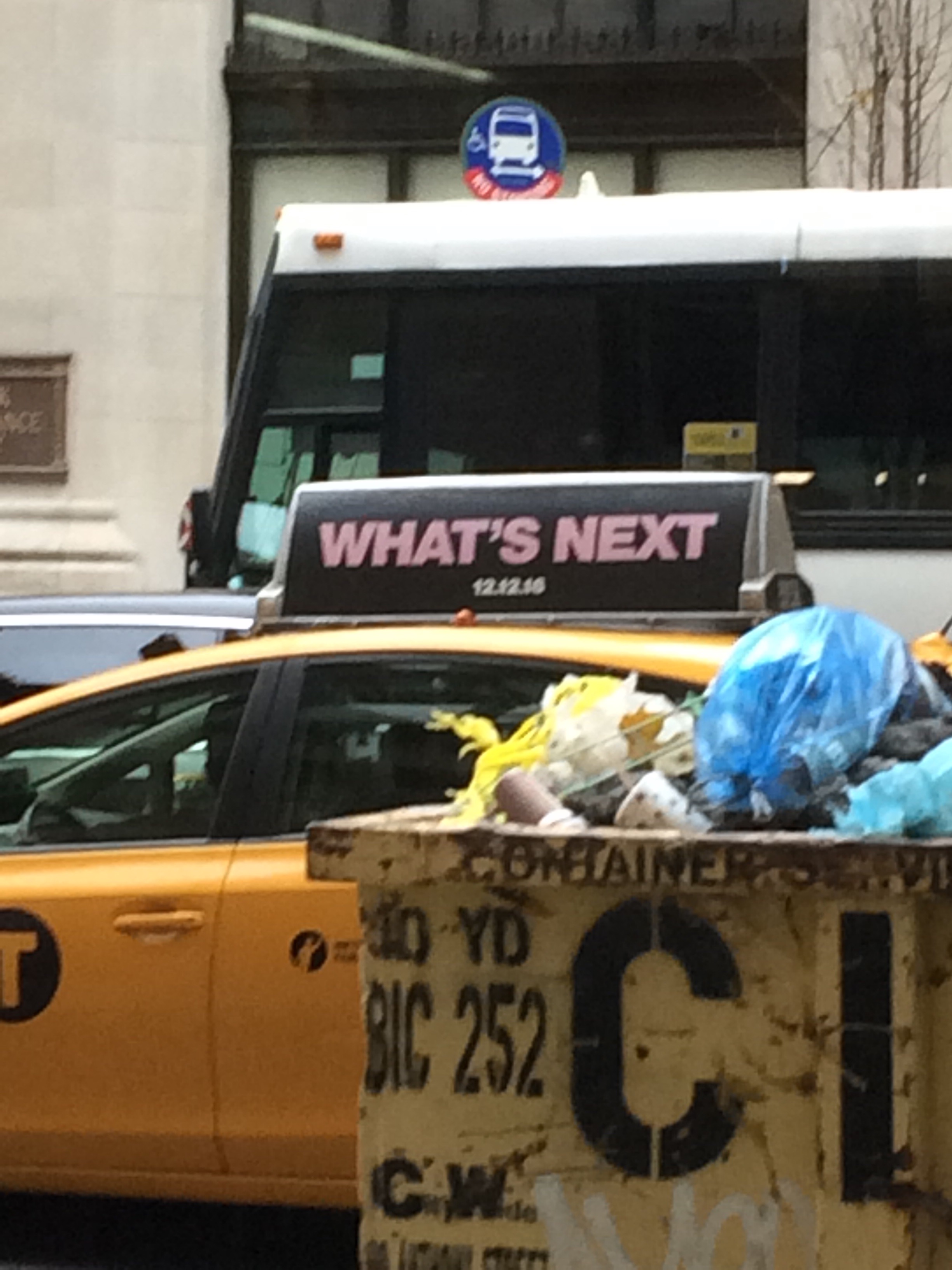
When Steve and I were in New York City recently, I looked out the window while we were grabbing a quick breakfast one morning and saw this taxi: “What’s next?” it read, followed by the date: “12-12-2016.”

“Seriously?” I said to Steve.

Today is the date of my mastectomy. I will be on blogging hiatus for a week, maybe two. Thank you for reading, and for all the kind comments. See you on the flip side…

They’re Not “Just Boobs” to Me

“They’re just boobs.”

More than one well-meaning friend or acquaintance has uttered that or a similar statement in an attempt to comfort me, minimize the anxiety I feel as I face a bilateral mastectomy. I will willingly say good-bye to my natural breasts in the interest of prolonging my life; it’s the wise choice. But there’s no “just” about it.

They aren’t “just” boobs. They’re my boobs. My breasts are part of me. I have not, and will not, “use” them, it is true, for their evolutionary purpose, to feed a child or children. As such, some might say they are extraneous.

But they’re mine. And I like them.

And I grieve their loss.

~~~

I didn’t always like my breasts. They debuted, when I was a young teen, as small knots on my chest, literally: hard bumps arose underneath each of my nipples. I was embarrassed to ask my pediatrician to examine these buds, but he reassured me (and my mother) everything was fine. For years I worried I was “too small,” even after I turned seventeen and suddenly gained a cup size, perhaps a result of the hearty German fare I ate while an exchange student that year. I still felt my minimal cleavage didn’t quite balance out my womanly hips, that my nipples were too prominent.

And they were troublemakers, these breasts of mine. When I was in my late twenties, I found a lump. It turned out to be nothing but a benign, fluid-filled cyst, and some doctors in the medical center at Ohio State, where I was in grad school, drained it. That was the first of many more benign cysts, too many to count.

makeup2It was also the start of many years of creative commentary by various medical professionals. I’m a “cyst-maker”; I have “busy breasts.” Enough nurses and doctors expressed surprise at the number and volume of my cysts that I felt like a curiosity. One surgeon in Georgia, who I’d been referred to for draining yet another set of what one nurse called my “natural implants,” greeted me by exclaiming, “Why, you’re just a little bitty thing!” He waved a copy of my scans through the air. ”After seeing the size of your cysts, I thought you’d have great big ba-zooms!”

I didn’t, though I was slowly learning to appreciate them just as they were. Practically speaking, smaller breasts offered maximum wardrobe flexibility: I could wear low-cut or clingy tops without attracting unwanted attention, and button-downs never gaped. But I also finally realized they were, actually, pretty nice breasts. Kind of perky, actually. By the time I reached my early thirties, I’d have said they were my favorite part of my body.

Like many women, I’ve often struggled with body image and self-doubt. It took me more than half my life to love my breasts. Now I must let them go, and re-learn to embrace my body, post-surgery, all over again.

~~~

I know I am no more or less a woman with or without my breasts. My identity as a woman, my worth as a human, is not defined by the shape or size of my chest. Nor do I assume that breasts are universal signifiers for femininity, womanhood, or desirability. In fact, the way breasts are weirdly glorified and overly sexualized, especially in American culture, has often puzzled and annoyed me. I once argued with a man who insisted that breasts were always sexual. No, I replied. If I choose to walk out my front door with my breasts exposed, or with no clothes on at all, that does not necessarily constitute a sexual act; minus a display of express and clear intent, it’s definitely not a sexual invitation. I’m just naked, and we’re all, as the saying goes, naked under our clothes.
portrait-poseSomething else I know: attachment is the root of all suffering. Yet I find it difficult not to be attached to something that is, well, attached to me. Front and center.

My breasts have been my conscious companions at the beach, suited up and sun-screened in a cleavage-baring bikini; on the figure-modeling dais, revealed in the service of a painter’s line, curve, and shadow; on the running trail, compressed and protected in a jazzy neon sports bra.

My breasts have brought me pleasure in private moments, sensual pleasure wrapped up in sensitive nerve endings and a lover’s tender touch, his open admiration. My breasts have brought me aesthetic pleasure, when I slip into a pretty dress that fits just so, hugs the curves of my hips and breasts in a way that makes me feel sexy and beautiful.

My breasts are not some idle, remote organ like an appendix, whose absence I’d scarcely notice. They are a daily presence and a source of pleasure, and I will miss them.

~~~

I will have reconstruction, and I’m grateful for that. I’ve talked to enough survivors, however, to understand the process is no picnic. And my bionic boobs, as I’ve come to call them, will look and feel quite different from my natural breasts.

I’ve been trying to find ways to reconcile myself to the coming changes. I’ve begun to try to re-frame the mastectomy in my mind: instead of thinking about losing my breasts, I focus on regaining my health. I’m saying goodbye to a cherished part of my body, but I am also saying goodbye to the cancer.

I’ve tried to imagine my breasts as being like an old friend, one whose friendship has become toxic. She was a perfect match in my younger years: we liked the same music, went to the same parties, celebrated good days and commiserated over bad ones. Then, she began to lash out, to drink too much; when I was around her, so did I. We had a great run, my old friend and I, but now—well, she’s not healthy for me anymore. I appreciate the good times we shared; I’m grateful and glad for her having been in my life. Even though it hurts, I know I have to say goodbye.

Still, my body isn’t a metaphor. Metaphors don’t go numb or swell with lymphedema. They don’t scar or press your chest with pain. They don’t change what you wake up to every morning, what you see in the mirror, for the remainder of your days.

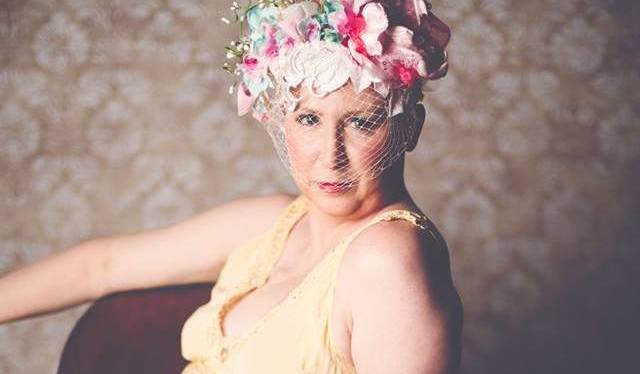
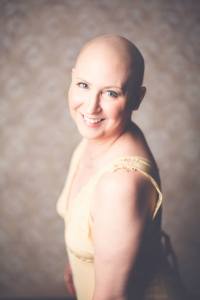
I’m working on cultivating greater self-compassion and acceptance. I recently hired a photographer to document and celebrate my pre-surgery body, highlighting my bald head with a beautiful custom headpiece. And this time, after surgery, I don’t want to wait thirty years to decide to like my body, my (new) breasts. It won’t always be easy, but loving myself as I am is a choice I will endeavor to make every day.

headpiece


The photos included here are a preview selection from the shoot described in the post: photos by Michael Wilson, Bohemian Robot Photography; make-up by Jolina Goad, Jolina does Make-up; bespoke headpiece by Sandra Eileen, Every Girl a Goddess Couture Headpieces.

Words to Live By: Cheryl Strayed’s Tiny Beautiful Things

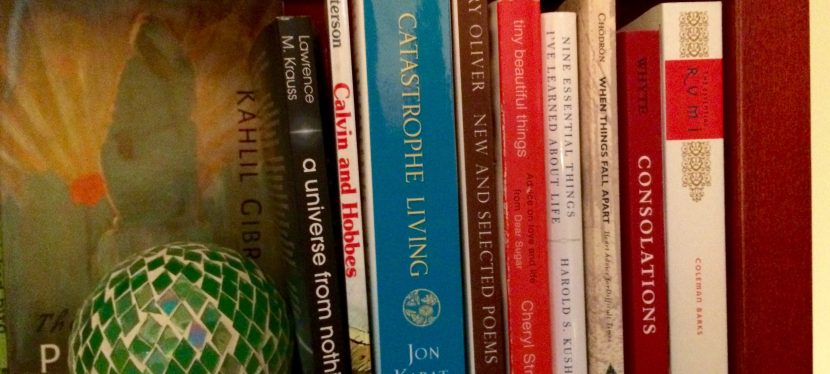
Last weekend Steve and I took a trip to New York City to see Cheryl Strayed’s Tiny Beautiful Things, adapted for the stage by Nia Vardalos (writer/star of My Big Fat Greek Wedding) and directed by Thomas Kail (director, Hamilton). The moment I saw the announcement, which was months before my diagnosis, that Strayed’s book would be adapted into a play and would run at the Public Theater in November and December, I told Steve that seeing it was what I wanted for my birthday. Because, to adopt my nephew Daniel’s language, “Tiny Beautiful Things changed my life.”

Strayed is best known for her memoir Wild, a number one New York Times bestseller, which recounts Strayed’s hike along the Pacific Crest Trail, a journey that helps her come to terms with her mother’s death. Tiny Beautiful Things came out in book form after Wild, but most of its contents had appeared previously on TheRumpus.net, for which Strayed anonymously penned the “Dear Sugar” advice column after taking it over from originator Steve Almond at his request.

TBT1The book is subtitled “Advice on love and life from Dear Sugar,” but to label Tiny Beautiful Things as merely a collection of advice columns does not do justice to its beauty or wisdom. Strayed turns the conventions of advice columns upside down and taps into her own memories and experiences in her responses, doing “something brilliantly counter-intuitive,” as noted by the  Public’s Artistic Director Oskar Eustis,” using self-revealing stories of her own life for generous purposes.” Strayed’s luminous and powerful responses to what are often heart-wrenching letters are some of the most lucid, honest, moving essays I have ever read.

I first encountered Strayed’s book shortly after it came out, in 2012. At the time I was struggling to make sense of my romantic life, which seemed to have stalled out in an on-again, off-again relationship that, deep down, I knew wasn’t going anywhere. As I read, especially her responses to the lovelorn, I underlined passages that spoke to me—sometimes because they comforted, but more often than not, because they pierced me with uncomfortable truths. A few months later I gifted the book to my sometime-fellow, and the same truths resonated with him. Inspired, at least in part, by Strayed’s words, we broke up, and stayed that way. Free to open my heart fully for the first time in several years, I soon met and fell in love with the man who is now my husband.

I wasn’t kidding when I said the book changed my life.

tbtplaybillMy heart buoys and breaks over different matters these days, but Strayed’s words still speak to me. Gauging by the shared laughter and the unmistakable sounds of whole-audience-weeping in the theatre, they speak to many. (When the lights came up, Steve turned to me, both of us still wiping our eyes, and he said, “You didn’t warn me!”) It was a powerful performance.
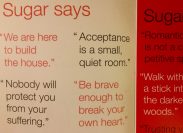
Seeing Strayed’s words brought to life on stage sent me back to the book. I find myself drawn to passages on managing suffering and finding healing. For example, in a response to a young woman mourning a miscarriage, she writes the following about grief. Though she is talking specifically about the lost daughter, her words resonated with me, as I’ve recently felt “stuck” in my own emotional journey: “This is how you get unstuck, Stuck. You reach. Not so you can walk away…but so you can live the life that is yours—the one that includes the sad loss of your daughter, but is not arrested by it. … That place of true healing is a fierce place. It’s a giant place. It’s a place of monstrous beauty and endless dark and glimmering light. And you have to work really, really hard to get there, but you can do it.” (22)

Later: “Nobody will protect you from your suffering. You can’t cry it away or eat it away or starve it away or walk it away or punch it away or even therapy it away. It’s just there, and you have to survive it. You have to endure it. You have to live through it and love it and move on and be better for it and run as far as you can in the direction of your best and happiest dreams across the bridge that was built by your own desire to heal.” (30)

DearSugar2And this, in response to a professor and class who asked Sugar’s advice to graduating college students: “Whatever happens to you belongs to you. Make it yours. Feed it to yourself even if it feels impossible to swallow. Let it nurture you, because it will.” (133)

Or this, recalling Strayed’s own response to an exchange with her estranged father: “I had that feeling you get—there is no word for this feeling—when you are simultaneously happy and sad and angry and grateful and accepting and appalled and every other possible emotion, all smashed together and amplified. Why is there no word for this feeling? Perhaps because the word is ‘healing’ and we don’t want to believe that. We want to believe healing is purer and more perfect, like a baby on its birthday. Like we’re holding it in our hands. Like we’ll be better people than we have before. Like we have to be. It is on that feeling I have survived. And it will be your salvation too, my dear.” (311)

Steve Almond says that Strayed practices “radical empathy.” If there’s anything the world could use more of these days, it’s radical empathy—for others, and for ourselves.

I have gifted Tiny Beautiful Things many times. It changed my life, and my nephew’s, too. Who knows? If you read it, it might also change yours.

Rest Up

I’m tired of resting.

Go ahead, roll your eyes. Think: some burden. Your privilege is killing me. Oh, the whining.

ImohResting
Imoh’s good at resting!

I get it. I’ve lived many years of my life when I would have been thrilled to have time, especially generous quantities of it, to rest. To slow down the semester, not bring work home every night. Not to have a sick cat, a visiting writer, and a traveling husband all fall in the same week. Not to berate myself for neglecting to phone family more often because I’m too exhausted at the end of the day to make one more call, even to someone I love.

I’ve written elsewhere about the need for more rest, more leisure in our lives. With rest comes reflection, and with reflection, innovation. Not to mention that rest is fundamental to good health and self-care. I don’t by any means mean to malign rest, and I am extremely grateful to have the privilege to rest when I need to, especially when I know so many, whether ill or healthy but simply tired, don’t.

It would be better stated to say I am tired of having to rest. Tired of having to parse out my days, knowing if I want to enjoy an evening with friends, I shouldn’t go to the grocery store in the afternoon. That if I have a doctor’s appointment, it might be the only outing I have energy for that day. I think maybe I didn’t really believe the doctors or other survivors when they told me how fatigued I’d be, and for how long. I used to compile errands, thinking, hey, while I’m out, I’ll stop at X and take care of Y, too. These days I’m mostly a one-stop shop, and sometimes even then I come home and nap.

spoons3There’s an article that’s made its way around the internet about the “spoon theory.” The writer, Christine Miserandino, has lupus, and recounts the day, over lunch, a friend of hers asked what it was like to live with the chronic condition. On impulse, Miserandino grabbed all the spoons from her own and several surrounding tables, handed them to her inquisitive friend, and an analogy was born. Though the spoon theory initially described life with chronic conditions, the theory also applies to those with long-term illnesses. The basic premise: a person with chronic or long-term illness has a limited number of “spoons” (energy) to use each day and has to decide how to “spend” them. Different activities use up different amounts of spoons; the person has to plan carefully, because once a day’s spoons are used up, that’s it. For example, one thing Miserandino points out is that simply getting showered and dressed requires a spoon or two. As I gain strength, making myself publicly presentable takes less of a toll, but I still sometimes leave a little time between getting ready and going out so I can rest up for a few minutes.

Hubby Steve and I just spent a lovely weekend in New York City, the first traveling I’ve done since July. We started slow each morning, sleeping in and heading out for brunch between 11 and noon. Both afternoons we visited small museums for about two hours, then returned to our hotel for a couple hours’ rest before going to a show in the evening. We had a fabulous time, but the difference in our itinerary from our first trip to the city two years ago, when highlights included an afternoon walking tour of chocolatiers and going for a run through Central Park, was marked.

coloringbook
Coloring has meditative effects.

Some of my anxiety about resting probably comes from guilt. Though I do find value in rest, there is a part of me that feels like I should be doing something, doing more. Some days I get in a few hours of writing, or organize a file drawer or two in my office. But some days I don’t have the physical energy or mental concentration for much of anything, even reading. When I was really sick from chemo early on, I binge-watched television shows, but I grew weary of that fast. As a child, I only watched TV during the day when I was home sick, so I associate daytime TV-watching with illness, and it makes me fidgety. Instead, I’ve turned to podcasts and coloring books. Both have their perks: I’ve laughed a lot through the podcasts (laughter is the best medicine), and coloring is quite meditative. Still, there’s this little part of my brain that says, “Coloring? Shouldn’t you be doing something more productive?”

The first year I moved to Roanoke I contracted pneumonia in early January. When the doctor diagnosed me, he prescribed an antibiotic, then told me to come back for a check-up in six weeks. “Six weeks?” I asked, incredulous. Yes, he said, it would probably take that long to clear. I drug through each workday, went home and lay on the sofa until bedtime, then retired to my bed for the night, repeating the routine every day for weeks. One mid-March morning I woke up and realized, with surprise, “This is what it feels like to wake up feeling good!” I’d been sick and tired for so long, I’d almost forgotten what it felt like to be healthy. It was a revelation.

img_0361I’m looking forward to experiencing that revelation again, whenever it finally arrives. I know it might be a while. Until then, I try to remember what my friend Sarah said when I shared my frustrations with her about my lack of productivity, my inability to do all the things I need and want to do.

“You are doing something,” she said. “Something very important: you’re healing.”

And in the meantime, I have my headphones, and a plethora of colored pencils.

beauty in the broken: the backstory

Carilion Clinic, through which I am receiving my medical care, partnered this year with the National Arts Program to sponsor a Patient Art Show, an initiative of the Dr. Robert L.A. Keeley Healing Arts Program. Any patient receiving care through a Carilion provider was eligible to submit art work, which is currently on display in the lobby of Carilion Roanoke Memorial Hospital, through December 15th. All the works are available for viewing in a photo gallery on Facebook, where you can vote for the People’s Choice Award (shameless plug: if you’d like to vote for my piece, click here.)

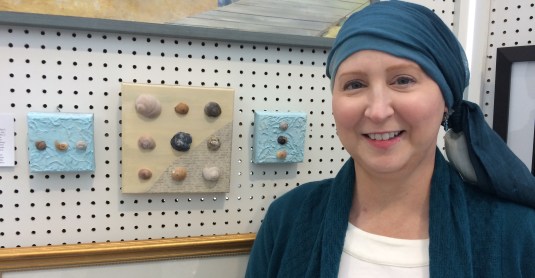
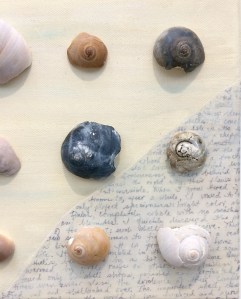
I submitted a mixed media triptych collage (acrylic on canvas, seashells, vellum, pen and ink) entitled “beauty in the broken.” I described my inspiration for this piece in a brief artist’s statement:

Shortly after I was diagnosed with breast cancer in June 2016, my husband and I visited Folly Beach. An avid sheller, I have long been drawn to the whorls of the moon snail, a shell made a symbol of women’s need for creative space by writer Anne Morrow Lindbergh. To keep the numbers of shells I brought home in check over the years, I usually collected only whole specimens. On this beach trip, facing chemotherapy and a bilateral mastectomy, suddenly the moon snail fragments reminded me of the curves and arcs of breasts. Even in their brokenness, especially in their variety, each was still beautiful. This mixed media collage attempts to honor the beauty in the broken.

I rather like the company the piece is keeping at the exhibit: a cheerful beach and a calming river.

There is a narrative incorporated into the collage itself. It cannot–intentionally–be read in its entirely on the artwork, reflecting the idea of fragmentation and imperfection. The narrative was excerpted and adapted from an essay I had written last year about collecting seashells:

When I first started shelling, I would often pick up blemished shells, the conch with a hole in the back, the slipper shell with a chipped, jagged edge. Sometimes the brilliant coloring or the graceful whorl exposed in a fractured shell looked too beautiful, even in its brokenness, to leave behind. Turned just the right way, the shell’s flaws were all but invisible. When I grew tired of the fragments, after a while, I vowed to collect only perfect specimens: bright color, shiny finish, completely whole with no marks or any blemishes. I quickly discovered the problem of the perfect: such shells were elusive. There were few such specimens to find.

A shell is a vestige of a living being. It is product of and home to a life; it has tumbled in the surf, cracked against other shells, been baked by a hot sun on some days, warmed by gentle rays on others. The flawless are found only in shell shops, polished and perfected, sometimes even under glass, the evidence of their complex lives buffed out and shellacked over. The imperfect shell, whole but marked by the world it has engaged and survived, is the real find. Maybe you can only see the real find after you understand what it is you’re truly looking for. Maybe the beauty in the broken only emerges once we recognize that same beauty in ourselves.

img_0144

Two quotations wrap the edges of the two small blue panels. The first, from Anne Morrow Lindbergh’s essay on the moon snail, reads “Only when one is connected to one’s own core is one connected to others.” The second is from E. M. Forster: “We must be willing to let go of the life we have planned, so as to have the life that is waiting for us.” I’ve found both of those ideas fundamental to healing and happiness.

Creating this piece was very meaningful to me. And while the timing of this post is purely coincidental, I know that many people are struggling this week with the sense that much in our world is broken, fragmented, divided. May we find our way to recognizing and owning our flaws, valuing our differences, and treating one another with respect.

One more shameless plug: if you’d like to vote for my piece for the People’s Choice Award, please “Like” it in the Patient Show Art Gallery: beauty in the broken. Please do visit the gallery, and feel free to share the link—there are many beautiful works in the exhibit, and many are available for purchase. Part of the proceeds benefit the Keeley Healing Arts Program. Thank you!


What We Talk About When We Talk About Cancer

The phrases are familiar: “Fight like a girl!” “We can beat this disease.” “Warriors in pink!” When we talk about cancer, the language of battle is so commonly invoked that you almost don’t register the underlying metaphor unless someone points it out. I have myself, more than once, referred to “kicking cancer’s butt,” and that’s felt reasonably accurate as a description of my attitude. Those rogue cells really aren’t welcome to keep hanging out in my body. In fact, I’m very happy to report that, according to a recent mammogram and ultrasound, they’ve been all but banished, the cancer shrunken to nothing or near it. Woot!

753_breast-cancer-fight-like-a-girlStill, as surgery looms on the horizon, I’ve grown more aware of how the language of aggression, while ostensibly empowering, also pits one against one’s own body in some curious and distressing ways. My sister-in-law Lisa, a survivor, mentioned her discomfort with this language shortly after I was diagnosed. Susan Sontag, in a 1978 essay entitled “Illness as Metaphor,” describes the dilemma: “The controlling metaphors in descriptions of cancer are, in fact, drawn…from the language of warfare; every physician and every attentive patient is familiar with, if perhaps inured to, this military terminology. Thus, cancer cells do not simply multiply; they are ‘invasive’” (714). The language surrounding treatment has a similar inflection: chemotherapy is “chemical warfare, using poisons” that aim to “kill” (715).
The “military metaphor in medicine” extends back to the 1880s in reference to bacteria, but as Sontag points out, “talk of siege and war to describe disease now has, with cancer, a striking literalness and authority. Not only is the clinical course of the disease and its medical treatment thus described, but the disease itself is conceived as the enemy on which society wages war” (716). The catch is that both attack and counterattack aren’t “out there” somewhere; they take place within us.

Breast Cancer Cells
Breast Cancer Cells

After watching the powerful documentary Embrace earlier this week, a film that asks hard questions about why so many women hate their bodies, I was reminded that most of us don’t require a cancer diagnosis to declare war on all or part of ourselves. It’s made me think about the power of the language we use to describe our relationship to this illness, how it affects my ability to make peace with the changes coming to my body. Cancer cells threaten my health, and I want them gone—but there’s no way to separate them entirely from myself, my body, my breast tissue, not without additional losses. Eliminating them has and will bring collateral damage. Suddenly casting those rogue cells as the “enemy” seems more complicated.

~~~

Personally, I’ve also struggled with the language of certainty that frequently emerges in conversations about cancer. While I know people’s intentions are to be supportive, bold declarations like “I know you will beat this” make me uncomfortable, as much or more because of the absolute underneath the “I know you will” as the aggression underscoring “beat.” Positive thinking is a powerful tool for healing, but I’ve found myself unwilling to make such absolute claims.

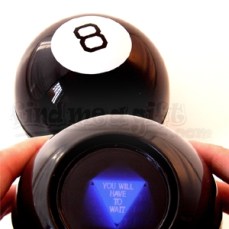
magic-8-ballThe main reason I resist is that none of us knows the future. That’s a fundamental truth. It isn’t that I don’t want to be healthy and cured—of course I do! But it feels like tempting fate to declare certainty in relation to a particular outcome; I don’t and can’t make predictions. I can only know the present.
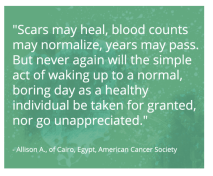
And the present is complex and, frankly, not always a big shining ball of positivity. And that’s okay. Sometimes the insistence on “staying positive” feels less like encouragement than a denial of reality. I am thrilled beyond measure that the chemo shrank the mass. And: the bottoms of my feet are still numb with neuropathy, my joints still ache, and I still wear out way too fast to accomplish much of anything. As Buddhist nun Pema Chödrön writes in When Things Fall Apart, suffering is part of life. “Rather than letting our negativity get the better of us, we could acknowledge that right now we feel like a piece of shit and not be squeamish about taking a good look. That’s the compassionate thing to do. That’s the brave thing to do,” she explains. “We can drop the fundamental hope that there is a better ‘me’ who will one day emerge. We can’t just jump over ourselves as if we were not there” (40).

Absolute declarations that I will be cured stake my happiness on a potential event I can’t actually control. We’re so used to privileging “hope” as a good that it’s a bit of a mind-bender to consider a different perspective. But Chödrön points out that focusing on hope casts us into the future and the stories we tell ourselves about it, robbing us, ultimately, of the present moment (40). And since hope and fear go hand in hand, to live driven by hope is also to live with fear (in this case, of recurrence) hovering just underneath the surface. It seems healthier to stay focused on the here and now.

~~~

I do believe language has profound power to shape our experience, that mantras and affirmations can make a real difference. It’s been a challenge to find positive, empowering language beyond battle metaphors and absolutes, but here are some of the phrases I’ve been able to embrace:

This is survivable.

My body can heal.

I will be okay. I am going to be okay.

From a meditation CD a friend sent:

Thank you for teaching me to stop and listen. Thank you for reminding me what is truly important. You can go now. I know I have things to do, gifts to give, purposes to accomplish, and I require a healthy, working body for this.

And perhaps my favorite, from another (salty) survivor:

All I have to do is outlive the f-ing cancer.

~~~

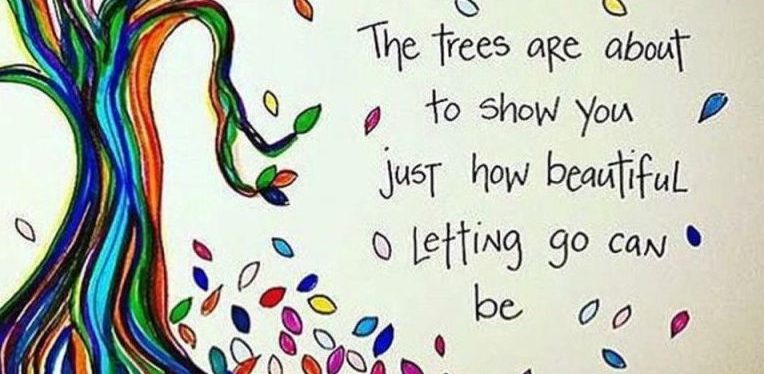
mtnstar_wordsofencouragementIf this is my life (and it is) and if my life (like all our lives) is finite, and if I don’t know its deadline (and none of us does), then how do I want to spend it? Waiting and wishing for a different kind of life, a different kind of day, a “better” one in some projected future? Or do I find a way to accept where I am in the present, since that’s all any of us really knows or has?
At the end of the film Embrace, filmmaker Taryn Brumfitt offers this advice to her daughter: Focus on what your body can do, feel, accomplish, contribute. Don’t waste a minute being at war with your body. Embrace it.

Now we’re talking. Do it today.

On Strength

So many people have told me how strong I am. I do not always feel strong.

What does it mean to be strong? My parents recently traveled to Scotland and discovered that our family name is connected to the MacLeod clan, whose motto is “Hold Fast.” That seems, at least at first, a reasonable way of thinking about strength: holding fast, holding tight, holding on. When people ask me how I am doing, I often find myself resorting to a more casual expression of the same idea: “hanging in.” “Strength,” for most I think, tends to call up ideas of persistence, toughness, control, perseverance.

But I have felt strongest, and most at peace, in moments of letting go.

img_7916

Not long after my initial diagnosis, when I was really reeling, a former student of mine, Carrie, sent me some wise, encouraging words. She wrote, “You’re one of the strongest people I have ever met. Strength doesn’t mean you can’t be mad, that you won’t cry, and that you won’t break down. All of those are forms of strength.” They don’t sound that way, at first. They sound like losing it. But in reality control was never mine to lose. And each of these responses is a form of letting go.

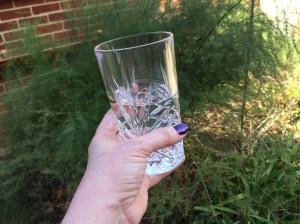
In the past few months, I’ve seen several videos titled something along the lines of “How Heavy is Your Glass of Water?” circulating around Facebook. My preferred version, by Knowable Studio, is “Remember to put your glass down.” The message in each is the same: a psychologist, speaking to an audience about stress, holds up a glass of water and asks how heavy it is. She goes on to make the point that its absolute weight is irrelevant. The longer one holds it, the heavier it feels, the harder it becomes to function. The same is true with stress and suffering in our lives. The lesson: remember to put the glass down.

img_9990

So I have found my own ritual way of setting the glass down, a physical as well as mental process. I prefer to find a place outside and sit or kneel on the ground, hands open to the sky, my heart lifted, my eyes closed. Then I have a short conversation with the universe.

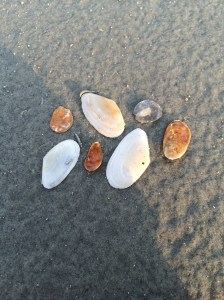
The first time I engaged in this ritual was almost accidental. It was our first evening on Folly Beach, when we were still waiting on some significant test results. I went for a sunset walk on the beach, collecting several Tellin clams and jingle shells along the way. Stopping to watch the light change as the sun dropping behind me reflected off and outlined a bank of clouds gathered over the ocean, I sank to the sand, facing the horizon, and spread my treasures on the beach before me. I told the universe and its various representatives that I needed to give this weight to them: Universe, God, Goddess, Jesus, Buddha, all that is that is greater than my knowledge and understanding, all that is that is Love in this world, I need to give this to you, because I cannot carry it. It is too much for me. I sat in silence for a few minutes, shed a few quiet tears, then rose and walked back up the beach, leaving my shell offering. I felt a distinct lightness, a sense of renewed peace.

img_7899

I’ve repeated a similar ritual since. Once is not enough; it’s too easy to begin grasping and gripping and holding on tight. Letting go requires practice. Letting go is scary, largely because it does mean giving up the illusion of control.

Sometimes I fear letting go, because I’m afraid it sounds, or feels, like giving up. Accepting I cannot control all that comes, saying I’ll embrace whatever happens, whether it’s what I want to happen or not, feels a little like giving the universe permission to do its worst. Maybe if I just hold on and worry over all the details and possibilities, a little voice in my head says, it will better prepare me, even prevent a bad outcome. Of course, that’s balderdash. Letting go does not mean surrendering my desire for health or long life. It’s simply an acknowledgment that I can hold on as tightly as I want to a desired outcome, but there are no guarantees. And there is power, peace, and strength in accepting that truth.

I remind myself of this fact as we anticipate the next appointments, the next pieces in the process: first, follow-up imaging, post-chemotherapy, to see how much the treatment shrank the cancer, and then my surgery consultation. I confess I’m bracing myself; thus far, outside the “no metastasis” declaration, the news has always been worse than we’d hoped: you want them to say the lump is benign, but it’s cancer; you want them to say it’s Stage 1, but it’s Stage 3. It’s strange, how you can find ways to keep shifting the barometer of what you can accept: I can deal with X as long as not Y, Y as long as not Z. The internal bargaining is exhausting and doesn’t accomplish much. I know I’ll fare better if I can let go of my ideas about what should be and meet myself and the world where we are.

img_9955

Perhaps I’ve been driven to seek my strength, the solace of letting go, outside on the sand, or under the trees, by the same impulse poet Wendell Berry renders so beautifully in “The Peace of Wild Things”:

When despair for the world grows in me
and I wake in the night at the least sound
in fear of what my life and my children’s lives may be,
I go and lie down where the wood drake
rests in his beauty on the water, and the great heron feeds.
I come into the peace of wild things
who do not tax their lives with forethought
of grief. I come into the presence of still water.
And I feel above me the day-blind stars
waiting with their light. For a time
I rest in the grace of the world, and am free.

img_7910

That evening on Folly Island, as I made my way back to our beach house, I paused to sit again on one of the large jetty boulders closest to our rental. When I looked down, a single olive shell rested in a cup of the rock at my feet. I reached down to pick it up, recalling that the very first time I’d told my now-husband Steve I loved him, I’d done so on a trip to the beach, by placing an olive shell I’d found on his pillow.

Was this new olive shell a message? A portent? I don’t know. I hold on to it as reminder to keep letting go. It tells me the peace of wild things is with me, and that is enough.