


Hello, friends. It’s been a while. 🙂
 I’m glad to say my hiatus is mostly a result of lots of good things going on, combined with an awareness that I still need to apportion my energy. My June reconstructive surgery went well; I’m overjoyed to have soft-ish implants in place of those bricks they call tissue expanders. My hubby Steve and I had a nice beach week at Emerald Isle, and I returned to work at the beginning of August, where my colleagues have been welcoming and supportive. There’ve been some hard things, too. We lost our sweet dog Imoh suddenly and unexpectedly to kidney failure in July. I have one more minor surgery to go yet, chemo brain is real, and I still have to do some combination of physical therapy, yoga, and/or self-massage daily to address range-of-motion limitations and prevent lymphedema.
That last is the other reason I’ve been writing less: now that I’m back at the office, spending a lot of work hours at the computer, my neck and shoulder lock up within a few hours. I have to ration my desk time, a frustrating scenario for a writer. I like to think my tales here do some good, that they offer a kind of window into a world that too many of us have (or will have) a need to understand. And I fear that because I stopped posting, I may have reinforced the idea that the cancer story ends when treatment is done and the rogue cells are vanquished. I (along with every other survivor) probably wish more fervently than anyone that that were true. I would love to “get back to normal.” But I’m still trying to figure out what “normal” looks like.
 Consider: at the last check-up with my medical oncologist, I teared up talking about some trifling symptom—a headache, a knee that kept popping—that had worried me briefly. He nodded, and said “After what you’ve been through, for a while, everything that happens to and with your body, you’ll think— ‘It’s cancer.’ That’s normal.”
Process that for a minute. That’s normal.
It’s hard, then, to know what to say when you get an email that includes a genuine, well-intentioned “hope you’re feeling 100%.” It feels cranky and self-pitying to reply, “Well, actually, my doctors keep reminding me that it takes 18 to 24 months after the last major treatment or surgery to get back to baseline.” Or what to think when a colleague asks “How are you? Really, how are you?” and when you begin to answer honestly—you’re good, but still have another surgery ahead and some big decisions to make—she interrupts and says, “But you’re here, you’re good, you look great, you’re healthy.” More than once I’ve felt chastised, like I’m supposed to be so grateful to be alive and cancer-free, I’m not allowed to have any other feelings about the losses I’ve endured. Or if I do, I’m not supposed to talk about them.
 The messy truth is that oftentimes people don’t really want to know the messy truth.
I think these kinds of responses are motivated by the same basic impulse: people want a happily ever after story. They want it for the person who’s been ill, because they sincerely care about that person and wish them health and happiness. But they also want it for themselves, because it’s reassuring. If my mortality no longer seems to be under immediate threat, they aren’t reminded of their own when they see me. None of us has to think about just how close we stand, every day, to the brink.
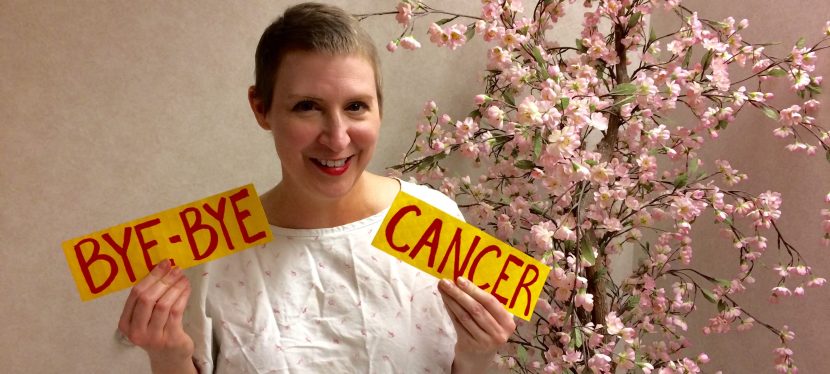
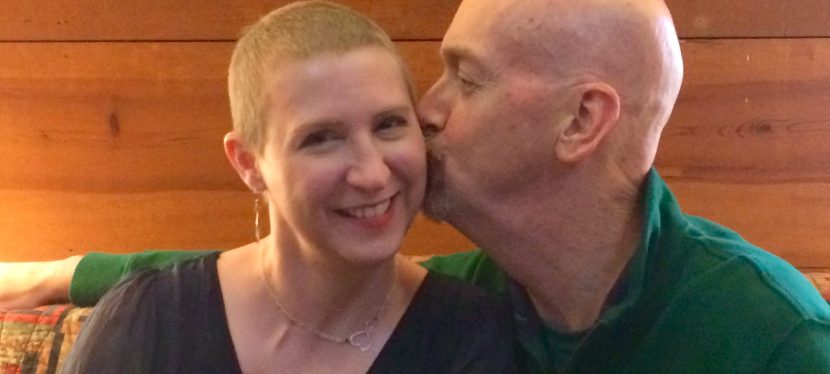
Maybe that’s why my still-short hair confuses and unsettles people. After chemo finished last October, my hair began to grow back by late December, but remained somewhere just shy of peach fuzz until February. As it filled in, people commented, “Your hair’s really coming back!” My returning hair was seen as a proxy for restored health. When I finally had enough for a haircut, I opted to keep it pixie short. With my range of motion issues, and more surgery on the horizon, spending half an hour with my arms lifted above my head every day to style it would be painful if not impossible. It was much easier to manage it short. Besides, I thought it looked kinda cute.
 But friends and colleagues, especially those I haven’t seen in a while, continue to comment on my hair growth, often with puzzlement or concern. Most know that treatment ended some months ago. There’s an unspoken question under their words: if everything’s okay, shouldn’t I have more hair by now?
I’ve come to wonder if there’s yet another reason I’ve kept my pixie. Since I don’t, nor do I want to, go around flashing my scars, it’s the primary way I have to telegraph to people that things have changed for me, permanently. That I am still processing through this experience physically, mentally, and emotionally, and I will be for a while. That there really isn’t any “getting back” to normal; “normal” is different than before, something I’m still negotiating, still learning to navigate.
I didn’t plan it that way, but I recognize now that my pixie cut is a kind of signifier. Maybe for myself, as much as anyone. It’s a reminder to be kind and gentle, with myself, and others. It’s a cue to take care of myself, to be patient with this long and often circuitous healing process.
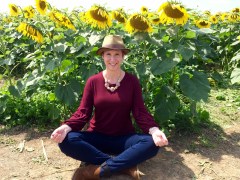
 Last year around this time, Steve, my father and I visited the first annual Sunflower Festival at Beaver Dam Farm in nearby Fincastle. It was a chemo weekend, but usually after a Friday infusion I’d have a reasonably good Saturday afternoon before the side-effects would hit hard. Sunflowers make me happy, and we had a good, but short, visit. This year Steve and I returned, and though the flowers themselves were a bit droopy due to lack of rain, it was sheer joy to stroll leisurely through the fields of their sunny faces, goofing around, sharing ice cream. Steve and I will celebrate our second wedding anniversary in a few days. For our first anniversary, we squeezed a trip back to the site of our honeymoon in between chemo treatments. I’ll happily supplant a fancier celebration with this year’s simple dinner at a local restaurant, accompanied by cancer-free body and the relative sense of peace in my heart.
I suspect that, eventually, I’ll grow my hair out, and take its color back again to the blond of my youth. But for now, if my pixie prompts me to spend less time in front of a mirror, and more time drinking in the wonders of this too-fragile world, it’s more than enough hair for me.
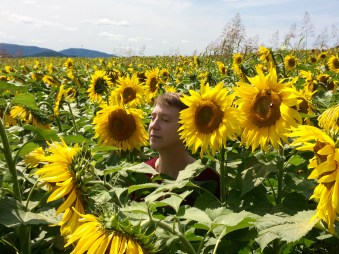
Photos taken at the second annual Sunflower Festival at Beaver Dam Farm, Fincastle, Virginia.
 On October 31st, 2016, then-President Barack Obama made a Presidential Proclamation declaring November “National Family Caregivers Month,” honoring “those who give of themselves to be there for their family, friends, and neighbors in challenging times.” At the time, I missed the announcement, still in a pretty pronounced post-chemo fog of pain and fatigue. And I was especially distracted that week: on November 1st, I was scheduled for a post-chemo mammogram and ultrasound, followed by an appointment with my oncologic surgeon to review the results of the scans, which would tell us whether or not chemo had been effective. November 1st was also hubby Steve’s birthday. When we’d met with the oncologic surgeon pre-chemo to talk scans, the news had been tough, so we’d held off scheduling any birthday festivities for the evening, just in case.

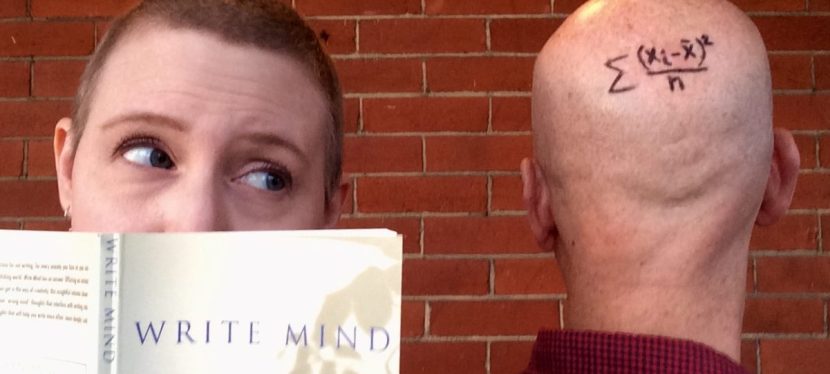

 The process of bilateral breast reconstruction has a tendency to highlight other asymmetries. The first thing my reconstructive surgeon said to me when he looked at my pre-surgery chest was that my left rib cage sat a little more forward, was a tiny bit more prominent, than my right. I’d never noticed this particular (minor) anomaly, but it’s apparently just as common for there to be asymmetry in the rib cage as in the face. The difference in my bone structure became most noticeable immediately after surgery and during my early tissue expander fills; for a while the right expander lagged behind the left, making me look lopsided. I also discovered I have a pocket of fat on my right upper back, unmatched on the left, which appeared only when I didn’t have breasts to pull the skin forward and keep it flattened out.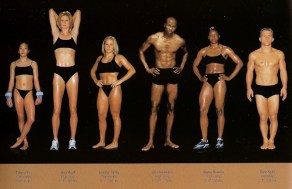
 I’ve often felt lucky to be in the body I am. Aside from some cranky tonsils, a couple bouts of pneumonia, and one broken bone, I’ve been hale and hearty most of my forty-seven years, and I’ve managed to stay active and maintain a healthy, if not altogether svelte, weight into my middle age without Herculean effort. Excepting the sixth grade, when my legs had a sudden growth spurt separate from the rest of my body that briefly turned me into a sort of hybrid stork-human, my parts are mostly proportional, and my face, while perhaps not symmetrical enough for Hollywood’s standards, is reasonably attractive.
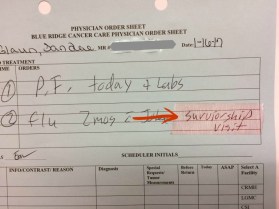 I’m just vain enough to feel relieved that the obvious asymmetries that appeared in my chest and back are slowly evening out as reconstruction progresses. But I’m far more reassured by a different realization. As I walked into the dining room Tuesday night, preparing to sit down to dinner with my hubby, it suddenly occurred to me: I no longer have cancer. Granted, my treatment isn’t quite done–follow-up radiation is the standard-of-care for triple negative diagnoses, even with a complete response to chemo, and reconstruction will take a while longer. But the chemotherapy worked; the surgery confirmed it. No more need I say, I have cancer. Now I can say, I had cancer.





 There’s an article that’s made its way around the internet about the
 I’m looking forward to experiencing that revelation again, whenever it finally arrives. I know it might be a while. Until then, I try to remember what my friend Sarah said when I shared my frustrations with her about my lack of productivity, my inability to do all the things I need and want to do.
 Still Life, Beyond Cancer