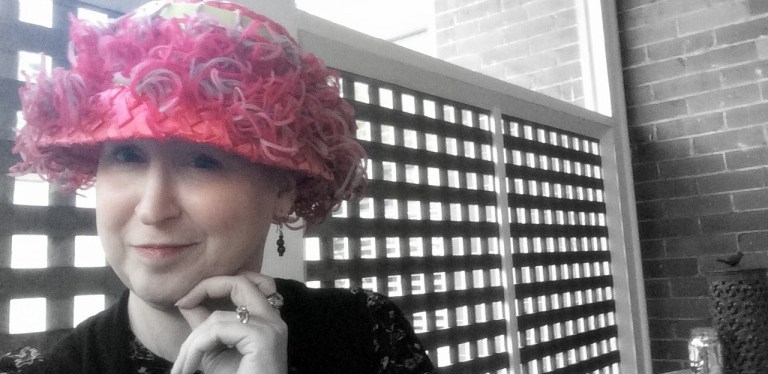
Be the Tea, Buy the Tee to Support Breast Cancer Research

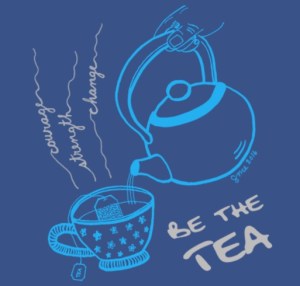
Be the Tea: A Parable about Adversity

I was inspired by the following story (many versions feature coffee, but I drink tea!) to create an original t-shirt design through the fundraising site Booster. Shirts are $15 and all profits ($5 per shirt) go directly to the Breast Cancer Research Foundation. Order by December 28th: https://www.booster.com/be-the-tea

A young woman is struggling through a difficult time in her life, and she seeks her mother’s advice. The mother leads her daughter to the kitchen, where she has placed three pots on the stove. After each has simmered a while, the mother asks her daughter to lift the lid of each of the pots, and tell her what she sees.

The daughter lifts each lid, one at a time, and then replies, “I see eggs, carrots, and a bag of tea leaves. Each is boiling in hot water.”

The mother nods, and asks her to look more closely. “What happens to an egg in boiling water?”

“It was fragile, but then it becomes hard,” the daughter replies.

“And what happens to carrots?” asks the mother.

“They begin hard, but in the water, they become soft and lose color,” replies the daughter.

“And what about the tea leaves?” asks the mother.

“The tea leaves turn the boiling water into tea,” replies the daughter.

“Yes,” says the mother. “Remember that. When in boiling water, the egg grows hard, and the carrots grow soft. But the tea? The tea changes the water it is in. When you find yourself in hot water, when you face challenges and adversity, strive to be the tea.”

betheteadesign

As I face surgery at the beginning of next week, I have needed to remind myself of this tale, and its lesson, again and again: instead of letting difficult circumstances harden what is fragile, or weaken what is strong, use them to transform not only yourself but the world around you for the better.

Healing from cancer is a long and arduous journey. I hope you will consider supporting breast cancer research efforts by purchasing a “Be the Tea” t-shirt designed by yours truly between now and December 28th: https://www.booster.com/be-the-tea.

Thank you!

Heads Up! #6: Vintage Sparkle

sandee-39

I celebrated a birthday at the beginning of this week. I think I can safely refer to myself as being in my “mid-forties” for one more year. The next time candles grace a cake for me, however, I’ll have shifted firmly to the “late-forties” category.

That’s okay. More than okay, actually. Being a breast cancer patient has given me a whole new perspective on aging. Growing older–having the chance to grow older–sounds pretty darn good. Aging has its challenges to be sure; even before I was ill, it had started taking me longer to recover from strenuous hikes, or late nights with friends, than it did ten or even five years ago. But given the various losses of mobility, energy, and dignity I’ve recently endured–and survived–I know I can cope with growing old. (And in the meantime, I better understand why old-timers sometimes feel cranky.)

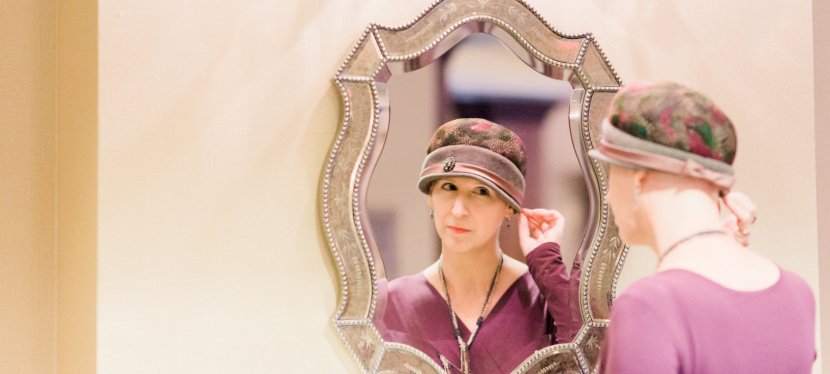
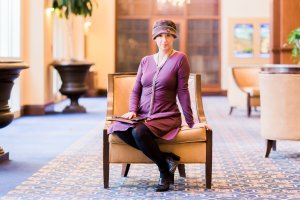
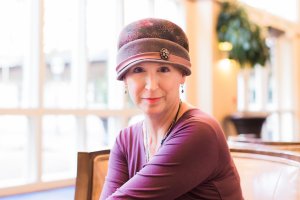
Though I suppose any vintage hat that has retained attitude and elegance could serve to underscore the merits of aging, I thought this one especially apt: a gray felt cloche topped by a feather detail. It appears sedate at first, but a closer look at the crown reveals a colorful medley of pink, green, and black-and-white feathers underneath fine netting. The gray brim of the hat is ringed by a satin ribbon that might, in its youth, have been bright pink, but has since faded to a lovely mauve. A round rhinestone accent, though darkened a bit by time, adds sass and sparkle.sandee-55

The hat is tagged as an “Evelyn Varon Exclusive.” According to Brenda Grantland in a comment on the Collectors Weekly website, Varon was a “French milliner whose designs were so popular that they were copied in the U.S.  A March 11, 1914 issue of the Evening Post Page of Wanamaker News reports that the store was offering copies of hats designed by Parisian milliners Suzanne Talbot, Evelyn Varon, Jeanne Duc, Caroline Reboux and Paul Poiret.” Grantland also claims that Varon designed costumes for the original Broadway version of Pins and Needles, but I haven’t been able to verify that claim.

In any case, it’s fun to embrace a little touch of 1914 Paris right here in 2016 Virginia. Ooh la la!

Heads Up!

All photographs by Laura Wade Photography.


∼ Beautiful, quirky vintage hats make me happy. The “Heads Up!” series is a reminder to keep my (currently bald) head up, to pay attention to the good in the world, and to encourage myself and others facing a tough road that it’s possible to find the fun in even the most challenging circumstances. ∼

Words to Live By: Cheryl Strayed’s Tiny Beautiful Things

Last weekend Steve and I took a trip to New York City to see Cheryl Strayed’s Tiny Beautiful Things, adapted for the stage by Nia Vardalos (writer/star of My Big Fat Greek Wedding) and directed by Thomas Kail (director, Hamilton). The moment I saw the announcement, which was months before my diagnosis, that Strayed’s book would be adapted into a play and would run at the Public Theater in November and December, I told Steve that seeing it was what I wanted for my birthday. Because, to adopt my nephew Daniel’s language, “Tiny Beautiful Things changed my life.”

Strayed is best known for her memoir Wild, a number one New York Times bestseller, which recounts Strayed’s hike along the Pacific Crest Trail, a journey that helps her come to terms with her mother’s death. Tiny Beautiful Things came out in book form after Wild, but most of its contents had appeared previously on TheRumpus.net, for which Strayed anonymously penned the “Dear Sugar” advice column after taking it over from originator Steve Almond at his request.

TBT1The book is subtitled “Advice on love and life from Dear Sugar,” but to label Tiny Beautiful Things as merely a collection of advice columns does not do justice to its beauty or wisdom. Strayed turns the conventions of advice columns upside down and taps into her own memories and experiences in her responses, doing “something brilliantly counter-intuitive,” as noted by the  Public’s Artistic Director Oskar Eustis,” using self-revealing stories of her own life for generous purposes.” Strayed’s luminous and powerful responses to what are often heart-wrenching letters are some of the most lucid, honest, moving essays I have ever read.

I first encountered Strayed’s book shortly after it came out, in 2012. At the time I was struggling to make sense of my romantic life, which seemed to have stalled out in an on-again, off-again relationship that, deep down, I knew wasn’t going anywhere. As I read, especially her responses to the lovelorn, I underlined passages that spoke to me—sometimes because they comforted, but more often than not, because they pierced me with uncomfortable truths. A few months later I gifted the book to my sometime-fellow, and the same truths resonated with him. Inspired, at least in part, by Strayed’s words, we broke up, and stayed that way. Free to open my heart fully for the first time in several years, I soon met and fell in love with the man who is now my husband.

I wasn’t kidding when I said the book changed my life.

tbtplaybillMy heart buoys and breaks over different matters these days, but Strayed’s words still speak to me. Gauging by the shared laughter and the unmistakable sounds of whole-audience-weeping in the theatre, they speak to many. (When the lights came up, Steve turned to me, both of us still wiping our eyes, and he said, “You didn’t warn me!”) It was a powerful performance.

Seeing Strayed’s words brought to life on stage sent me back to the book. I find myself drawn to passages on managing suffering and finding healing. For example, in a response to a young woman mourning a miscarriage, she writes the following about grief. Though she is talking specifically about the lost daughter, her words resonated with me, as I’ve recently felt “stuck” in my own emotional journey: “This is how you get unstuck, Stuck. You reach. Not so you can walk away…but so you can live the life that is yours—the one that includes the sad loss of your daughter, but is not arrested by it. … That place of true healing is a fierce place. It’s a giant place. It’s a place of monstrous beauty and endless dark and glimmering light. And you have to work really, really hard to get there, but you can do it.” (22)

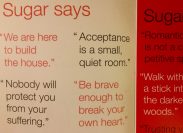
Later: “Nobody will protect you from your suffering. You can’t cry it away or eat it away or starve it away or walk it away or punch it away or even therapy it away. It’s just there, and you have to survive it. You have to endure it. You have to live through it and love it and move on and be better for it and run as far as you can in the direction of your best and happiest dreams across the bridge that was built by your own desire to heal.” (30)

DearSugar2And this, in response to a professor and class who asked Sugar’s advice to graduating college students: “Whatever happens to you belongs to you. Make it yours. Feed it to yourself even if it feels impossible to swallow. Let it nurture you, because it will.” (133)

Or this, recalling Strayed’s own response to an exchange with her estranged father: “I had that feeling you get—there is no word for this feeling—when you are simultaneously happy and sad and angry and grateful and accepting and appalled and every other possible emotion, all smashed together and amplified. Why is there no word for this feeling? Perhaps because the word is ‘healing’ and we don’t want to believe that. We want to believe healing is purer and more perfect, like a baby on its birthday. Like we’re holding it in our hands. Like we’ll be better people than we have before. Like we have to be. It is on that feeling I have survived. And it will be your salvation too, my dear.” (311)

Steve Almond says that Strayed practices “radical empathy.” If there’s anything the world could use more of these days, it’s radical empathy—for others, and for ourselves.

I have gifted Tiny Beautiful Things many times. It changed my life, and my nephew’s, too. Who knows? If you read it, it might also change yours.

Rest Up

I’m tired of resting.

Go ahead, roll your eyes. Think: some burden. Your privilege is killing me. Oh, the whining.

ImohResting
Imoh’s good at resting!

I get it. I’ve lived many years of my life when I would have been thrilled to have time, especially generous quantities of it, to rest. To slow down the semester, not bring work home every night. Not to have a sick cat, a visiting writer, and a traveling husband all fall in the same week. Not to berate myself for neglecting to phone family more often because I’m too exhausted at the end of the day to make one more call, even to someone I love.

I’ve written elsewhere about the need for more rest, more leisure in our lives. With rest comes reflection, and with reflection, innovation. Not to mention that rest is fundamental to good health and self-care. I don’t by any means mean to malign rest, and I am extremely grateful to have the privilege to rest when I need to, especially when I know so many, whether ill or healthy but simply tired, don’t.

It would be better stated to say I am tired of having to rest. Tired of having to parse out my days, knowing if I want to enjoy an evening with friends, I shouldn’t go to the grocery store in the afternoon. That if I have a doctor’s appointment, it might be the only outing I have energy for that day. I think maybe I didn’t really believe the doctors or other survivors when they told me how fatigued I’d be, and for how long. I used to compile errands, thinking, hey, while I’m out, I’ll stop at X and take care of Y, too. These days I’m mostly a one-stop shop, and sometimes even then I come home and nap.

spoons3There’s an article that’s made its way around the internet about the “spoon theory.” The writer, Christine Miserandino, has lupus, and recounts the day, over lunch, a friend of hers asked what it was like to live with the chronic condition. On impulse, Miserandino grabbed all the spoons from her own and several surrounding tables, handed them to her inquisitive friend, and an analogy was born. Though the spoon theory initially described life with chronic conditions, the theory also applies to those with long-term illnesses. The basic premise: a person with chronic or long-term illness has a limited number of “spoons” (energy) to use each day and has to decide how to “spend” them. Different activities use up different amounts of spoons; the person has to plan carefully, because once a day’s spoons are used up, that’s it. For example, one thing Miserandino points out is that simply getting showered and dressed requires a spoon or two. As I gain strength, making myself publicly presentable takes less of a toll, but I still sometimes leave a little time between getting ready and going out so I can rest up for a few minutes.

Hubby Steve and I just spent a lovely weekend in New York City, the first traveling I’ve done since July. We started slow each morning, sleeping in and heading out for brunch between 11 and noon. Both afternoons we visited small museums for about two hours, then returned to our hotel for a couple hours’ rest before going to a show in the evening. We had a fabulous time, but the difference in our itinerary from our first trip to the city two years ago, when highlights included an afternoon walking tour of chocolatiers and going for a run through Central Park, was marked.

coloringbook
Coloring has meditative effects.

Some of my anxiety about resting probably comes from guilt. Though I do find value in rest, there is a part of me that feels like I should be doing something, doing more. Some days I get in a few hours of writing, or organize a file drawer or two in my office. But some days I don’t have the physical energy or mental concentration for much of anything, even reading. When I was really sick from chemo early on, I binge-watched television shows, but I grew weary of that fast. As a child, I only watched TV during the day when I was home sick, so I associate daytime TV-watching with illness, and it makes me fidgety. Instead, I’ve turned to podcasts and coloring books. Both have their perks: I’ve laughed a lot through the podcasts (laughter is the best medicine), and coloring is quite meditative. Still, there’s this little part of my brain that says, “Coloring? Shouldn’t you be doing something more productive?”

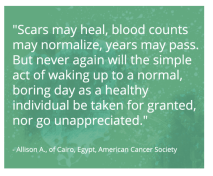
The first year I moved to Roanoke I contracted pneumonia in early January. When the doctor diagnosed me, he prescribed an antibiotic, then told me to come back for a check-up in six weeks. “Six weeks?” I asked, incredulous. Yes, he said, it would probably take that long to clear. I drug through each workday, went home and lay on the sofa until bedtime, then retired to my bed for the night, repeating the routine every day for weeks. One mid-March morning I woke up and realized, with surprise, “This is what it feels like to wake up feeling good!” I’d been sick and tired for so long, I’d almost forgotten what it felt like to be healthy. It was a revelation.

img_0361I’m looking forward to experiencing that revelation again, whenever it finally arrives. I know it might be a while. Until then, I try to remember what my friend Sarah said when I shared my frustrations with her about my lack of productivity, my inability to do all the things I need and want to do.

“You are doing something,” she said. “Something very important: you’re healing.”

And in the meantime, I have my headphones, and a plethora of colored pencils.

beauty in the broken: the backstory

Carilion Clinic, through which I am receiving my medical care, partnered this year with the National Arts Program to sponsor a Patient Art Show, an initiative of the Dr. Robert L.A. Keeley Healing Arts Program. Any patient receiving care through a Carilion provider was eligible to submit art work, which is currently on display in the lobby of Carilion Roanoke Memorial Hospital, through December 15th. All the works are available for viewing in a photo gallery on Facebook, where you can vote for the People’s Choice Award (shameless plug: if you’d like to vote for my piece, click here.)

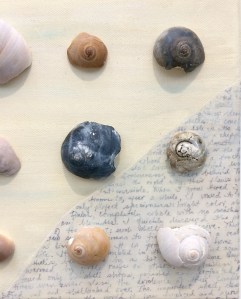
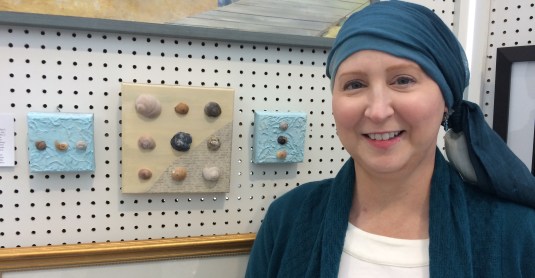
I submitted a mixed media triptych collage (acrylic on canvas, seashells, vellum, pen and ink) entitled “beauty in the broken.” I described my inspiration for this piece in a brief artist’s statement:

Shortly after I was diagnosed with breast cancer in June 2016, my husband and I visited Folly Beach. An avid sheller, I have long been drawn to the whorls of the moon snail, a shell made a symbol of women’s need for creative space by writer Anne Morrow Lindbergh. To keep the numbers of shells I brought home in check over the years, I usually collected only whole specimens. On this beach trip, facing chemotherapy and a bilateral mastectomy, suddenly the moon snail fragments reminded me of the curves and arcs of breasts. Even in their brokenness, especially in their variety, each was still beautiful. This mixed media collage attempts to honor the beauty in the broken.

I rather like the company the piece is keeping at the exhibit: a cheerful beach and a calming river.

There is a narrative incorporated into the collage itself. It cannot–intentionally–be read in its entirely on the artwork, reflecting the idea of fragmentation and imperfection. The narrative was excerpted and adapted from an essay I had written last year about collecting seashells:

When I first started shelling, I would often pick up blemished shells, the conch with a hole in the back, the slipper shell with a chipped, jagged edge. Sometimes the brilliant coloring or the graceful whorl exposed in a fractured shell looked too beautiful, even in its brokenness, to leave behind. Turned just the right way, the shell’s flaws were all but invisible. When I grew tired of the fragments, after a while, I vowed to collect only perfect specimens: bright color, shiny finish, completely whole with no marks or any blemishes. I quickly discovered the problem of the perfect: such shells were elusive. There were few such specimens to find.

A shell is a vestige of a living being. It is product of and home to a life; it has tumbled in the surf, cracked against other shells, been baked by a hot sun on some days, warmed by gentle rays on others. The flawless are found only in shell shops, polished and perfected, sometimes even under glass, the evidence of their complex lives buffed out and shellacked over. The imperfect shell, whole but marked by the world it has engaged and survived, is the real find. Maybe you can only see the real find after you understand what it is you’re truly looking for. Maybe the beauty in the broken only emerges once we recognize that same beauty in ourselves.

img_0144

Two quotations wrap the edges of the two small blue panels. The first, from Anne Morrow Lindbergh’s essay on the moon snail, reads “Only when one is connected to one’s own core is one connected to others.” The second is from E. M. Forster: “We must be willing to let go of the life we have planned, so as to have the life that is waiting for us.” I’ve found both of those ideas fundamental to healing and happiness.

Creating this piece was very meaningful to me. And while the timing of this post is purely coincidental, I know that many people are struggling this week with the sense that much in our world is broken, fragmented, divided. May we find our way to recognizing and owning our flaws, valuing our differences, and treating one another with respect.

One more shameless plug: if you’d like to vote for my piece for the People’s Choice Award, please “Like” it in the Patient Show Art Gallery: beauty in the broken. Please do visit the gallery, and feel free to share the link—there are many beautiful works in the exhibit, and many are available for purchase. Part of the proceeds benefit the Keeley Healing Arts Program. Thank you!


Heads Up! #5: Deep Purple

It’s a big day in the U.S. of A. today: after months (years) of wildly optimistic campaign promises, sometimes baffling debates, and too many social media meltdowns, the presidential election is finally here.

A big day deserves a bold hat!

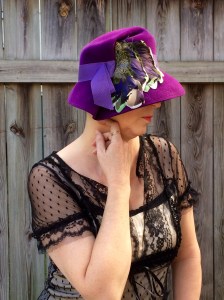
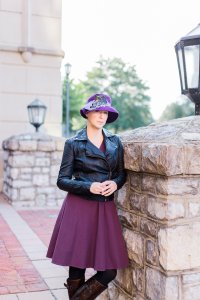
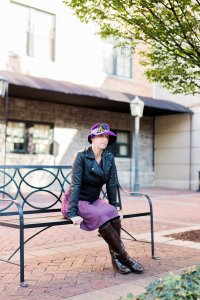
This purple velvet beauty, trimmed in a sweep of iridescent blue, green, and white feathers (peacock, perhaps?) and a wide purple grosgrain ribbon, makes me think of the femme fatale in a 1940s film noir. The brim is low and wide, dipping below the eye on one side, giving it a bit of mystery and drama.

I find it pairs well with black and a bit of attitude.

Still, its bright hue and asymmetrical fold keep it from getting too serious.

Maybe we should keep that kind of balance in mind when we’re talking politics?

The hat was made by “Wesco.” There have been at least three different U.S. companies who sported that name, though it was not clear which of them were in the millinery trade. There are a number of other vintage hats on Etsy and eBay advertised as “Wesco” chapeaux, but no one notes any additional details.

It is a hat, then, with more mystery than history. On a day that’s making history for other reasons—the first time we have the opportunity to vote for a woman as a major party candidate for president—perhaps that’s just as it should be.

Heads Up!

All photos in gallery 1 by Margaret McGlaun.

Header photo and all photos in gallery 2 by Laura Wade Photography.


∼ Beautiful, quirky vintage hats make me happy. The “Heads Up!” series is a reminder to keep my (currently bald) head up, to pay attention to the good in the world, and to encourage myself and others facing a tough road that it’s possible to find the fun in even the most challenging circumstances. ∼

What We Talk About When We Talk About Cancer

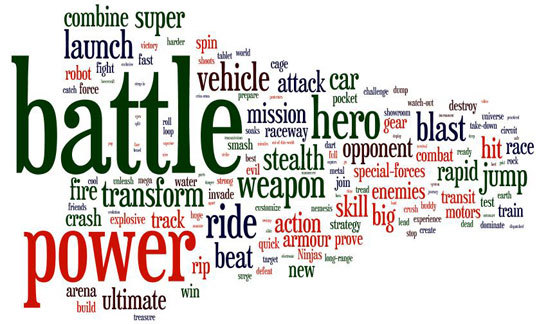
The phrases are familiar: “Fight like a girl!” “We can beat this disease.” “Warriors in pink!” When we talk about cancer, the language of battle is so commonly invoked that you almost don’t register the underlying metaphor unless someone points it out. I have myself, more than once, referred to “kicking cancer’s butt,” and that’s felt reasonably accurate as a description of my attitude. Those rogue cells really aren’t welcome to keep hanging out in my body. In fact, I’m very happy to report that, according to a recent mammogram and ultrasound, they’ve been all but banished, the cancer shrunken to nothing or near it. Woot!

753_breast-cancer-fight-like-a-girlStill, as surgery looms on the horizon, I’ve grown more aware of how the language of aggression, while ostensibly empowering, also pits one against one’s own body in some curious and distressing ways. My sister-in-law Lisa, a survivor, mentioned her discomfort with this language shortly after I was diagnosed. Susan Sontag, in a 1978 essay entitled “Illness as Metaphor,” describes the dilemma: “The controlling metaphors in descriptions of cancer are, in fact, drawn…from the language of warfare; every physician and every attentive patient is familiar with, if perhaps inured to, this military terminology. Thus, cancer cells do not simply multiply; they are ‘invasive’” (714). The language surrounding treatment has a similar inflection: chemotherapy is “chemical warfare, using poisons” that aim to “kill” (715).

The “military metaphor in medicine” extends back to the 1880s in reference to bacteria, but as Sontag points out, “talk of siege and war to describe disease now has, with cancer, a striking literalness and authority. Not only is the clinical course of the disease and its medical treatment thus described, but the disease itself is conceived as the enemy on which society wages war” (716). The catch is that both attack and counterattack aren’t “out there” somewhere; they take place within us.

Breast Cancer Cells
Breast Cancer Cells

After watching the powerful documentary Embrace earlier this week, a film that asks hard questions about why so many women hate their bodies, I was reminded that most of us don’t require a cancer diagnosis to declare war on all or part of ourselves. It’s made me think about the power of the language we use to describe our relationship to this illness, how it affects my ability to make peace with the changes coming to my body. Cancer cells threaten my health, and I want them gone—but there’s no way to separate them entirely from myself, my body, my breast tissue, not without additional losses. Eliminating them has and will bring collateral damage. Suddenly casting those rogue cells as the “enemy” seems more complicated.

~~~

Personally, I’ve also struggled with the language of certainty that frequently emerges in conversations about cancer. While I know people’s intentions are to be supportive, bold declarations like “I know you will beat this” make me uncomfortable, as much or more because of the absolute underneath the “I know you will” as the aggression underscoring “beat.” Positive thinking is a powerful tool for healing, but I’ve found myself unwilling to make such absolute claims.

magic-8-ballThe main reason I resist is that none of us knows the future. That’s a fundamental truth. It isn’t that I don’t want to be healthy and cured—of course I do! But it feels like tempting fate to declare certainty in relation to a particular outcome; I don’t and can’t make predictions. I can only know the present.

And the present is complex and, frankly, not always a big shining ball of positivity. And that’s okay. Sometimes the insistence on “staying positive” feels less like encouragement than a denial of reality. I am thrilled beyond measure that the chemo shrank the mass. And: the bottoms of my feet are still numb with neuropathy, my joints still ache, and I still wear out way too fast to accomplish much of anything. As Buddhist nun Pema Chödrön writes in When Things Fall Apart, suffering is part of life. “Rather than letting our negativity get the better of us, we could acknowledge that right now we feel like a piece of shit and not be squeamish about taking a good look. That’s the compassionate thing to do. That’s the brave thing to do,” she explains. “We can drop the fundamental hope that there is a better ‘me’ who will one day emerge. We can’t just jump over ourselves as if we were not there” (40).

Absolute declarations that I will be cured stake my happiness on a potential event I can’t actually control. We’re so used to privileging “hope” as a good that it’s a bit of a mind-bender to consider a different perspective. But Chödrön points out that focusing on hope casts us into the future and the stories we tell ourselves about it, robbing us, ultimately, of the present moment (40). And since hope and fear go hand in hand, to live driven by hope is also to live with fear (in this case, of recurrence) hovering just underneath the surface. It seems healthier to stay focused on the here and now.

~~~

I do believe language has profound power to shape our experience, that mantras and affirmations can make a real difference. It’s been a challenge to find positive, empowering language beyond battle metaphors and absolutes, but here are some of the phrases I’ve been able to embrace:

This is survivable.

My body can heal.

I will be okay. I am going to be okay.

From a meditation CD a friend sent:

Thank you for teaching me to stop and listen. Thank you for reminding me what is truly important. You can go now. I know I have things to do, gifts to give, purposes to accomplish, and I require a healthy, working body for this.

And perhaps my favorite, from another (salty) survivor:

All I have to do is outlive the f-ing cancer.

~~~

mtnstar_wordsofencouragementIf this is my life (and it is) and if my life (like all our lives) is finite, and if I don’t know its deadline (and none of us does), then how do I want to spend it? Waiting and wishing for a different kind of life, a different kind of day, a “better” one in some projected future? Or do I find a way to accept where I am in the present, since that’s all any of us really knows or has?

At the end of the film Embrace, filmmaker Taryn Brumfitt offers this advice to her daughter: Focus on what your body can do, feel, accomplish, contribute. Don’t waste a minute being at war with your body. Embrace it.

Now we’re talking. Do it today.

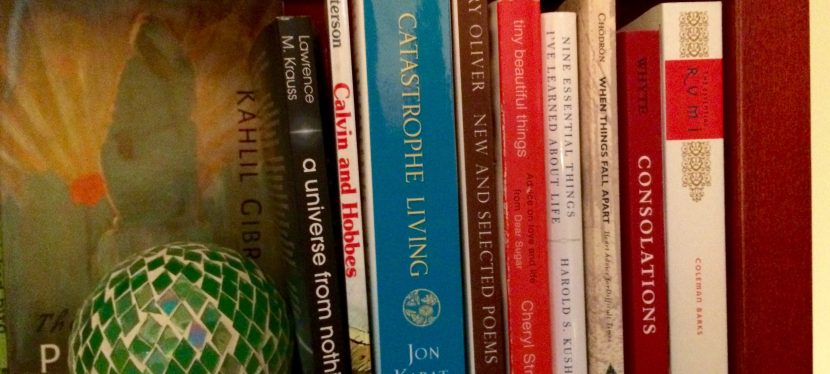
BCBC: Harold Kushner’s Nine Essential Things I’ve Learned About Life

Rabbi Harold Kushner is probably best known for his 1981 book When Bad Things Happen to Good People. In that text he describes his son Aaron’s journey through progeria, rapid-aging syndrome, and how that experience profoundly affected Kushner’s relationship to religion, God, and his congregants. Kushner has written a number of books since, and I happened upon this, his most recent, published in 2015, in a book catalog I received in the mail. Intrigued by the title, I was curious what essential life lessons he had to impart.

Kushner1Kushner’s work is embedded in the Jewish faith, though his lessons are broadly applicable, drawing equally upon everyday people’s stories as well as religious texts and history for illustration. I’m a spiritual seeker who does not identify solely or specifically with any single faith tradition at this point in my life, though I feel there is something larger and greater than individual human desires, and I tend to imagine the sacred, in the broadest terms, as the realization of the combined forces of love and compassion in the world. So much of Kushner’s understanding of who and what “God” is (and isn’t) resonates with me, given that one of his truths is “God is Not a Man Who Lives in the Sky.” He writes, “To me, God is like love, affecting all people but affecting each one differently, according to who he or she is. God is like courage, a single trait that manifests itself differently as it is filtered through the lives and souls of specific individuals” (29). Love and courage: both profoundly human and deeply sacred.

I also like what Kushner says about prayer, especially in relation to illness. As I noted in my previous post on strength and letting go, getting attached to or assuming that only one specific outcome is acceptable can be emotionally dangerous. Kushner, wisely I think, opines that it’s the doctor’s job to “make sick people healthy,” whereas it’s “God’s job is to make sick people brave” (29). He notes in more detail later, “God’s role is to give us the vision to know what we need to do, to bless us with the qualities of soul that we will need in order to do them ourselves, no matter how hard they may be, and to accompany us on that journey” (34). “God,” in that description, manifests as both internal traits like strength and fortitude, and external supports like friends and caregivers. That is a vision of God I understand.

While I enjoyed the book as a whole, the two lessons/chapters I connected with most, as someone in the throes of a health challenge, were “God Does Not Send the Problem; God Sends Us the Strength to Deal with the Problem,” and “Leave Room for Doubt and Anger in Your Religious Outlook.”  In the first, Kushner writes, “I find God not in the tests that life imposes on us but in the ability of ordinary people to rise to the challenge, to find within themselves qualities of soul, qualities of courage they did not know they had until the day they needed them” (43).  Again, he focuses on traits at once spiritual and humane, and our ability to access them through grit and grace.

Kushnercopy1In the later chapter on doubt and anger, Kushner explores another theme close to my heart, especially at this juncture in my life. I have always been a bit allergic to certainty, and he actively embraces the idea that we should raise questions, “admit our anger” when it arises, and affirm a “readiness to live with doubt.” To do otherwise means we’re avoiding truth and minimizing the complexity of any genuine relationship: “Accepting anger, ours and that of people close to us, has to be part of any honest relationship” (130), writes Kushner, and it’s only through acknowledging that the tough stuff is equally as valid as the good that we can love–that we can be fully present in any capacity, I would add–with our whole hearts.

Kushner’s claims that religion, ideally, should connect, rather than separate or divide, and that the best way to feel better about oneself is to find a way to help others, also ring true.

In short, there is much in this brief, readable volume (170 pages) to comfort and inspire. Happy reading!

On Strength

So many people have told me how strong I am. I do not always feel strong.

What does it mean to be strong? My parents recently traveled to Scotland and discovered that our family name is connected to the MacLeod clan, whose motto is “Hold Fast.” That seems, at least at first, a reasonable way of thinking about strength: holding fast, holding tight, holding on. When people ask me how I am doing, I often find myself resorting to a more casual expression of the same idea: “hanging in.” “Strength,” for most I think, tends to call up ideas of persistence, toughness, control, perseverance.

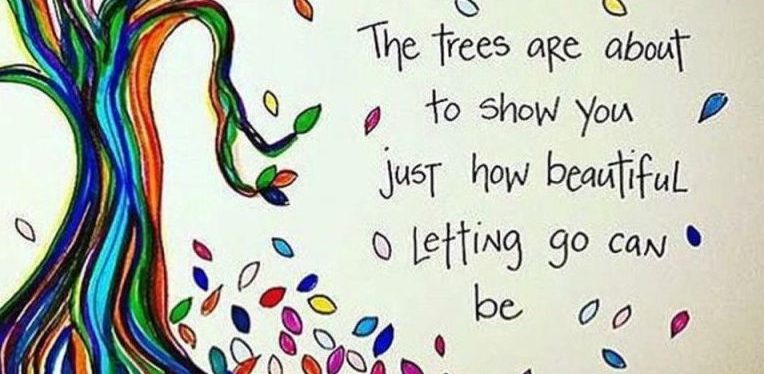
But I have felt strongest, and most at peace, in moments of letting go.
img_7916

Not long after my initial diagnosis, when I was really reeling, a former student of mine, Carrie, sent me some wise, encouraging words. She wrote, “You’re one of the strongest people I have ever met. Strength doesn’t mean you can’t be mad, that you won’t cry, and that you won’t break down. All of those are forms of strength.” They don’t sound that way, at first. They sound like losing it. But in reality control was never mine to lose. And each of these responses is a form of letting go.

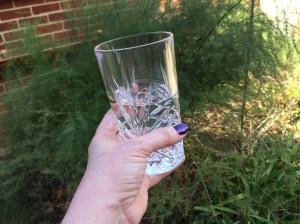
In the past few months, I’ve seen several videos titled something along the lines of “How Heavy is Your Glass of Water?” circulating around Facebook. My preferred version, by Knowable Studio, is “Remember to put your glass down.” The message in each is the same: a psychologist, speaking to an audience about stress, holds up a glass of water and asks how heavy it is. She goes on to make the point that its absolute weight is irrelevant. The longer one holds it, the heavier it feels, the harder it becomes to function. The same is true with stress and suffering in our lives. The lesson: remember to put the glass down.
img_9990

So I have found my own ritual way of setting the glass down, a physical as well as mental process. I prefer to find a place outside and sit or kneel on the ground, hands open to the sky, my heart lifted, my eyes closed. Then I have a short conversation with the universe.

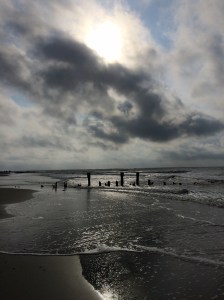
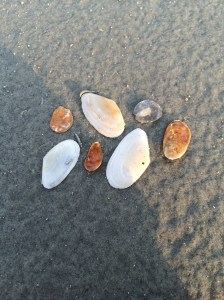
The first time I engaged in this ritual was almost accidental. It was our first evening on Folly Beach, when we were still waiting on some significant test results. I went for a sunset walk on the beach, collecting several Tellin clams and jingle shells along the way. Stopping to watch the light change as the sun dropping behind me reflected off and outlined a bank of clouds gathered over the ocean, I sank to the sand, facing the horizon, and spread my treasures on the beach before me. I told the universe and its various representatives that I needed to give this weight to them: Universe, God, Goddess, Jesus, Buddha, all that is that is greater than my knowledge and understanding, all that is that is Love in this world, I need to give this to you, because I cannot carry it. It is too much for me. I sat in silence for a few minutes, shed a few quiet tears, then rose and walked back up the beach, leaving my shell offering. I felt a distinct lightness, a sense of renewed peace.
img_7899

I’ve repeated a similar ritual since. Once is not enough; it’s too easy to begin grasping and gripping and holding on tight. Letting go requires practice. Letting go is scary, largely because it does mean giving up the illusion of control.

Sometimes I fear letting go, because I’m afraid it sounds, or feels, like giving up. Accepting I cannot control all that comes, saying I’ll embrace whatever happens, whether it’s what I want to happen or not, feels a little like giving the universe permission to do its worst. Maybe if I just hold on and worry over all the details and possibilities, a little voice in my head says, it will better prepare me, even prevent a bad outcome. Of course, that’s balderdash. Letting go does not mean surrendering my desire for health or long life. It’s simply an acknowledgment that I can hold on as tightly as I want to a desired outcome, but there are no guarantees. And there is power, peace, and strength in accepting that truth.

I remind myself of this fact as we anticipate the next appointments, the next pieces in the process: first, follow-up imaging, post-chemotherapy, to see how much the treatment shrank the cancer, and then my surgery consultation. I confess I’m bracing myself; thus far, outside the “no metastasis” declaration, the news has always been worse than we’d hoped: you want them to say the lump is benign, but it’s cancer; you want them to say it’s Stage 1, but it’s Stage 3. It’s strange, how you can find ways to keep shifting the barometer of what you can accept: I can deal with X as long as not Y, Y as long as not Z. The internal bargaining is exhausting and doesn’t accomplish much. I know I’ll fare better if I can let go of my ideas about what should be and meet myself and the world where we are.

img_9955

Perhaps I’ve been driven to seek my strength, the solace of letting go, outside on the sand, or under the trees, by the same impulse poet Wendell Berry renders so beautifully in “The Peace of Wild Things”:

When despair for the world grows in me
and I wake in the night at the least sound
in fear of what my life and my children’s lives may be,
I go and lie down where the wood drake
rests in his beauty on the water, and the great heron feeds.
I come into the peace of wild things
who do not tax their lives with forethought
of grief. I come into the presence of still water.
And I feel above me the day-blind stars
waiting with their light. For a time
I rest in the grace of the world, and am free.

img_7910

That evening on Folly Island, as I made my way back to our beach house, I paused to sit again on one of the large jetty boulders closest to our rental. When I looked down, a single olive shell rested in a cup of the rock at my feet. I reached down to pick it up, recalling that the very first time I’d told my now-husband Steve I loved him, I’d done so on a trip to the beach, by placing an olive shell I’d found on his pillow.

Was this new olive shell a message? A portent? I don’t know. I hold on to it as reminder to keep letting go. It tells me the peace of wild things is with me, and that is enough.

Thinking About Pink

October, as most are likely aware, is Breast Cancer Awareness Month. My husband Steve has been doing some traveling lately, and he’s sent back a few reports on the awareness efforts he’s encountered on the road. Yesterday all the flight attendants on his trip sported pink ribbons, and the in-flight magazine had a feature story. A couple of weeks ago, he dined at a restaurant that served up pink tortilla chips. Not that travel is required to see plenty of pink during October: I previously noted the Ulta ad that landed in my mailbox, and every time I turn on the television, I find a public service announcement for a tie or scarf I can purchase to help the cause.

think-pink-cafe-000-page-1Public support and awareness is a good thing, of course. Our local mall recently hosted a “Positively Pink Parade,” raising funds for the Every Woman’s Life program, which provides free mammograms to low-income, uninsured, and underinsured women in our area. Personally, I had the opportunity to attend a retreat for breast cancer survivors sponsored by our local breast care center. It was a powerful experience, both uplifting and draining, physically and emotionally. We interacted with other survivors, created healing art, asked questions of a panel of doctors. It was humbling and inspiring to hear the stories and witness the resilience of the women gathered there, several of whom referred to our shared experience as a kind of sisterhood.
Yet I find myself resisting the proliferation of pink, the idea that with my diagnosis I’ve joined a club of sorts, one that comes ready-made with a club symbol, theme color, purchasable bling, and annual rituals. Maybe all of it takes me uncomfortably back to my visit to the wedding book aisle as a forty-something first-time bride, when I felt like I’d been transported into Barbie- and baby-land, all pink and purple book covers and unrelentingly cutesy fonts. I mean, wedding planning is something grown women do, ideally, not tweens. Similarly, I find much of the imagery of Breast Cancer Awareness Month cloying and cutesifying, when not disturbingly sexualized. I’ve heard this phenomenon referred to as “pink-washing,” and while some women find solace there, many others experience the explosion of pretty tchotchkes and slogans like “Save the ta-tas” as more trivializing than empowering. At times the approach seems almost celebratory.

There’s nothing fun about having breast cancer. At this moment in my journey, I am faced with deciding whether to have only one or both of my breasts surgically removed. I am about to undergo genetic testing to find out if my ovaries might need to follow. There’s nothing cute about contemplating reconstruction options. There’s nothing sexy about the prospect of losing my nipples, all sensation in my breasts. There is not enough pink tulle on the planet to make any of this palatable or easy. I will not need souvenirs manufactured in China: the scars I will come to bear will be pink ribbon reminder enough.

porchtea3

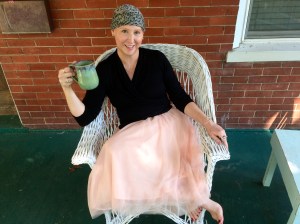
I like pink. I even own a pink tulle skirt—purchased long before my diagnosis. To me, it says “ballerina,” not “breast cancer.” The only statement it makes is a style statement, and I’d like to keep it that way.

This is not a club I would have chosen to join.

Given a choice, I’m guessing most people wouldn’t. (I think of Groucho Marx, who reputedly once sent a wire stating, “Please accept my resignation. I don’t care to belong to any club that will have me as a member.”) I’m not a joiner by nature, never have been, so some of my resistance no doubt stems thence. My husband Steve compared this process to graduate school. Deep bonds are forged there—often through some trial and misery—that remain for a lifetime, but once you graduate, you’re no longer a student, and you move on, leave that identity behind. I am a person who lives where I am. I don’t wax nostalgic about high school, or grad school, or my first job or home. I turn my attention to the people and places of this moment.

I expect my experience with cancer to be similar. For now, a significant part of my identity is “cancer patient,” but (god willing) that will not always be true. And I will, for the rest of my life (god willing), be a cancer survivor. But I am and will also be a writer, a teacher, a wife, an artist, a daughter, a friend. I will always be of a double mind about having had this disease. Cancer is teaching me important lessons about how to pay more attention to what really matters, how to let go of what doesn’t. But if I’m honest, given the option to go back and not have cancer, I can’t say I’d embrace it, even if it meant losing a lesson or two.

pinkparadeimage

Let me say again: public support and awareness are unequivocally good. If a pink parade ensures a woman gets the mammogram that saves her life, that parade is worth every ounce of its pink bling. If 5,000 people buy beaded bracelets at Ulta, and that money goes to ground-breaking research, those bracelets are worth their weight in gold.

Yet I wonder how successful these events are in terms of really educating people. How many people know that most women diagnosed with breast cancer do not have a family history? How many people know that there are a number of different types of breast cancer, and each has different treatment protocols? How many know that, even with those differences, surgery is still almost always the standard bearer? How many people understand that even once you are “cancer-free,” there is a waiting period, a wondering period, when recurrence is a concern, up to 3, 5, even 10 years? Research is advancing rapidly in many ways; doctors can target treatment so much more effectively than even five years ago. Yet the primary cures—mastectomy, chemotherapy, radiation—remain pretty darn toxic and brutal. When will that change?

Given the prominence of pink in October, I find it hard to imagine that people aren’t “aware” of breast cancer in a larger sense. It’s other cancers that often get short shrift. My husband is a testicular cancer survivor; a dear friend is a survivor of intestinal cancer; a Facebook friend from high school has just seen her daughter treated for brain cancer. These forms of cancer don’t get the press that breast cancer does, but they cause just as much pain and suffering. All cancers hurt. Maybe we can pull back a bit on the pink and invest in understanding causes and treatments that work while doing as little harm as possible.

cancersucks

So if the bling is not your thing, what can you do? From the front lines, here are my recommendations:

  • Ladies (gents, too, especially if you have a family cancer history), do your monthly self-exams. Get your mammogram. Ask if your facility has 3-D mammography. If you are informed (as, by law, you must be in many states) that you have “dense breast tissue,” ask your doctor what your rights are to a follow-up ultrasound, paid for by insurance. If you have a history of family cancer, you might want to ask about genetic testing and/or additional screening: those with established risk factors have access to more options.
  • Donate to research—and do your homework first. From my explorations thus far, I recommend Stand Up to Cancer, the American Cancer Society, and the Breast Cancer Research Foundation.
  • Alternately, focus on local initiatives and care centers, or directly support individual families and patients you know. A colleague of mine organized a Meal Train for us during chemotherapy, and it was an absolute godsend. A cozy blanket to cuddle under and Lifesavers to suck on during the saline wash while in the chemo chair will, I can attest, be deeply appreciated.

Cancer sucks. Let’s kick its butt together.