Here’s to the Husbands and Partners

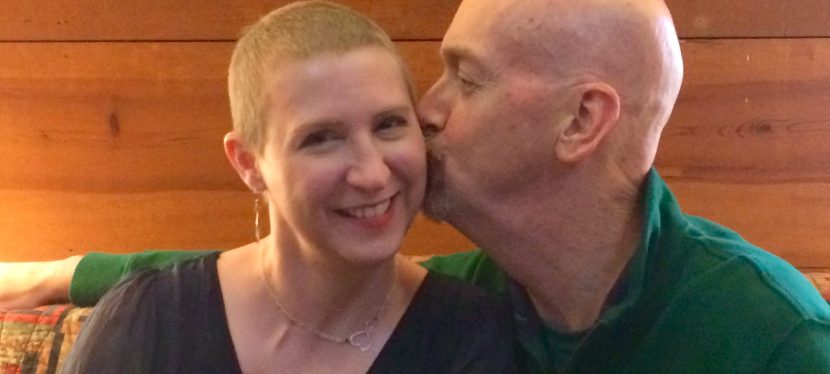
caregiverOn October 31st, 2016, then-President Barack Obama made a Presidential Proclamation declaring November “National Family Caregivers Month,” honoring “those who give of themselves to be there for their family, friends, and neighbors in challenging times.” At the time, I missed the announcement, still in a pretty pronounced post-chemo fog of pain and fatigue. And I was especially distracted that week: on November 1st, I was scheduled for a post-chemo mammogram and ultrasound, followed by an appointment with my oncologic surgeon to review the results of the scans, which would tell us whether or not chemo had been effective. November 1st was also hubby Steve’s birthday. When we’d met with the oncologic surgeon pre-chemo to talk scans, the news had been tough, so we’d held off scheduling any birthday festivities for the evening, just in case.

Though anxious, we were hopeful, and thankfully, the news was good. Still, I felt guilty, filling Steve’s birthday with yet another set of medical appointments. He’d been right by my side for most every single doctor’s visit or test since June, whether surgical consultation or CT scan or hours-long chemotherapy treatment. Going to the doctor isn’t much fun even when it’s your own body you’re trying to heal, and a sterile medical office with outdated magazines definitely does not scream “birthday party.”

My Sweetie Pi
My Sweetie Pi

In his proclamation, the former President lauded the “incredible generosity” of family caregivers, a description that itself seems almost not generous enough for the reality of spouses and partners of women with breast cancer. Along with accompanying me to appointments, Steve has driven me to offices and errands near and far, waited patiently, lent a second ear, helped me manage the information overload. He’s taken on the bulk of the household chores. He’s held me when I needed to cry; he makes jokes so I don’t forget to laugh. He’s encouraged me to take naps and go on walks, and he’s fetched my prescriptions and the occasional Coca-Cola Icee whenever I craved one. After surgery, when I was especially unsteady, I took over his bathroom because the shower there was easier to get in and out of. Meanwhile, he slept on a mattress on the bedroom floor for a month because I needed to keep the head of the bed elevated to prevent tangling my drains.

And speaking of drains, he gently, and diligently, stripped my JP drain tubes each morning and evening, without batting an eye, kneeling by the bedside, eye level with my bruised, scarred, and misshapen chest. Seeing my altered landscape must have been weird for him; I mean, it was, and is, weird for me. Yet Steve has never let on that he’s bothered by the changes in my body. (Okay, he admitted he was a little grossed out by the stringy chicken-fat-like gunk that occasionally showed up in my drains, but—so was I. Major yuck.)

I think it’s safe to say Steve has gone above and beyond. Seriously: this is a man who let me demonstrate the discomfort of my tissue expanders by allowing me to reach around his chest from behind, grab his pecs, and squeeze as hard as I could.

Maybe once you’ve made your vows and declared “for better or worse, in sickness and in health,” it’s just expected that you’ll be fully present for your partner in a medical crisis. But I don’t think a spouse’s ability to be a good caregiver is a given, and I don’t take my husband’s compassion or support for granted.

Obama opened his proclamation honoring family caregivers with the observation that “[o]ur nation was founded on the fundamental idea that we all do better when we look out for one another.” And so we do. So here’s to all the husbands and partners, who drive us to appointments and do all the dishes; who listen and lift up; who help us grow comfortable—physically and emotionally—with our changing bodies; who stand beside us through the tough times.

Artist & Scientist
Artist & Scientist

Steve recently marched by my side in our local Women’s March. He identifies as a socially liberal, fiscal conservative, while I am (I took a test) left of the Dalai Lama. He does support a majority of the March’s official platform, but we hold different enough views that when we discuss politics, we often find ourselves baffled and frustrated by the other’s perspective. Still, we listen, and we learn. We don’t expect we’ll come to consensus about every issue, and we don’t make consensus a precondition for civility or respect, and certainly not love. I knew, when we found each other, that what we’d found was rare. After traveling through cancerland together, I understand that truth even more deeply. And after watching the world in the past week, I understand, and value it, more deeply still.

Radiation begins on Monday. Steve still helps me into my coat every day. And until my range of motion improves enough for me to put it on by myself, I know he’ll be there, holding it open and sliding it over my shoulders, ensuring I stay warm and protected through the long winter’s chill.
Past Perfect: The Grammar of Healing

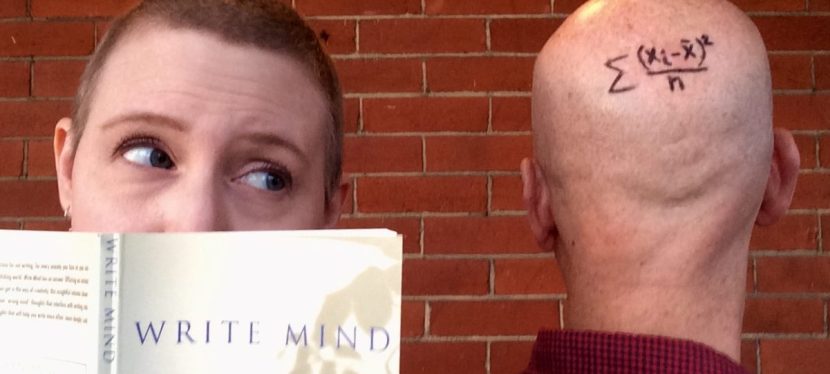
My husband is the math mind in the family; I’m the English nerd. But lately I’ve found myself thinking less about settings and symbolism, and more about symmetry and statistics.

img_1044
Mirror, Mirror…

Many years ago, I did an experiment where I held a small mirror up to the center of my face while looking in a second larger mirror, so I could see how I’d appear if my face were perfectly symmetrical. All of us are at least a little asymmetrical, so the trick quickly reveals the differences, large or small, in the two sides of one’s face: the right eye has a little more tilt than the left, maybe, or one cheek is a bit fuller than its counterpart. The altered reflection, for me, almost felt like looking at different person, perhaps a sibling of myself.

notetnc2The process of bilateral breast reconstruction has a tendency to highlight other asymmetries. The first thing my reconstructive surgeon said to me when he looked at my pre-surgery chest was that my left rib cage sat a little more forward, was a tiny bit more prominent, than my right. I’d never noticed this particular (minor) anomaly, but it’s apparently just as common for there to be asymmetry in the rib cage as in the face. The difference in my bone structure became most noticeable immediately after surgery and during my early tissue expander fills; for a while the right expander lagged behind the left, making me look lopsided. I also discovered I have a pocket of fat on my right upper back, unmatched on the left, which appeared only when I didn’t have breasts to pull the skin forward and keep it flattened out.
howard-schatz-and-beverly-ornstein-olympic-athlete-body-types-gymnastics-high-jump-triple-jump-wrestling
Even Olympic athletes’ bodies vary dramatically. (Photo by Schatz and Ornstein)

Studies indicate we equate higher levels of symmetry with perception of beauty, so it’s only too easy to worry over our various anatomical irregularities. But there’s so much about our bodies that’s out of our control: the set of our features; our bone structure; height; the size and shape of breasts, booty, genitals, hands and feet. We can exercise and lift weights to affect our body composition—but the ability to bulk up muscle mass, and the places our fat cells are predisposed to distribute themselves? That’s pre-determined. Significant elements of our health are hardwired too: some suffer multiple allergies from birth, for example, while others are born with immune systems seemingly hewn from impenetrable stone.

Bodies are glitchy and unpredictable in surprising ways, for better and for worse. The fact my body grew a malignant mass is somewhat mysterious: I am, as best we can tell, the first person in my blood family on either side to develop cancer of any kind. My body’s responsiveness to treatment is, to my mind, equally mysterious, and awe-inspiring: I learned this week that only 20 to 30 percent of triple negative breast cancer patients have, as I did, a “complete pathologic response” to chemotherapy. I was thrilled when we got the pathology report stating they’d found no evidence of remaining cancer during surgery, but the news felt weirdly abstracted. Learning the actual statistical probability of achieving that response was sobering. It made me realize just how incredibly fortunate I am. Having a complete response lessens the chance of recurrence dramatically, dropping it from 35+ percent down to 5 percent. As my oncologist said, it’s cancer, so there are no guarantees. But short of never having developed it in the first place, the odds for long-term survival are the best they can be.

davinciI’ve often felt lucky to be in the body I am. Aside from some cranky tonsils, a couple bouts of pneumonia, and one broken bone, I’ve been hale and hearty most of my forty-seven years, and I’ve managed to stay active and maintain a healthy, if not altogether svelte, weight into my middle age without Herculean effort. Excepting the sixth grade, when my legs had a sudden growth spurt separate from the rest of my body that briefly turned me into a sort of hybrid stork-human, my parts are mostly proportional, and my face, while perhaps not symmetrical enough for Hollywood’s standards, is reasonably attractive.
I did nothing (unless you count that bane of puberty, wearing braces) to “earn” any of these features of anatomy. They just are, like my cancer, like my cancer’s responsiveness to treatment. Why did my body grow malignant cells in the first place? I don’t know. Why were those cells especially sensitive to death-by-chemotherapy? I don’t know the answer to that either. I do know I’m extremely lucky and profoundly grateful to be in the relatively small percentage of survivors who have that experience.

survivorship4I’m just vain enough to feel relieved that the obvious asymmetries that appeared in my chest and back are slowly evening out as reconstruction progresses. But I’m far more reassured by a different realization. As I walked into the dining room Tuesday night, preparing to sit down to dinner with my hubby, it suddenly occurred to me: I no longer have cancer. Granted, my treatment isn’t quite done–follow-up radiation is the standard-of-care for triple negative diagnoses, even with a complete response to chemo, and reconstruction will take a while longer. But the chemotherapy worked; the surgery confirmed it. No more need I say, I have cancer.  Now I can say, I had cancer.
My inner English nerd reappeared, rejoicing: the simple past tense has never sounded so beautiful.

Heads Up! #7: Cozy Cobalt Felted Wool

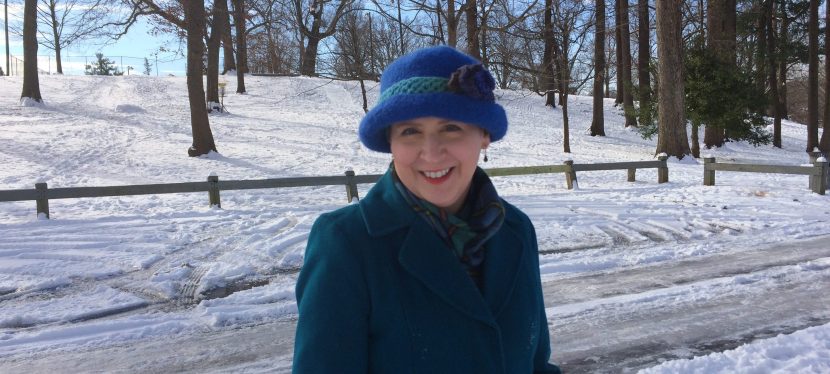
img_0912Like much of the U.S., we recently had snow here in Southwest Virginia. I usually welcome snow, as it tends (at least here in the South) to make us slow down a bit and refocus our attention, for a day or two, on things like nature’s beauty, play, and family. The cold inspires gratitude for the warm shelter I call home, a gift denied to too many.

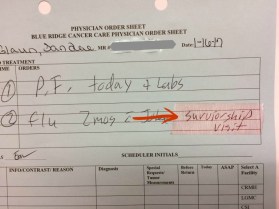
Our recent snow days–accompanied by single digit temperatures–seemed like the perfect time to feature my cozy cobalt felted wool hat, handmade by artist Sandy Stanton. I purchased the hat new back in September at the Asheville NC Homecrafts store, located in the Historic Grove Arcade in downtown Asheville. There were so many wonderful hats there to choose from, it was tough to select just one (I didn’t; I’ll be featuring my second purchase at a later date…). But I was immediately drawn to the beautiful blues of this hat, its primary cobalt accented by a band and flower knitted from an ombre-dyed yarn that shifts from jade to turquoise to cadet blue, into gray, brown, and finally cobalt at the flower’s center.img_0951

I gravitate toward shades of blue in my winter clothing, perhaps as a way of harnessing and transforming the emotional blues I often suffer in cold weather and its long, dark days. When so many other colors disappear from the landscape in winter, we are left with the blues: the crisp cerulean sky that reigns over the coldest days, steel-blue clouds signaling an oncoming storm, ice’s translucent aquas, the ethereal periwinkle of moonlit snow. Beautiful in their own right, these winter hues also recall the blues of kinder seasons: the robin’s egg blue of a cloudless autumn afternoon, a pewter horizon hanging over a sapphire sea, water lapping at the azure edges of a sunny backyard pool.

Occasionally snow days are an unwelcome interruption: they frustrate routines, delay travel, cancel our much-anticipated plans. But even when the clouds confound us, the thing about snow is this: it eventually melts. The storm will pass, the roads will clear. And as the world emerges from its white cocoon, the sky above will spread its wings, inviting us once again to delight in its fair, wide, beautiful blue.

Heads Up!

Photos by Steve Prisley


 ∼ Beautiful, quirky hats make me happy. The “Heads Up!” series is a reminder to keep my (currently bald) head up, to pay attention to the good in the world, and to encourage myself and others facing a tough road that it’s possible to find the fun in even the most challenging circumstances. ∼

Feel Good-> Do Good-> Feel Good: Make a “Good Citizen” Resource Folder

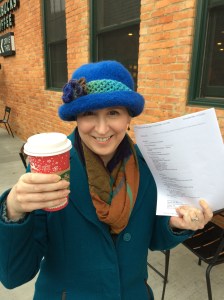
More good news to report today: at my weekly “fill” appointment, my remaining drain was removed. After sporting it as a mandatory fashion accessory every day for a month, I was only too happy to say farewell. Toasted with a celebratory Starbucks, and done!

And more good news: my “Be the Tea” t-shirts arrived today, and they came out (if I do say so myself) super-cute! Even better, $130 and change in proceeds has now been donated to the Breast Cancer Research Foundation as a result. Thank you to DB, Donna, Katie, Laura, Lauren, Lucie, Sam, Sherry, Steve, Tony, Tracy and Nick! I am hoping to put the design back up again, possibly on a tote-bag or tea-towel, so stay tuned if you’re interested in supporting cancer research.

Feeling good about all this good news, along with the fact of the new year, inspired a Do Good to Feel Good post. This one is a little different, more about preparation and planning for action than the actual action itself, but having a plan can be key to following through on good intentions when life gets busy.

DGTFG: Make a “Good Citizen” Folder (paper, virtual, or both)

There are two parts to the “Good Citizen” folder, as I’m imagining it: Engage and Contribute.

Part 1–Engage: Part 1 contains all the information you need to contact your government representatives: the White House, your congressional representatives in Washington DC, your state representatives, your governor, and relevant local officials. For each one of these officials, include phone numbers and mailing addresses  (in many cases, for both local/district and government/capitol offices) and email addresses.

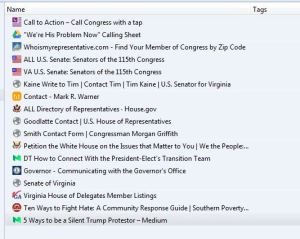
Collecting all necessary contact information in one, easy-to-access place makes it easier to let your voice be heard on issues important to you. Our government representatives need to hear their constituents’ voices clearly and be held accountable. I created a folder in my browser’s “Bookmark” function, titled it “Engage to Do Good,” and placed bookmarks for contact information and forms for all my relevant government representatives. I also printed out much of the same information to keep in a folder on my desk. When an urgent issue arises, I don’t have to spend any time looking up how to make my voice heard; a couple of clicks, and I’m ready. You might also consider putting the phone numbers of your two senators and your district’s representative in the House directly in your phone, or use the Call to Action web app, which will connect you quickly and easily. Calling is especially important, as calls are more influential than emails or letters.

Find your representatives’ info here: WhoIsMyRepresentative.com and Engage!

do-goos-action-folder-2
Part 1 of my Good Citizen e-folder
Part 2–Contribute: Part 2 of the Good Citizen folder contains contact and donation information for causes and organizations that are important to you. I have too often been guilty of “planning” to send support but then neglecting to follow through. Again, easy access to information means you are more likely to act.

Many organizations can now process donations online, which makes things very simple if you have good internet access. I created a second folder in my Bookmarks section and titled it “Contribute to Do Good.” I selected 12 organizations–one for each month of the year–then bookmarked the links to each of their donation pages and saved it in the folder. I also printed out a list of the organizations as a back-up. I plan to donate to one organization on the first day of each month, as a way to start the month off on a positive note. My list includes organizations that support a wide variety of causes: human rights, animal welfare, the environment, etc. Some are national or international in scope, while others are local.

You might prefer to set up an automatic monthly donation to a single cause, which makes it even easier to contribute regularly. If you have limited funds yourself but would like to invest in a good cause, consider a micro-loan program like Kiva.org. You can donate as little as $25, and once it is repaid, you can re-loan the same $25 again, and again, and again. I kicked off my project with my January donation going to Kiva.

Choose your causes and Contribute!

It feels good to do good. (And to be drainless at last!) Cheers!

teashirt4


Of All The Hair I Lost…

Of all the hair I lost, I missed my pubic hair the most.

I know a lot of people go to great effort and endure significant discomfort to remove the hair in their nethers. I briefly tried shaving once a few years ago, and I didn’t get the appeal. When after chemo my pubic hair shed alongside all the other hairs on my body (exception: seven eyelashes), I’ve never felt more profoundly naked.

hairless2
Minimal eyebrows, maximum cheeks
Losing my eyebrows was a close second. When I was first diagnosed, I knew I’d lose my head of hair; I knew, eventually, I’d lose my breasts. No one warned me that, for a while at least, I’d also lose my face.

As a born blonde, my brows have always been light, especially in summer when they’re bleached by sun exposure. I usually fill them in a bit with a light brown pencil, lest it appear I have no brows. For the month or so that I did, in fact, have no eyebrows, I almost couldn’t recognize the pale, perpetually startled face in the mirror (an effect enhanced by my having the cheeks of a puffer-fish, courtesy of steroids). Eyebrows are a key factor in facial recognition, according to a 2003 study conducted by behavioral neuroscientist Javid Sadr: study subjects asked to identify fifty famous faces in digitally altered photos could ID the celebrity only 46 percent of the time when the eyebrows were absent. Small wonder my browless visage looked unfamiliar, even to me.

img_9523
The borrowed wig
Losing the hair on my head bothered me least, which is probably why I never opted for a wig. I tried them on twice. The first time, I borrowed a short wig from another survivor so I wouldn’t have to take my new driver’s license photo bald. It was a very nice wig, but the weave was thick, and I’ve never had that much hair in my life. I felt like a fake.

Later, a friend of mine invited me along to visit her hairdresser’s wig shop in Lynchburg while she got a haircut. I found a few wigs there that I felt more comfortable in; they were constructed differently and better mimicked my naturally fine hair. I couldn’t decide if I should be comforted or alarmed that the one we all liked best was an angled bob—especially in gray.

My chemo had already concluded at that point, though, and I was hoping my own hair would soon return. Plus, it was hard to imagine asking my doctor for a prescription for a “cranial prosthesis” with a straight face—the term most insurance companies require for coverage.

Thankfully, my various hairs have begun to grow back, though the universe has had a great sense of humor about the order of things. The first place I detected stubble was on my legs, specifically my calves. Seriously? I thought. The first hair to come back is the hair I deliberately shave off several times a week?

img_0829Hair also began to grow “back” in places I didn’t remember having hair before. Like the front of my neck. Large downy patches on my cheeks. As a fine fuzz began to cover my scalp, tiny hairs also outlined the helix of each ear in a soft halo. I know most humans, women included, have a layer of fine facial hair, but I don’t recall mine previously having been quite so thick.
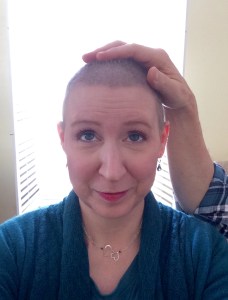
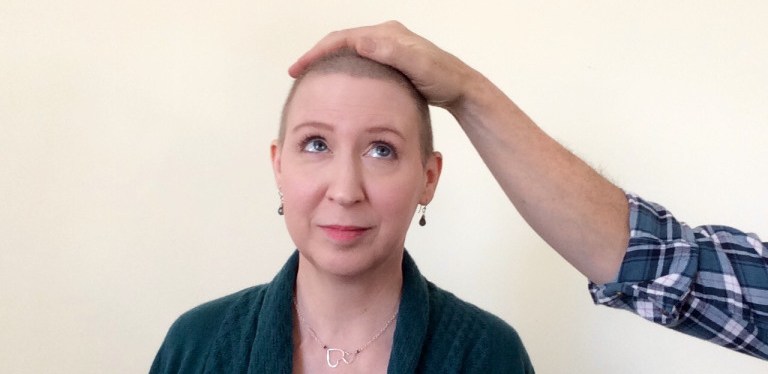
The verdict is still out on the color of my incoming head hair. My mother thought the initial peach fuzz looked light, “like the white-blond hair you had when you were a little girl,” she said. I wish. Steve thinks it’s brown. I definitely see some lighter highlights, but I’m guessing they’re gray. If I’m lucky, they’ll be that pretty, glinty, silvery gray some folks get. And texture is a real toss-up post-chemo: hair that was once straight often comes in curly; curly hair grows in straight. Since mine is maybe yet a quarter-inch long, the only texture it has at present is soft and fuzzy, like a velour jacket. My head seems to invite a lot of rubbing.

img_0837As my eyebrows have returned, I’ve stopped having to draw them on from memory (tricky to get even, easily smeared). They’re coming in the same light-brown, taupe-ish color they’ve been since college. It’s nice to see a glimpse of the familiar when I glance in the mirror, instead of a surprised alien.

And yes, it’s a relief to be less bare “down there.” I’m told there are wigs, called merkins, available for one’s nethers; movie stars sometimes wear them in nude scenes for a little extra coverage. But though I felt unduly exposed, I can no more fathom going to the trouble of attaching extra hair to my crotch than I can fathom enduring the pain of waxing it bare. Besides, according to an article by Ian Lecklitner on the Dollar Shave Club website (oh, the irony), all of our naturally-occurring human hairs have an evolutionary purpose: eyebrows, in addition to identification, are “ergonomically engineered” to protect the eyes from moisture and debris; pubic hair helps to foil bacteria; head hair serves as insulation. So I’m glad, for the most part, that my follicles are up and at ‘em again.

Though I do wish someone could explain just what evolutionary advantage I’ve gained by having fuzzy ears.


As Good As It Gets!

The good news: when I went in for my second “fill” today, I was able to have one of my JP drains removed. Here I am, happily saying goodbye to it:

img_0797

The length of tubing stretching from the open end in my left hand to the fingers of my right was what was inside my body–yikes. Makes we wonder where, exactly, it all wound around.

So that’s the good news. But the BEST news is this: my pathology reports from surgery came back, and I am officially cancer-free! They found NO cancer cells in either breast or in lymph nodes. None. Nada. Zilch. Hooray!

img_0806

Receiving the report makes for a great start to the new year. This is me enjoying a celebratory Starbucks. Cheers!

I will still undergo radiation treatments, as one final precautionary push-back against the possibility of local recurrence in the skin or area lymph nodes. Radiation will start in another three weeks or so. In the meantime, drain #2 will likely come out within the week (which may, on its own, be enough to warrant a second celebratory latte!).

There are no guarantees; there never are in life. But in this context, on this journey, today’s news is genuinely as good as it gets. I am humbled and deeply grateful.

Please celebrate with me by hugging someone you love, and telling them how much they mean to you. Happy, happy new year, all!


Coming soon: more thoughts on hair, an homage to husbands, and some new ideas for doing good to feel good in 2017. Thanks as always for reading!

Post-Mastectomy: The Lay of the Land

barbieshow2
Barbie show

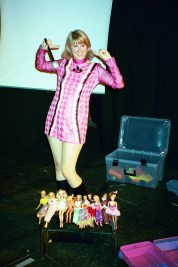
Some years ago, during my late twenties and early thirties, I penned and performed a one-woman show about Barbie. I had (and still have) a love-hate relationship with the ubiquitous doll, who, as the play reveals, was the source of many happy hours of childhood play, but whose questionable influence on young girls’ ideas about women’s bodies and gender roles troubles me. One scene in the show tells the story of a lavender nightgown I was given by a friend who’d outgrown it, a gown 10-year-old me was enamored of because its silky nylon bodice with sheer chiffon sleeves reminded me of a similar Barbie doll gown I found particularly glamorous. There was only one fault with the lavender nightdress: it hung straight down from my shoulders, whereas my Barbie’s gown “nipped in at the waist, flowed out over rounded hips,” accentuating her every curve. I began to insist my gown needed a belt, and after much pleading, my mother—reluctantly—purchased me a yard and a quarter of matching lavender ribbon. I bloused the top of the gown over the ribbon belt, reasonably satisfied.

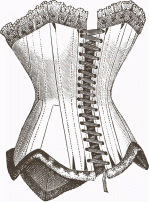
My original vision for staging this scene in performance was to wear a gown similar to the one described; then, as I told the story, I would raise my arms into the air and stand on tiptoe as a stagehand came out and laced me, grommet by grommet and tug by tug, into an old-fashioned corset. Though it proved impractical to realize, that’s still my preferred staging of the scene: the tale of the little girl glorying in the big girl nightgown, beauty equal in her mind to Barbie’s womanly curves, juxtaposed with a literal representation of the cost of attaining that desire. As she (innocently) embraces society’s ideal of feminine beauty, she becomes increasing restricted by the corset.

img_0728
Equipment tray for my first fill

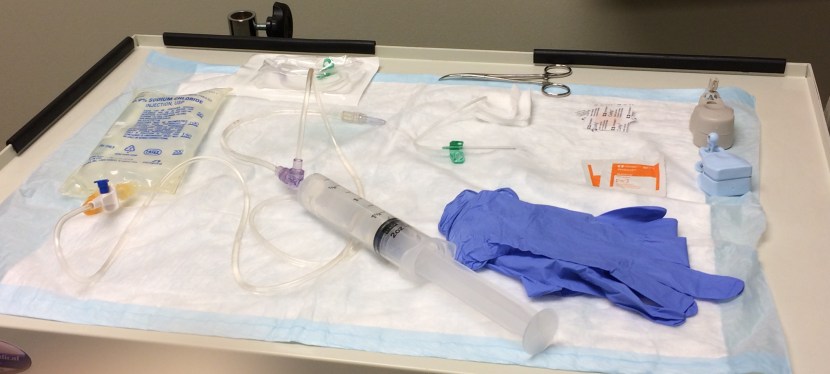
That image has been on my mind recently, now that I am almost three weeks out from a bilateral mastectomy and in the beginning stages of reconstruction. During surgery, after my natural breast tissue was removed, two devices called “tissue expanders” were placed between my chest wall and my pectoralis muscles. Essentially “baggies with ports attached” (my surgeon’s description), the expanders function as placeholders for future implants and, more importantly, slowly stretch the skin and muscle to accommodate them. What that means in practice is a series of appointments during which the doctor uses a magnetic device to locate the metal port and imprint the skin with an “X”-marks-the-spot. Then 100 milliliters of saline are injected into the expander through the port. These are called “fills,” and I will receive a weekly “fill” until my expanders reach their maximum capacity of 550 milliliters each, their size having been determined by the size of my natural breasts.

corset_harpers_bezar1882l1

I’ve heard other breast cancer survivors refer to the expanders as the “iron bra”; some have compared the process of getting fills to having dental braces that are tightened at regular intervals. Both are fair descriptions, though between the expanders and the various pressures exerted by tight muscle fibers and swelling from the trauma of surgery, I feel more like someone has implanted an entire whalebone corset—rather like the one I’d imagined in my Barbie play—inside my body. Sometimes I feel like I’m wearing a strapless, corseted evening gown whose stays keep riding up, jamming into my armpits. My impulse is to want to grab hold and shimmy the offenders back into place, but it’s my own flesh and framework that has risen up to cause me pain.

~~~

So I’ve been thinking a lot about that little girl in her nightgown, the costs and trade-offs of my desire to have breasts, my choice to undergo reconstruction. Without it, I could shorten the whole process: I would heal faster, experience less discomfort. I cannot get my permanent implants until radiation treatments are done and I’ve fully recovered from them, so I’ll be living with my internal corset for six months or longer, if I can stand it.

img_0760
My edgy androgynous look…?

More and more women are electing to remain flat-chested post-mastectomy, in part because the process is long and uncomfortable. There’s a definite declaration of freedom in that choice, and I admire women who make it. With my currently flat chest and super-short buzz-cut, I’m projecting what I like to think of as an edgy androgynous look. As a woman who enjoys playing with fashion and modeling, it’s intriguing to see this other version of me look back from the mirror. But I don’t think I’m prepared to embrace her long-term.

Seeing my altered body for the first time post-surgery was hard, though less traumatic than I anticipated. I’d heard of women who refused to look at themselves, or let lovers see them, for weeks or even months. Instructed by the surgeon to shower and remove my bandages 48 hours after my release from the hospital, I didn’t have much choice but to take the plunge.

Having both breasts removed, I think, made the changed topography of my body seem less, rather than more, shocking, since there was no immediate point of comparison between what was before and what was after. Seeing a flattened and grayed-out mountaintop removal mining site is devastating in part because of its contrast to the beautiful, rolling green hills surrounding it. But my chest had become an entirely foreign landscape, as if I’d fallen asleep in the Appalachian foothills and woken up to the western prairie. I was a little bumpy and not entirely flat, given the expanders and some general swelling; two reasonably symmetrical incisions sealed with a length of surgical tape bisected the memory of each breast mound. That was the phrase the reconstructive surgeon had used when he came by my pre-op station the morning of surgery, and it was the one gesture that had made me cry: watching him outline my natural breasts in black marker so he could remember their placement after they were gone. It was also my last sight of them.

~~~

I feel a strange blend of grief and fascination when I look at or touch my changed body. At first everything just hurt; I had limited use of my arms and needed help going to or from lying prone. As I’ve healed, the overall soreness has faded so that now there’s a distinct difference between the skin over the expanders, which is essentially numb, and everything else, still tender. I’d been warned I would lose most of the sensation in the skin of my breasts. Steve asked if the sensation was akin to how your face feels after a shot of Novocain at the dentist, and some areas are a bit like that. But a more accurate comparison would be to place a book on your thigh, and then tap on the book—you can feel the vibration of the tapping in your leg, but no direct sensation from your fingers touching it. When I got my first fill, I felt nothing when the needle of the saline syringe pierced my skin.

img_0743
JP drain at work

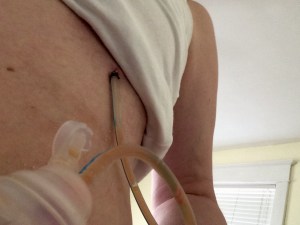
Perhaps I’m able, for the most part, to retain a certain level of detached curiosity because I’m aware the construction of my new breasts is a long process, and it’s still early days. It’s a little bit like writing: my first drafts are messy, uneven, and rarely look much like the final product, but their deficiencies are tolerable because I know I’m not yet finished. Knowing it’s a process helps me feel less disturbed by my bionic boobs’ current non-breast-like appearance. They’re still a bit Frankensteinian at present, with some discoloration from bruising, the odd swelling, and those infernal JP drains, whose tubes are sewn into my skin and descend down my sides to two plastic bulbs. I tuck the bulbs into pockets during the day and squeeze the collected fluid out of them each evening with my husband’s help. Sexy, right?

~~~

 In my Barbie play, I follow the story of the lavender nightgown with the story of Cindy Jackson, who underwent more than twenty plastic surgeries in an effort to become a living Barbie doll. Together, the two stories were intended as a kind of cautionary tale. Just how high a price are we willing to pay to have our bodies conform to the hourglass ideal? The memory gives me pause. My eventual implants, whether fashioned from silicone or my own tissue, will be far more comfortable than the tissue expanders, though my new breasts will probably never regain much sensation. I hope that someday, instead of calling up the feeling of a corset, they will indeed begin to feel like bionic boobs, that they will become a part of me, imperfect but powerful reminders of my strength as a survivor.

Until then, I’ll just have to resist the urge to grab hold of the skin in each of my armpits and yank.

Simple Gifts

The Twelve Days of Christmas traditionally start on Christmas Day, December 25th, and continue through January 6th. The “twelves” that are on my mind these days are a bit different: having had surgery on December 12th means that today, Christmas Eve, marks my 12th day of recovery. Everyone has told me that the first two weeks are the hardest (and I hope they’re right), so I am glad to have reached this milestone, and look forward to continued healing over the next days and weeks.

img_0591I am more aware than ever of the many gifts in my life. Plentiful food; a warm, safe, spacious home. The love and care of so many people: devoted family who share their time and energy generously, decorating the tree, making meals, running errands, offering a voice of experience. Beloved friends who text encouraging messages, share their skills and favorite books, send beautiful holiday cards and bouquets that brighten up the darker days. And an incredible husband who stands by my side, makes me laugh, and doesn’t blink at changing bandages or fetching yet another Coca-Cola Icee (or even question my weird craving for them).

img_0593I’m also aware of gifts I’ve received for so many years without any comprehension they were gifts: the mobility to towel myself dry after a shower, mindlessly, unaware of the many twists and turns my body had to make to accomplish this simple task; the steadiness to reach the sugar where it lives on the highest kitchen shelf without having to ask for help; the stamina to sit at my computer and write for hours at a stretch. The gift of the absence of pain or discomfort. The gift of good health. Gifts I hope to receive again, and fully appreciate hereafter.

img_0634We won’t receive the full pathology report from the surgery until early January: we are hoping, based on the post-chemo scans, for good news.  Until then, we will continue to celebrate the gift–a precious one– of another Christmas together. And I’ll keep you posted as often as I’m able about my ongoing Adventures in Cancerland.
Happy holidays, everyone!

Write Soon

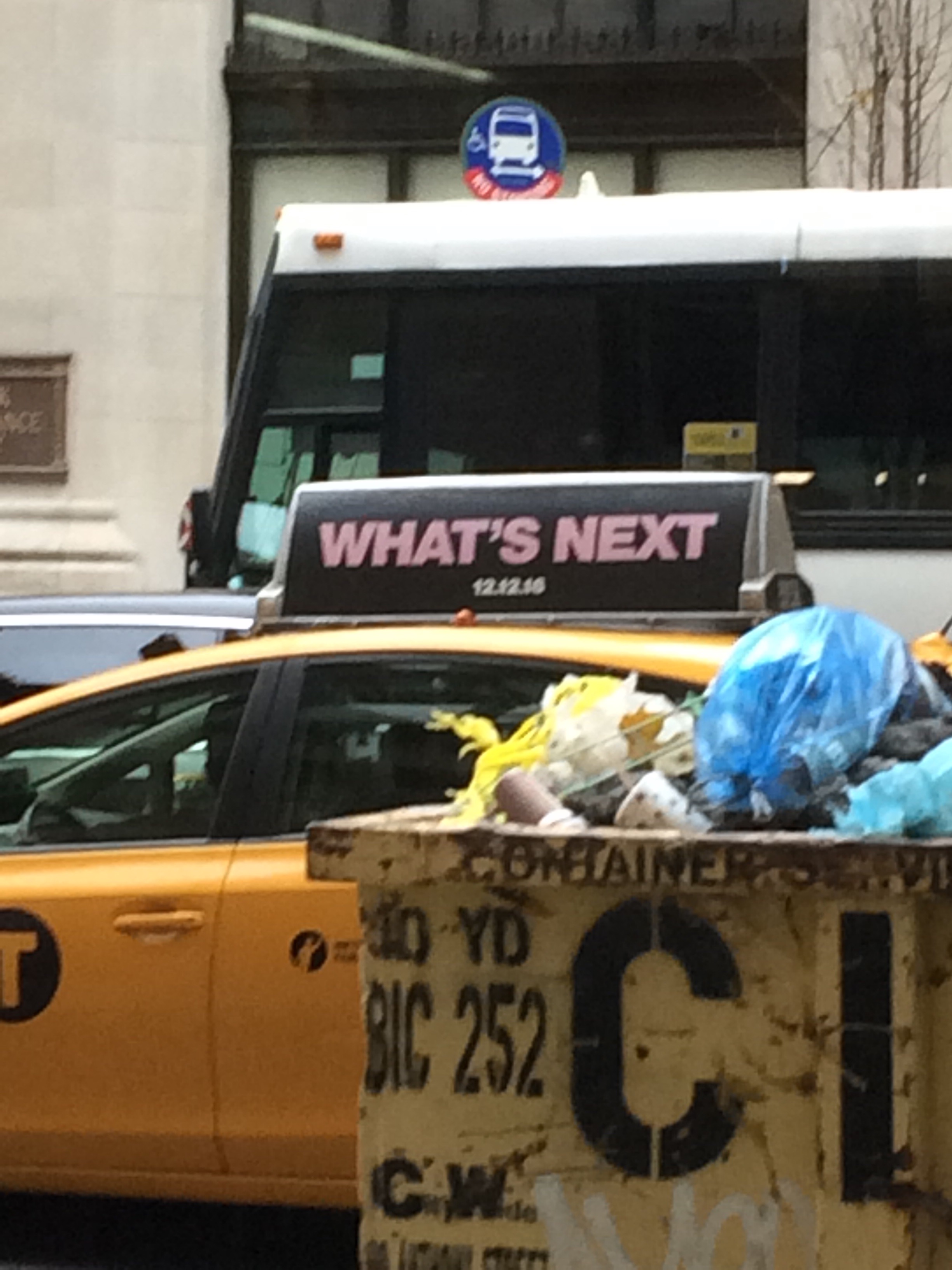
When Steve and I were in New York City recently, I looked out the window while we were grabbing a quick breakfast one morning and saw this taxi: “What’s next?” it read, followed by the date: “12-12-2016.”

“Seriously?” I said to Steve.

Today is the date of my mastectomy. I will be on blogging hiatus for a week, maybe two. Thank you for reading, and for all the kind comments. See you on the flip side…

They’re Not “Just Boobs” to Me

“They’re just boobs.”

More than one well-meaning friend or acquaintance has uttered that or a similar statement in an attempt to comfort me, minimize the anxiety I feel as I face a bilateral mastectomy. I will willingly say good-bye to my natural breasts in the interest of prolonging my life; it’s the wise choice. But there’s no “just” about it.

They aren’t “just” boobs. They’re my boobs. My breasts are part of me. I have not, and will not, “use” them, it is true, for their evolutionary purpose, to feed a child or children. As such, some might say they are extraneous.

But they’re mine. And I like them.

And I grieve their loss.

~~~

I didn’t always like my breasts. They debuted, when I was a young teen, as small knots on my chest, literally: hard bumps arose underneath each of my nipples. I was embarrassed to ask my pediatrician to examine these buds, but he reassured me (and my mother) everything was fine. For years I worried I was “too small,” even after I turned seventeen and suddenly gained a cup size, perhaps a result of the hearty German fare I ate while an exchange student that year. I still felt my minimal cleavage didn’t quite balance out my womanly hips, that my nipples were too prominent.

And they were troublemakers, these breasts of mine. When I was in my late twenties, I found a lump. It turned out to be nothing but a benign, fluid-filled cyst, and some doctors in the medical center at Ohio State, where I was in grad school, drained it. That was the first of many more benign cysts, too many to count.

makeup2It was also the start of many years of creative commentary by various medical professionals. I’m a “cyst-maker”; I have “busy breasts.” Enough nurses and doctors expressed surprise at the number and volume of my cysts that I felt like a curiosity. One surgeon in Georgia, who I’d been referred to for draining yet another set of what one nurse called my “natural implants,” greeted me by exclaiming, “Why, you’re just a little bitty thing!” He waved a copy of my scans through the air. ”After seeing the size of your cysts, I thought you’d have great big ba-zooms!”
I didn’t, though I was slowly learning to appreciate them just as they were. Practically speaking, smaller breasts offered maximum wardrobe flexibility: I could wear low-cut or clingy tops without attracting unwanted attention, and button-downs never gaped. But I also finally realized they were, actually, pretty nice breasts. Kind of perky, actually. By the time I reached my early thirties, I’d have said they were my favorite part of my body.

Like many women, I’ve often struggled with body image and self-doubt. It took me more than half my life to love my breasts. Now I must let them go, and re-learn to embrace my body, post-surgery, all over again.

~~~

I know I am no more or less a woman with or without my breasts. My identity as a woman, my worth as a human, is not defined by the shape or size of my chest. Nor do I assume that breasts are universal signifiers for femininity, womanhood, or desirability. In fact, the way breasts are weirdly glorified and overly sexualized, especially in American culture, has often puzzled and annoyed me. I once argued with a man who insisted that breasts were always sexual. No, I replied. If I choose to walk out my front door with my breasts exposed, or with no clothes on at all, that does not necessarily constitute a sexual act; minus a display of express and clear intent, it’s definitely not a sexual invitation. I’m just naked, and we’re all, as the saying goes, naked under our clothes.

portrait-poseSomething else I know: attachment is the root of all suffering. Yet I find it difficult not to be attached to something that is, well, attached to me. Front and center.

My breasts have been my conscious companions at the beach, suited up and sun-screened in a cleavage-baring bikini; on the figure-modeling dais, revealed in the service of a painter’s line, curve, and shadow; on the running trail, compressed and protected in a jazzy neon sports bra.

My breasts have brought me pleasure in private moments, sensual pleasure wrapped up in sensitive nerve endings and a lover’s tender touch, his open admiration. My breasts have brought me aesthetic pleasure, when I slip into a pretty dress that fits just so, hugs the curves of my hips and breasts in a way that makes me feel sexy and beautiful.

My breasts are not some idle, remote organ like an appendix, whose absence I’d scarcely notice. They are a daily presence and a source of pleasure, and I will miss them.

~~~

I will have reconstruction, and I’m grateful for that. I’ve talked to enough survivors, however, to understand the process is no picnic. And my bionic boobs, as I’ve come to call them, will look and feel quite different from my natural breasts.

I’ve been trying to find ways to reconcile myself to the coming changes. I’ve begun to try to re-frame the mastectomy in my mind: instead of thinking about losing my breasts, I focus on regaining my health. I’m saying goodbye to a cherished part of my body, but I am also saying goodbye to the cancer.

I’ve tried to imagine my breasts as being like an old friend, one whose friendship has become toxic. She was a perfect match in my younger years: we liked the same music, went to the same parties, celebrated good days and commiserated over bad ones. Then, she began to lash out, to drink too much; when I was around her, so did I. We had a great run, my old friend and I, but now—well, she’s not healthy for me anymore. I appreciate the good times we shared; I’m grateful and glad for her having been in my life. Even though it hurts, I know I have to say goodbye.

Still, my body isn’t a metaphor. Metaphors don’t go numb or swell with lymphedema. They don’t scar or press your chest with pain. They don’t change what you wake up to every morning, what you see in the mirror, for the remainder of your days.

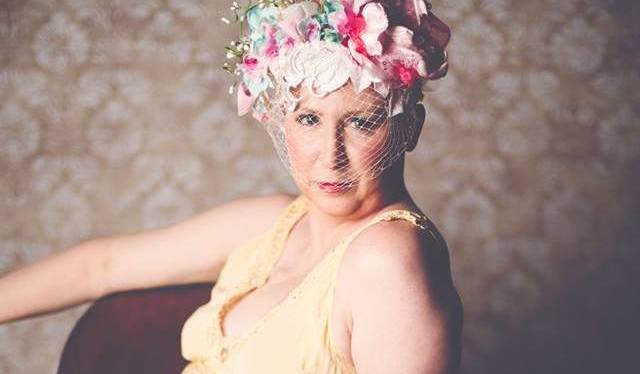
I’m working on cultivating greater self-compassion and acceptance. I recently hired a photographer to document and celebrate my pre-surgery body, highlighting my bald head with a beautiful custom headpiece. And this time, after surgery, I don’t want to wait thirty years to decide to like my body, my (new) breasts. It won’t always be easy, but loving myself as I am is a choice I will endeavor to make every day.

headpiece


The photos included here are a preview selection from the shoot described in the post: photos by Michael Wilson, Bohemian Robot Photography; make-up by Jolina Goad, Jolina does Make-up; bespoke headpiece by Sandra Eileen, Every Girl a Goddess Couture Headpieces.